
 close
close


 LOGIN
LOGINYou are viewing 1 of your 1 free articles
Rib Bone Stress Injuries
Clinicians classify bone stress injuries (BSIs) as bone stress reactions and bone stress fractures. But with this comes the acknowledgment of the challenges in diagnosing, managing, and preventing them. Shauna Tweedie unpacks the underlying, multifaceted intrinsic and extrinsic factors behind these rib BSIs.


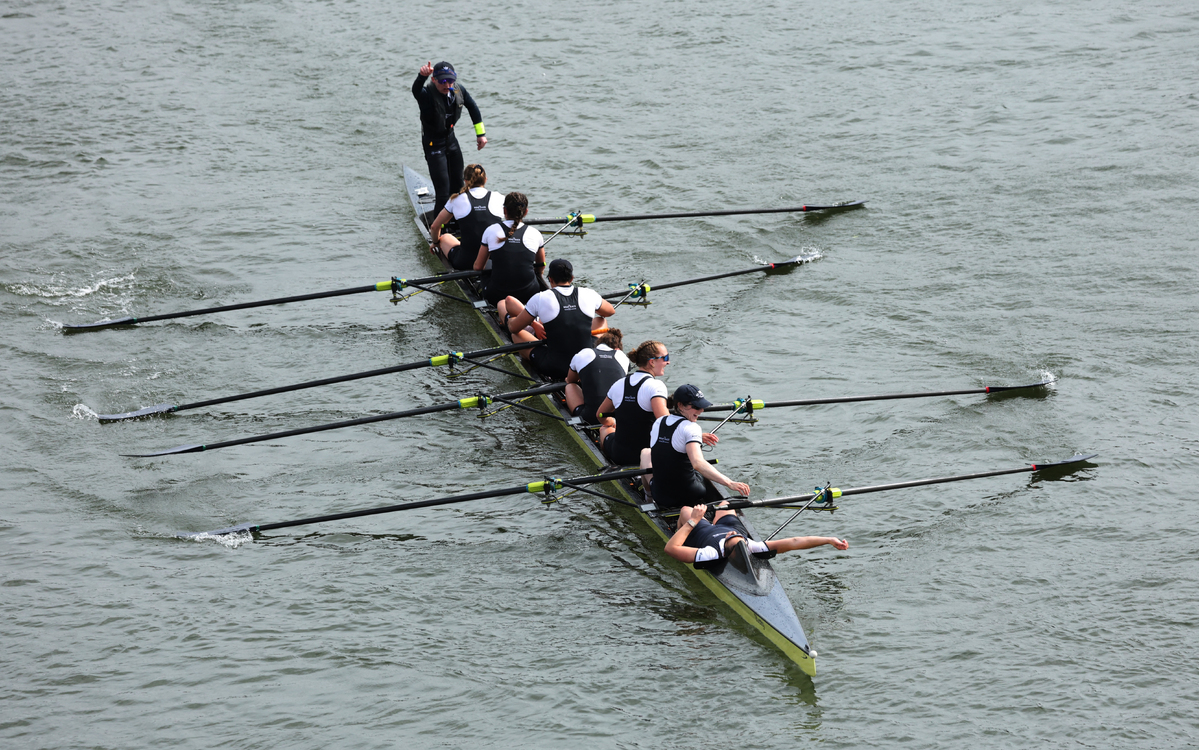
Oxford celebrates winning the women’s race REUTERS/Andrew Boyers.
The International Delphi consensus highlights increasing recognition of bone stress injuries(1). Rib BSIs may not be on many clinicians’ radars compared with the more familiar lower limb stress injuries encountered in runners. However, they may be particularly prevalent in sports with repetitive upper limb and thoracic motion- most notably in rowing but also found in baseball, cricket fast bowling, tennis, swimming and golf(2,3).
Although the majority of published research has been conducted in rowing, the underlying principles of rib BSI, including diagnosis, risk-factor identification, load management and rehabilitation, are applicable across athletes participating in repetitive overhead and rotational sports.
Bone stress injuries can be career-ending in elite sports and require an athlete to take significant time off to recover. During this time, overall global deconditioning can have a huge impact on the return to sport, too. Athletes may be required to rest for 8-10 weeks(4,5). Physiotherapists are critical in identifying the early warning signs and creating management plans that facilitate recovery and mitigate further deconditioning.
Epidemiology
There is limited evidence comparing the epidemiology of rib BSIs within certain sports. Most of the available evidence is centered on rowers, with a 2011 review by authors in New Zealand stating that, at the time, epidemiology showed 8.1-16.4% in elite rowers, 2% in university level, and 1% in juniors(5). Aside from rowing, the remaining literature consists of case reports and small retrospective series, limiting the ability to estimate incidence, prevalence, and recurrence. Consequently, the true epidemiological burden of rib BSIs in overhead and rotational sports remains unknown.
While epidemiology is poorly understood, the anatomical location of rib BSIs varies markedly across sports (see figure 1).
“The simplest trigger is an increase in load...”
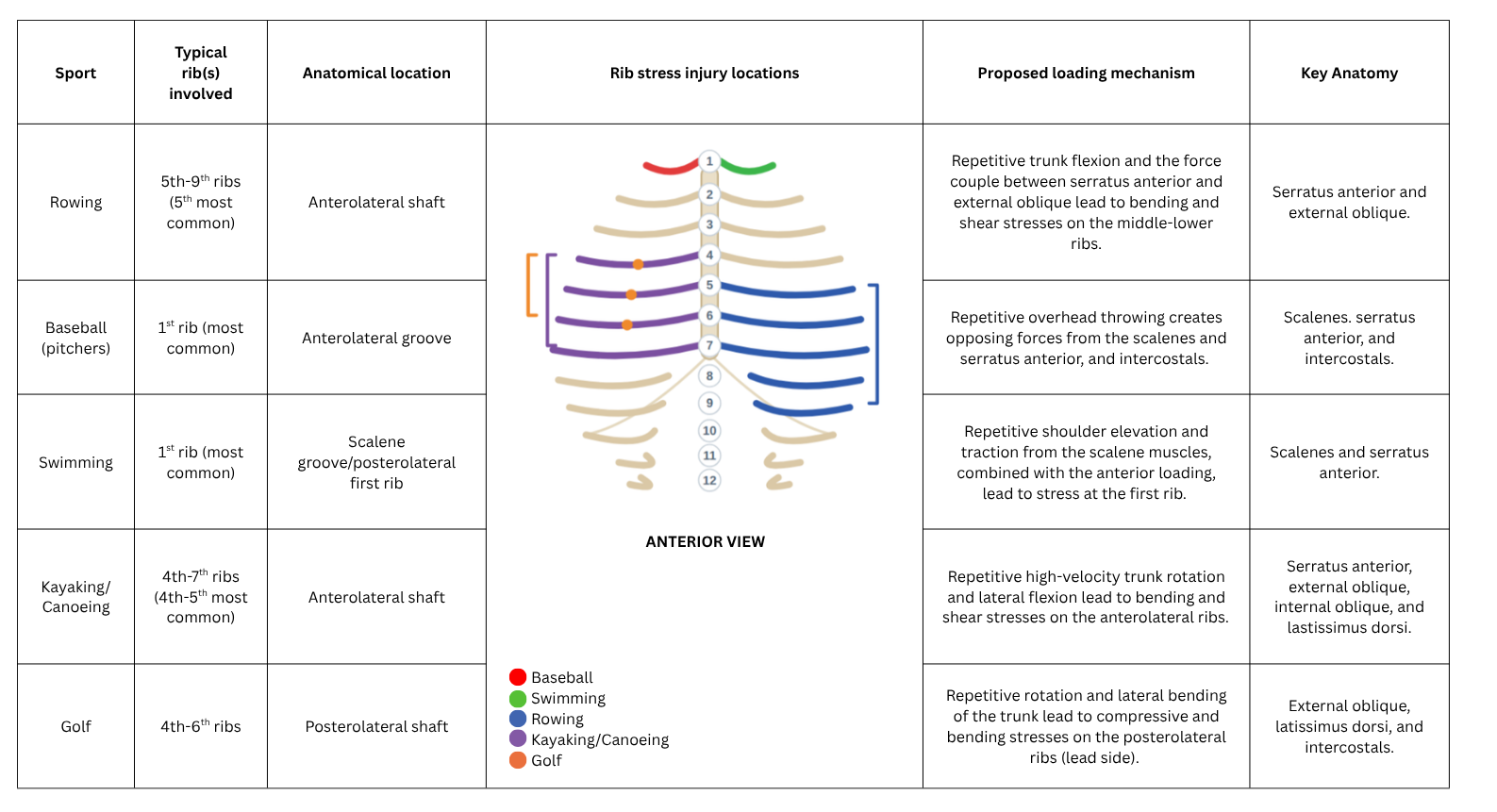
Figure synthesized from McDonnell 2011; Warden 2002; Schowalter 2022; Coris 2005; Lord 2006; Frangakis 2003.
Diagnosis
Medical staff of the Great Britain rowing team, in a two-part 2015 review, detailed that rib BSIs are often misdiagnosed as intercostal muscle strains, referred pain from the shoulder or rotator cuff, and thoracic disc or facet-related injury(6). Their proposed diagnostic protocol provides a practical framework for clinicians to use, especially when imaging is not readily available(7). They provide subjective and objective criteria when assessing athletes with suspected rib BSIs (see table 1).
Table 1: Common subjective and objective clinical findings associated with rib bone stress injuries(7)
| Subjective Findings | Objective Findings |
| Sudden, worsening pain around ribs- may be localized or diffuse | Tenderness around the mid-axillary line of the chest wall, most commonly involving ribs 5–9 |
| Pain on deep breathing* | Tenderness over the region of edema, with a possible palpable callus |
| Pain when pushing or pulling doors* | Positive rib spring test (anteroposterior and lateral compression)* |
| Pain when rolling over in bed or sitting up from a lying position* | Pain on resisted serratus anterior testing and/or during a functional press-up* |
| Pain and difficulty sleeping on the affected side* | Pain on initiating trunk flexion (e.g., sit-up with an oblique bias)* |
| May or may not have pain on coughing or sneezing* |
The imaging gold standard for rib BSIs is MRI, although imaging can sometimes lag behind clinical symptoms. Thus, understanding identified clinical markers is important in diagnosing the severity of the injury. This will guide the rehabilitation plan and expectations for returning to sport(6).
Mild BSIs are often tricky to identify as they can be quite vague, with low-level pain that the patient may be able to push through. Clinicians may initially suspect a soft-tissue injury and advise the athlete to continue training and competing. Therefore, they may diagnose BSIs only at more advanced stages. A patient may have tried to self-manage, thinking it was just a muscle strain. Moderate and severe rib BSIs have more clinical markers and are easier to identify. Moderate will start to impact training more, but once an athlete has started to experience pain at rest or during general day-to-day tasks, e.g., reaching up or out, they are likely to be dealing with a severe-level injury(6).
Extrinsic and Intrinsic Factors
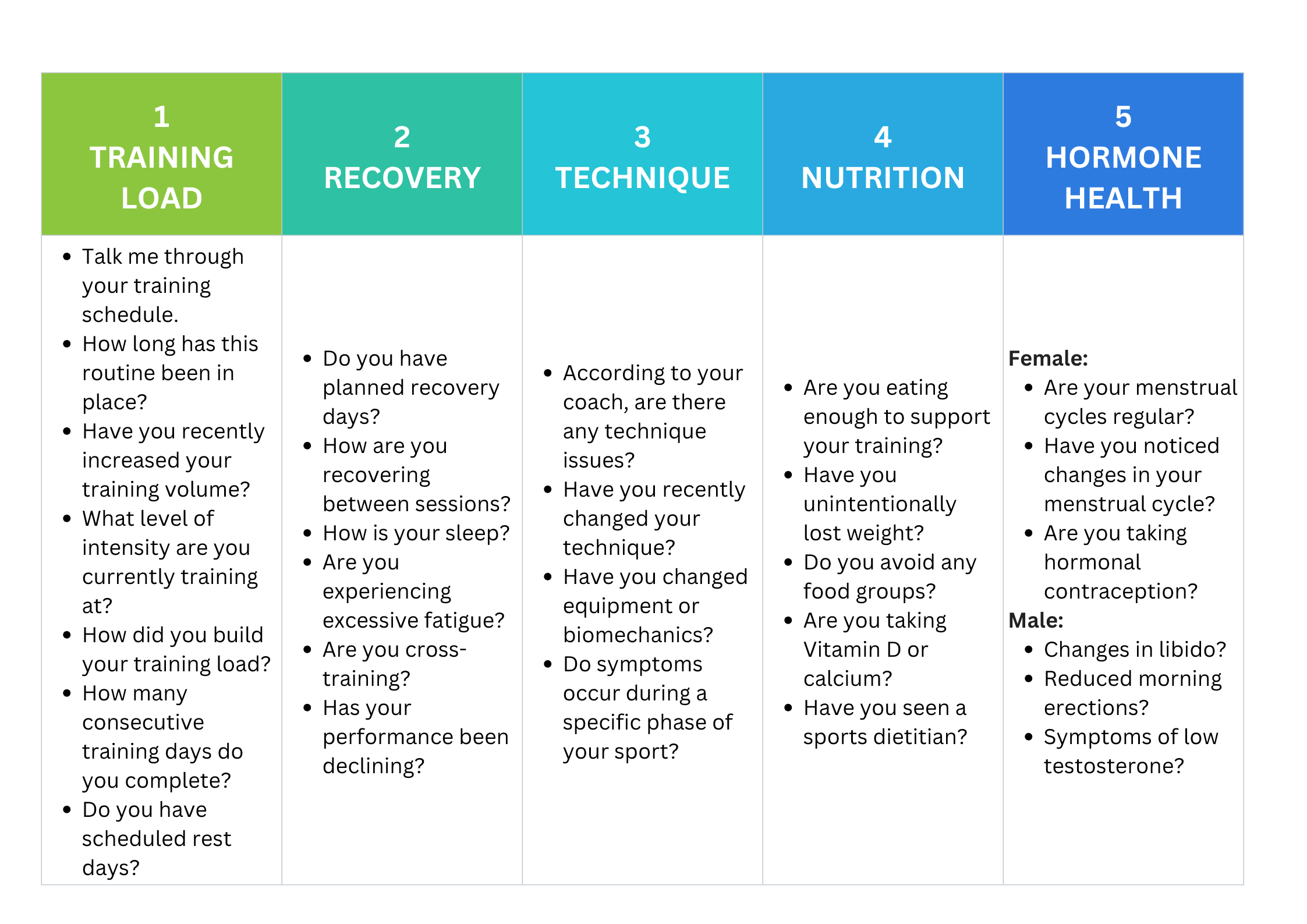
A clinician’s subjective skills are instrumental in identifying BSIs, as the questions will determine whether this is even on their radar. Furthermore, investigating intrinsic and extrinsic factors is essential for managing all BSIs and preventing recurrence. The simplest trigger is an increase in load- the “too much, too soon” principle. However, BSIs are rarely simple, and a subjective assessment requires scrutiny of the athlete’s training pattern. Insight into the athlete’s training schedule and demands of sport will greatly influence the subjective assessment. But teasing through some extrinsic and intrinsic factors is essential (see figure 2)(1).
Importantly for clinicians, they must consider Relative Energy Deficiency in Sport (RED-S) as an underlying predisposition and ensure they assess the athletes:
- Previous stress fracture history (vital),
- History of low bone mineral density,
- History of eating disorder/disordered eating,
- Recent illness,
- Persistent fatigue,
- Low energy availability,
- Previous diagnosis of RED-S(1).
Screening questionnaires, such as the IOC RED-S CAT2, will provide more accurate information.
Sport-specific Biomechanics
Many intrinsic factors, alongside extrinsic training factors, can increase the risk of rib BSI. Training load may be less of a contributing factor and more down to technique. For example, in rowing, clinicians must assess the athlete’s coordination of seat and handle movement, their sequencing of lower limb, trunk, and upper limb motion during the rowing stroke, relative dominance of elbow flexor strength compared with knee extensor strength, acceleration during the early drive phase, shoulder range of motion during the stroke, and gearing, which may increase mechanical loading through the rib cage(3,5).
In baseball, overhead pitchers are more prone to first rib BSI than sidearm pitchers, and starting pitchers are at higher risk as well. Biomechanical risk factors include:
- High throwing volume and cumulative pitching workload,
- High pitching intensity and frequency,
- Altered pitching mechanics increasing rib loading,
- Kinetic chain dysfunction (including reduced thoracic mobility, poor lumbopelvic control, and scapular dyskinesis)(8).
Management Principles
A BSI occurs when the load applied exceeds the capacity of the bone in question and exists on a continuum rather than defined stages (see figure 3). Early management is expected within 3-6 weeks and starts with offloading, as with all BSIs. Once all clinical markers have resolved, a gradual return to training may commence, but with the load kept under supervision. Clinicians can use a six-stage model to progress athletes through their recovery (see table 2). The stages overlap, and nutrition, strength, education, and correction of training errors should begin early and continue throughout the rehabilitation process(1).
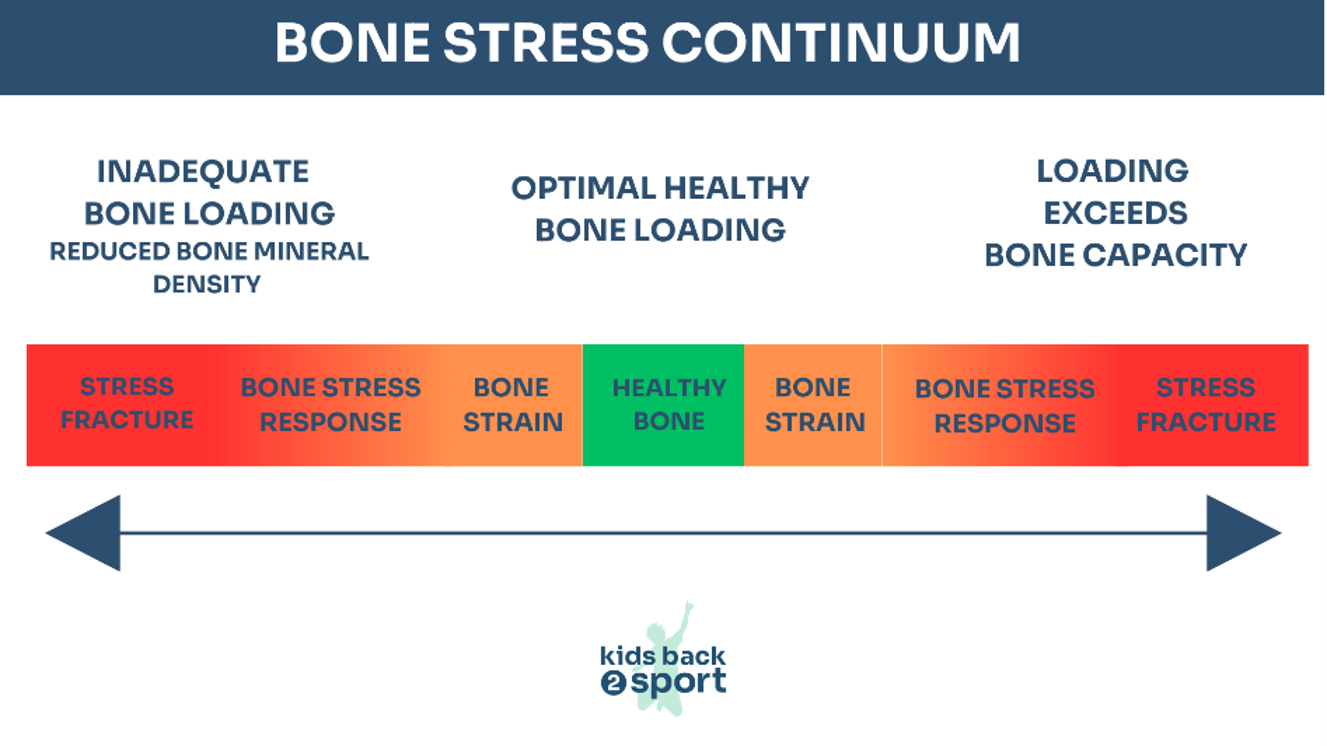
Image taken from Kids Back 2 Sport, Angela Jackson article for Sports Injury Bulletin.
“A BSI occurs when the load applied exceeds the capacity of the bone...”
Table 2: Six stages of return to rowing in rib BSIs in rowing.
| Stage | Primary goal | Management |
| Confirm diagnosis and grade severity. | Identify the injury and exclude other causes of chest-wall pain | Assess focal rib tenderness, pain with rowing, coughing, sneezing, deep breathing, rolling in bed, and resisted trunk or shoulder movements. Consider MRI when clinical suspicion is high, particularly in competitive rowers, because early radiographs may be normal. Assess the location, extent of bone edema, and presence of a fracture line. |
| Protect the rib and settle symptoms. | Prevent progression along the bone stress continuum | Stop rowing and ergometer training when they reproduce pain. Temporarily remove painful upper-body pulling, pressing, loaded trunk rotation, and heavy respiratory loading. Maintain fitness through pain-free lower-limb conditioning such as walking or stationary cycling. |
| Maintain conditioning and address contributing factors. | Preserve fitness while improving bone recovery. | Continue pain-free cardiovascular training. Assess energy availability, dietary intake, menstrual or hormonal health (in females), calcium and vitamin D status, sleep, previous bone stress injury and recent changes in rowing volume or intensity. Modify unusually high ergometer exposure or abrupt increases in training load. |
| Restore trunk, shoulder-girdle and rowing capacity. | Prepare the rib cage to tolerate rowing forces. | Introduce progressive pain-free strengthening of the serratus anterior, scapular stabilizers, latissimus dorsi, trunk musculature and lower limbs. Include thoracic mobility, breathing control and rowing-pattern drills. Progress from isometric and low-load exercises to controlled pulling, pressing and anti-rotation work. |
| Graduated return to rowing | Reintroduce repetitive rib loading. | Begin with short, low-intensity rowing bouts. A practical starting point may be 10–15 minutes at low resistance and a comfortable stroke rate. Increase duration before increasing resistance, stroke rate or power. Initially allow recovery between rowing sessions. Dynamic ergometers, slides or on-water rowing may reduce some peak loading compared with heavy fixed-ergometer work, but the choice should be individualized. |
| Return to full training and competition. | Restore complete rowing performance. | Progress steady-state volume, rowing frequency, power per stroke, higher stroke rates, threshold work, starts and race-pace pieces. Reintroduce heavy strength training and maximal ergometer testing last. Monitor total rowing load, ergometer exposure, recovery and nutrition. |
Conclusion
Although rib BSIs are relatively uncommon and sport-specific, they should be considered in athletes who participate in repetitive overhead or rotational sports and present with persistent chest wall pain. Early identification, appropriate load modification, and thorough investigation of intrinsic and extrinsic risk factors are likely to improve outcomes and reduce recurrence. While much of the current evidence originates from rowing, the clinical principles are transferable across other overhead and rotational sports, highlighting the physiotherapist’s role not only in rehabilitation but also in identifying the underlying factors that contributed to injury.
References
1. Br J Sports Med. 2025 Jan;59(2):78-90.
2. Curr Sports Med Rep. 2025 Jun;24(6):153-163.
3. Sports Med. 2002;32(13):819-836.
4. Br J Sports Med. 2020 Jul;54(16):991-996.
5. Sports Med. 2011 Nov;41(11):883-901.
6. Br J Sports Med. 2015;0:1-4.
7. Br J Sports Med. 2016;50:270-272.
8. Open Access J Sports Med. 2022;13:89-105.

Shauna Tweedie

Latest Issue

Subscribe Today
Newsletter Sign Up
Subscriber Testimonials
Dr. Alexandra Fandetti-Robin, Back & Body Chiropractic
Elspeth Cowell MSCh DpodM SRCh HCPC reg
William Hunter, Nuffield Health
Subscribe Today

Newsletter Sign Up
Coaches Testimonials
Dr. Alexandra Fandetti-Robin, Back & Body Chiropractic
Elspeth Cowell MSCh DpodM SRCh HCPC reg
William Hunter, Nuffield Health
Subscribe Today
Latest Issue

Be at the leading edge of sports injury management
Our international team of qualified experts (see above) spend hours poring over scores of technical journals and medical papers that even the most interested professionals don't have time to read.
For 17 years, we've helped hard-working physiotherapists and sports professionals like you, overwhelmed by the vast amount of new research, bring science to their treatment. Sports Injury Bulletin is the ideal resource for practitioners too busy to cull through all the monthly journals to find meaningful and applicable studies.
*includes 3 coaching manuals
Get Inspired
All the latest techniques and approaches


Sports Injury Bulletin brings together a worldwide panel of experts – including physiotherapists, doctors, researchers and sports scientists. Together we deliver everything you need to help your clients avoid – or recover as quickly as possible from – injuries.
We strip away the scientific jargon and deliver you easy-to-follow training exercises, nutrition tips, psychological strategies and recovery programmes and exercises in plain English.
