
 close
close


 LOGIN
LOGINAs the Shoulder Turns: Understanding the Subscapularis - Part I
The subscapularis is the largest and most powerful muscle of the rotator cuff, and an important anterior stabiliser of the humeral head. With that in mind, Chris Mallac explores the anatomy and biomechanics of subscapularis in the first of two articles, including the most common injury presentations.


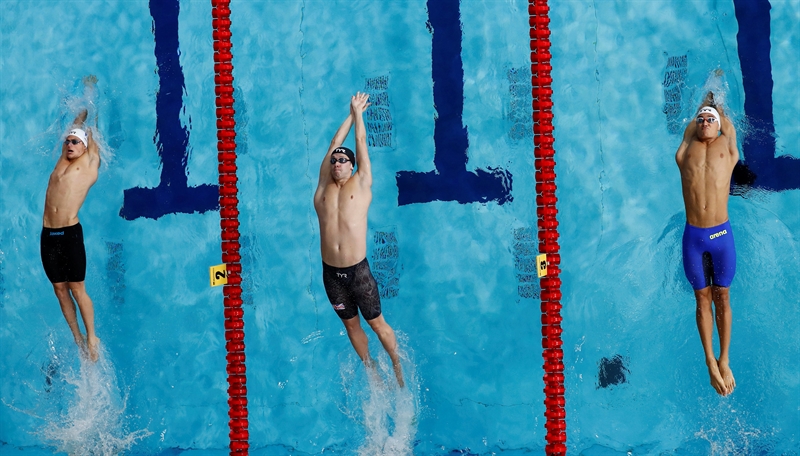
Direct injuries to the muscle-tendon unit of the subscapularis commonly affect overhead athletes such as tennis players and swimmers. It was once believed that injury to the subscapularis tendon was relatively rare. However, advances in arthroscopic techniques revealed a 50% incidence visualised on arthroscope examination(1, 2). More commonly, dysfunction in the subscapularis in the form of inhibition and weakness can lead to biomechanical abnormalities in the glenohumeral joint, such as poor anterior stabilisation of the shoulder joint in the athletic shoulder.
Anatomy
The subscapularis originates on the anterior surface of the scapular (subscapular fossa) and inserts onto the lesser tuberosity of the humerus and a portion of the proximal humerus. It is the largest of the rotator cuff muscles and its cross-sectional area is larger than the other three rotator cuff combined (infraspinatus, teres minor, supraspinatus – see Figure 1)(3).
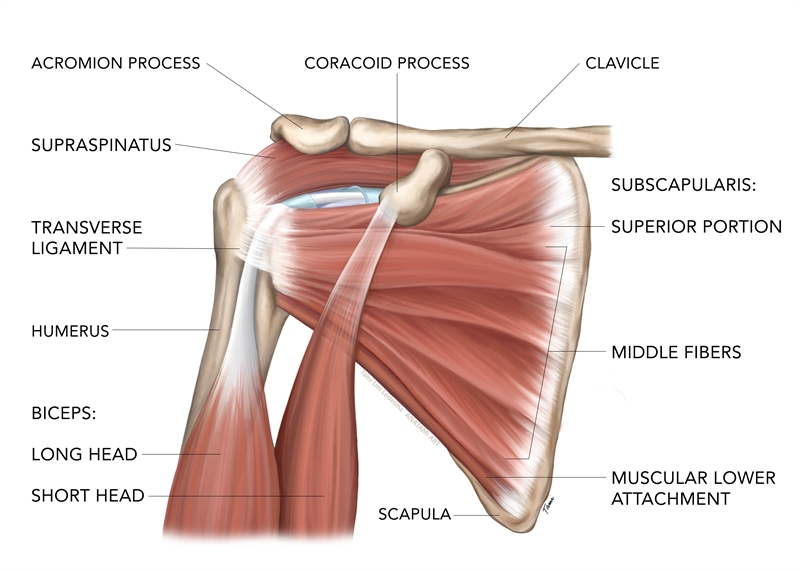
The musculotendinous portion of the muscle passes laterally beneath the coracoid to insert onto the upper humerus. The insertion of the subscapularis is complex, with recent research into the insertion of the subscapularis tendon describing three distinct portions that have different insertion areas. These are;
- The superior portion that blends with the ‘biceps pulley system’.
- Thick multi fibres middle portion on the lesser tuberosity.
- Muscular lower attachment.
The superior fibres that are separate to the middle fibres extend laterally and superiorly to form the medial wall of the biceps tendon groove and merge with the supraspinatus tendon. Fibres from the subscapularis and supraspinatus interlock and converge together as they course around and above the humeral head to their respective insertion sites on the greater tubercle. Anatomically, the upper subscapularis acts in a similar way to the supraspinatus muscle(4). Finally, the subscapularis tendon fibres contained within a fibrous expansion from the pectoralis major tendon form the transverse ligament, which is a fascia covering the vertical portion of the long head of the biceps tendon (LHBT).
The subscapularis has an intimate relationship with the LHBT via the biceps ‘sling’. This is a capsuloligamentous complex that acts to stabilise the LHBT in the bicipital groove. The pulley complex is composed of the superior glenohumeral ligament, the coracohumeral ligament, and the distal attachment of the subscapularis tendon. This complex is located within the rotator interval between the anterior edge of the supraspinatus tendon and the superior edge of the subscapularis tendon (see previous article for a complete description of the LHBT and the ‘biceps pulley sling’).
The middle tendon is made up of four to six thick collagen bundles that originate from the muscle belly insert at the lesser tuberosity. A recent study found the footprint of the subscapularis tendon on the lesser tuberosity seems to have four different planes of insertion, which are termed ‘facets’(5),. The superior two facets represent about 60% of the entire subscapularis insertion area.
The lower part of the subscapularis insertion is more of a muscular attachment of the subscapularis to the lesser tuberosity of the proximal humerus, and this part of the muscle-tendon unit is not commonly involved in pathology (see below). The subscapularis also plays a key anatomical role as part of the ‘rotator interval’. This is a triangular shaped space described by the following(6):
- Inferiorly by the superior free edge of the subscapularis tendon.
- Superiorly by the anterior free edge of the supraspinatus tendon.
- Medially the base of this triangle is formed by the coracoid process.
- Laterally, with the apex being the intertubercular sulcus.
- The anterior aspect of the rotator interval is formed by a fibrous capsule made of blended fibres coming from the subscapualris and supraspinatus tendons.
- Two ligaments reinforce this capsule, the coracohumeral ligament (CHL) and the superior glenohumeral ligament (SGHL).
- The inferomedial CHL, the SGHL and the superior fibres of the SSC tendon unite in the lateral rotator interval, and act as a pulley system for the LHBT, which is a key element for stabilisation of the LHBT.
Primary roles
The primary roles of the subscapularis on the glenohumeral joint are as follows:
- A depressor of the humeral head(7, 8). The force vectors of the subscapularis and the infraspinatus are biomechanically more optimally aligned to efficiently provide depression of the humeral head, (compared with the supraspinatus) and offset the elevation effect of the deltoid(2, 9-11).
- An anterior stabiliser of the humeral head (glides the humeral head posteriorly relative to the glenoid fossa)(12).
- Internal rotator of the shoulder (along with the powerful pectoralis major and latissimus dorsi).
- The subscapularis muscle is the most influential stabilising structure during passive external rotation of the glenohumeral joint at zero degrees of abduction in the frontal plane(13).
- The tendon fibres interlock and blend with the anterior capsule of the shoulder and thus reinforce the anterior shoulder capsule(14). This protective overlapping of interlocking fibres may potentially preserve the functional integrity of the rotator cuff’s dynamic stabilisation role in case of a partial tear or complete rupture (due to this integrated anatomical relationship of the rotator cuff tendon fibres)(4, 9, 15).
- The upper subscapularis tendon may also have a significant role in abduction/elevation of the humerus along with humeral head depression, a similar role played by the supraspinatus. The upper subscapularis also demonstrates higher levels of activation than the lower portion, which confirms the hypothesis of participation in abduction(16).
The subscapularis muscle is considered to be less important as a shoulder internal rotator (as the pectoralis major and latissimus dorsi are strong internal rotators) and is more important as a dynamic anterior stabiliser of the glenohumeral joint via its action in preventing anterior shear/glide of the humeral head. The large amount of collagen in the subscapularis may enhance its role as a passive stabiliser by providing a barrier against anterior translation of the head of humerus.
Injuries to the subscapularis
Like all the rotator cuff muscles, the subscapularis is subject to stress forces that may damage the integrity of the muscle and muscle-tendon unit. Although tears to the subscapularis are not as common as tears in the other rotator cuff (particularly supraspinatus), injuries to the subscapularis may prove to be more problematic due to its anatomical proximity to the LHBT.
Tears in the subscapularis were originally reported in 1834(17) and the landmark paper on subscapularis tears was by Codman in 1934(18). Research on this topic was limited and, thus, tears of the subscapularis tendon were not well recognised and largely excluded from the orthopaedic literature until more recently. Isolated ruptures of the subscapularis were first reported in the literature by Gerber and Krushell in 1991(19). They described the mechanism of injury as being a forced hyper-extension and/or external rotation force on the shoulder, such as falling onto an outstretched arm or – infrequently- as a consequence of a shoulder dislocation.
More recently, arthroscopy has elucidated the true prevalence of subscapularis lesions, as it permits visualisation of the articular side where partial tears are usually located(15). The prevalence is between 27 and 30% in all shoulder arthroscopies, and between 49 and 59% in arthroscopic rotator cuff surgery(20-23). Isolated subscapularis tears are uncommon and occur in about 10% of patients with rotator cuff tears(22).
Subscapularis tears are generally non-traumatic, and are associated with intrinsic degeneration, subcoracoid and/or anterosuperior impingement(24, 25). Etiologic factors involve impingement of the subscapular tendon against the coracoid during internal rotation, and against the anterosuperior glenoid rim during flexion and internal rotation(26, 27). This would explain the higher frequency of lesions on the articular side.
Direct injuries to the subscapularis tendon may also occur in athletes or occupations that require a lot of forceful shoulder internal rotation (baseball pitching, tennis, swimming). Overuse of the muscle-tendon complex may create a strain response in the tendon that may not adequately heal. As a result, fibrosis and fatty tissue deposition in the tendon may result. Trigger points in the muscle may then develop that tighten and weaken the muscle.
Location of tendon injuries
Tendon injuries are more commonly located in the upper two-thirds of the tendon (sometimes called a ‘leading edge’ tear) which attaches roughly 60% of the tendon. In complete ruptures of the subscapularis, this injury most likely represents this upper two thirds portion. The incidence of subscapularis tendon tears in this area can be as high as 50% (5, 22, 23, 28).
In throwing athletes, subscapularis injuries usually occur in the inferior half of the muscle at the myotendinous junction. Due to the orientation of the tendon relative to the muscle, when the thrower’s arm is at 90 degrees of abduction and external rotation, the inferior fibres of the subscapularis come to be aligned in the transverse plane across the glenohumeral joint, and are placed at greatest stretch during the late cocking and early acceleration phases of throwing(29).
Subscapularis tear classification
Although a number of classification systems for subscapularis tears exist (22, 30, 31)the more recent classification system may be classified as follows(5):
- Type I: fraying or longitudinal split of subscapularis leading edge tendon.
- Type IIA: less than 50% subscapularis tendon detachment to first facet
- Type IIB: greater than 50% detachment without complete disruption of lateral hood, which is approximately a one quarter to one-third tear of the entire subscapularis tendon’s superior-inferior length.
- Type III: entire first facet with complete thickness tear (lateral hood disruption or tear)
- Type IV: first and second facets exposed, with tendon having a much more medial retraction (approximately two thirds tear of the entire subscapularis superior-inferior length; the entire tendinous portion).
- Type V: complete subscapularis tendon tear involving the muscular portion. The most common type of tear was Type II (about 50 % of entire distribution) involving the first facet.
Injuries to the subscapularis tendon may compromise the integrity of the biceps ‘sling’(32). To keep the biceps tendon in place and stabilised, tension in the superior glenohumeral ligament and the support of the most superior insertion point of the subscapularis from behind the ligament is required(33). Disruption of this ‘biceps sling’ is a common pathology in athletes, whose sports require frequent and forceful shoulder rotation such as the cocking position in baseball pitching.
Finally, a local muscle imbalance at the shoulder between the subscapularis and the infraspinatus may lead to positional faults in the head of the humerus, whereby the humeral head is not centralised in the glenoid fossa and excessive anterior shear of the humeral head occurs that leads to impingement and instability sensations in the shoulder.
Subscapularis and shoulder stability
Hess et al found that in a simulated throwing action utilising rapid shoulder external rotation, participants with subscapularis shoulder pathology had a delayed onset on recruitment during external rotation compared with supraspinatus and infraspinatus(34). However, in normal pain-free shoulders, the subscapularis was activated earlier, and before the shoulder started to externally rotate - evidence that the subscapularis works in a feed-forward mechanism to ‘pre-empt’ movement and to contract earlier than movement to provide anterior shoulder stability. It is suggested therefore that shoulder pain patients may lose part of the active stabilising mechanisms in the shoulder. As a result, the humeral head may glide and shear anteriorly and superiorly in the glenohumeral joint, thus leading to anterior shoulder impingements.
Conclusion
The subscapularis is an important rotator cuff muscle, which has an important role to play in glenohumeral stability during high-demand athletic function. It is a muscle that may be injured and become dysfunctional, and it is a commonly injured muscle in the shoulder. In part two of this article, we will discuss how to assess subscapularis dysfunction, and provide management ideas for injury to the subscapularis.
References
- Arthroscopy 2011; 27:1123-1128
- Skeletal Radiol 2011; 40:255-269
- Clin Orthop Relat Res. 2006;448:157-163
- Am J Sports Med. 1996;24:286-292
- Arthroscopy 2015; 31:19-28
- J Radiol 88(11 Pt 1):1669–1677
- J Orthop Sports Phys Ther. 2009;39 (2):105-117
- Bone Joint Surg 26: 1–9, 1944
- J Am Acad Orthop Surg. 2006;14(11):599609
- J Orthop Res. 2001;19:206-212
- Neuman D. Kinesiology of the musculoskeletal system. Foundations for physical rehabilitation. Shoulder Complex. St.Louis. Churchhill Livingstone. 2002:91-132
- J Bone Joint Surg Br; 1972. 54(3):476–483
- J Bone Joint Surg Am. 1981;63(8):1208-1217
- Clin Orthop Relat Res. 1993;289:144-155
- J Shoulder and Elbow Surg. 1998;7(5):510-515
- Res Int J Res Clin Phys Ther; 2006. 11(3):148–151
- London Med Gazette 1834;14:280
- Codman Ea. The shoulder: rupture of the supraspinatus tendon and other lesions in or about the subacromial bursa. Boston: Thomas Todd Co, 1934
- The Journal of Bone and Joint Surgery. 1991. 73-B(3); pp 389-394
- Schiefer et al Rev Bras Ortop. 2012;47(5):588-92
- 2001;17(2):173-80
- Journal of Bone and Joint Surgery Am 2007; 89(6): 1184-93
- 2006, 20(10). 1076-1084
- Arthroscopy 2003;19: 1142–1150
- J Shoulder Elbow Surg 2000;9:483– 490
- Am J Sports Med 2011;39:258–265
- Knee Surg Sports Traumatol Arthrosc 2007;15:1482–1485
- Arthroscopy 2008; 24:9971004
- The Orthopaedic Journal of Sports Medicine, 3(7)(suppl 2) DOI: 10.1177/ 2325967115S00160
- Tech Shoulder Elbow Surg. 2003, 4(4); 154-68
- Orthop Traumatol Surg Res 2012;98:S186-192
- 2011; 31(3):791-810
- Journal of Shoulder and Elbow Surgery. 2010;19(1):58-64
- 2005; 35(12); pp 812-820

Latest Issue

Subscribe Today
Newsletter Sign Up
Subscriber Testimonials
Dr. Alexandra Fandetti-Robin, Back & Body Chiropractic
Elspeth Cowell MSCh DpodM SRCh HCPC reg
William Hunter, Nuffield Health
Subscribe Today




Newsletter Sign Up
Coaches Testimonials
Dr. Alexandra Fandetti-Robin, Back & Body Chiropractic
Elspeth Cowell MSCh DpodM SRCh HCPC reg
William Hunter, Nuffield Health
Subscribe Today
Latest Issue

Be at the leading edge of sports injury management
Our international team of qualified experts (see above) spend hours poring over scores of technical journals and medical papers that even the most interested professionals don't have time to read.
For 17 years, we've helped hard-working physiotherapists and sports professionals like you, overwhelmed by the vast amount of new research, bring science to their treatment. Sports Injury Bulletin is the ideal resource for practitioners too busy to cull through all the monthly journals to find meaningful and applicable studies.
*includes 3 coaching manuals
Get Inspired
All the latest techniques and approaches


Sports Injury Bulletin brings together a worldwide panel of experts – including physiotherapists, doctors, researchers and sports scientists. Together we deliver everything you need to help your clients avoid – or recover as quickly as possible from – injuries.
We strip away the scientific jargon and deliver you easy-to-follow training exercises, nutrition tips, psychological strategies and recovery programmes and exercises in plain English.
