
 close
close


 LOGIN
LOGINGet a Grip!
Chris Mallac, Tarek Taz Chouja and Nathan Quinn discuss the fundamental concepts of grip strength training and the benefits of improving grip strength - both for improving athletic performance and also developing proximal shoulder strength.


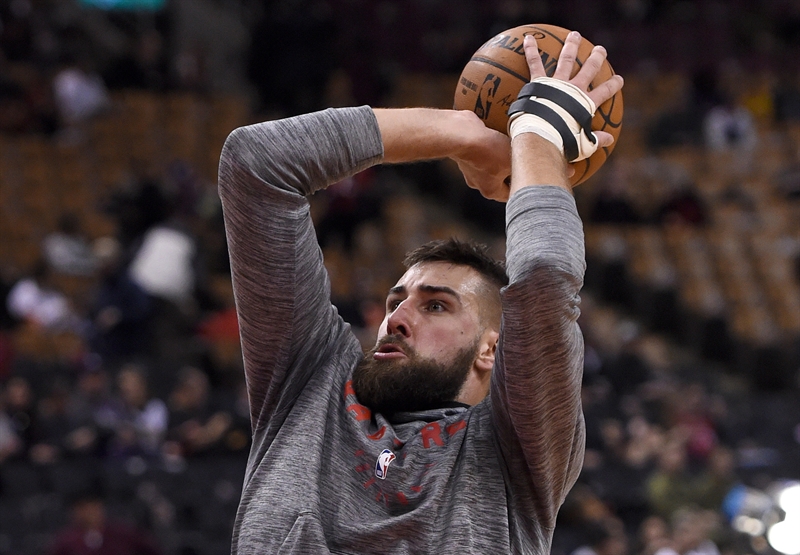
In the context of athletic performance, grip strength is a fundamental prerequisite in many sports that require aggressive ‘crushing grip’ type movements. The obvious sports that require grip strength are powerlifting (deadlifts) and all the Olympic lifts. CrossFit athletes are exposed to workouts that heavily utilise grip strength in the execution of some of the movements. Sports such as rugby and American football require grip strength in the grappling and tackling of opponents. Many combat sports such as MMA, Brazilian JuJitsu (BJJ), Judo and Wrestling also need above average levels of grip strength. Finally, climbing sports and gymnastics movements also require large levels of grip strength in different hand positions.
Interestingly, grip strength has been associated with strength in the rotator cuff and proximal shoulder muscles, perpetuating the argument that improved grip strength will lead to better shoulder strength and reduced shoulder pathology (see below). This relationship has been proposed as a result of the requirement of a stable proximal shoulder girdle to enable optimal recruitment of the distal muscles, and the force transmitted along the myofascial pathways(1).
Some key findings reported by studies on grip strength and shoulder function
- A standardised hand grip task in a neutral position activates supraspinatus and infraspinatus(2).
- A correlation exists between grip strength and strength of the upper extremity, and general strength of the body(3).
- Grip strength has been shown to be an effective objective measure of upper extremity function(4).
- A statistical significance exists between isometric grip strength and isokinetic peak torque and work measures of the shoulder stabilising muscles(5, 6).
- When Kwasniewski et al compared bilateral rotator cuff strength in patients with a unilateral hand or wrist disorder using a hand-held dynamometer, they reported a statistically significant decrease in elevated external rotation strength(7).
- Budoffet al 2008 found an increased prevalence of rotator cuff weakness of the limb with an associated hand or wrist disorder(8).
- It is reported that the electromyographic activity of rotator cuff musculature (most significantly the supraspinatus) increases significantly during isometric handgrip tasks, particularly in positions of shoulder flexion/abduction, and that biceps brachii activity also increased during handgrip(9-11). It has been suggested that this may cause changes in activity of the shoulder muscles, and potentially changes in ‘internal loading’ of the shoulder(12).
- Walaa and Walaa 2014 also found that hand grip strength correlated with body position(13). They compared hand grip strength in several positions and found that hand grip strength decreased in the order: standing, sitting, supine, side lying and prone. They proposed that rehabilitation of the shoulder musculature should be started from the prone position, followed by the sitting or standing position after gaining more strength in hand grip, and from side-lying, sitting or standing for shoulder abductors.
- There is a strong correlation between grip strength and lateral rotator strength at all positions for both left and right hands(14). This suggests that assessment of grip strength could be used to monitor the function of the posterior cuff, once baseline readings have been attained during training and rehabilitation. With the arm in a neutral position, grip strength could be used to monitor the stages of the rehabilitation process, especially in patients who have a limited range of motion and/or pain.
Many researchers have shown alterations in muscle activity patterns around the shoulder in the presence of shoulder dysfunction, with the activity of some shoulder muscles increasing, whereas others decrease when gripping is added to shoulder movements(15-17). Gripping may result in a redistribution of force in the rotator cuff muscles(12). Because co-activation of the proximal and distal arm muscles has been shown to occur during gripping (possibly as a result of the grip motor control command eliciting activity in the proximal shoulder muscles), it is feasible that assessment of grip will give an indication of the activity of the rotator cuff(18).
Muscles of the forearm and hand
There are a host of muscles involved in the execution of a powerful grip. Some of these muscles reside in the forearm (called the extrinsic muscles) and the rest lie within the hand (the intrinsic muscles). It is beyond the scope of this paper to discuss in detail all the relevant muscles and the actions they perform. However, a few pertinent points regarding muscle balance needs to be pointed out:
- The forearm pronators are stronger the than the forearm supinators.
- The wrist/finger flexors are stronger than the extensors.
- The thumb flexor and adductors are stronger than the extensor/abductors.
- Wrist extension strength is heavily utilised in grip actions (primarily a wrist/finger flexion action). The reason behind this is that the wrist/finger flexors operate with more mechanical efficiency if the wrist is held in slight extension and then stabilised by the extensors.
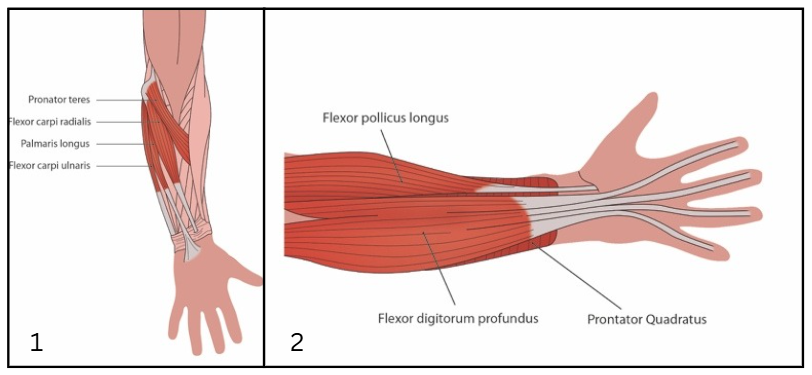
Extrinsic flexor compartment (see Figures 1 and 2)
- Flexor carpi ulnaris (superficial)
- Palmaris longus (superficial)
- Flexor carpi radialis (superficial)
- Pronator teres (superficial)
- Flexor digitorum superficialis (intermediate)
- Flexor digitorum Profundus (deep)
- Flexor pollicus Longus (deep)
- Pronator quadratus (deep)
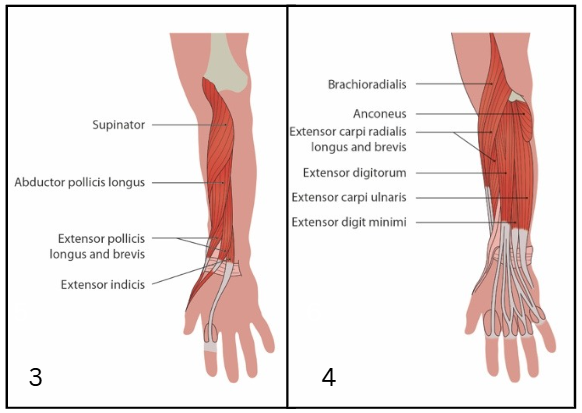
Extrinsic Extensor compartment (see Figures 3 and 4)
- Brachioradialis (superficial)
- Extensor carpi radialis longus (superficial)
- Extensor carpi radialis brevis (superficial)
- Extensor digitorum (superficial)
- Extensor digiti minimi (superficial)
- Extensor carpi ulnaris (superficial)
- Anconeus (superficial)
- Supinator (deep)
- Abductor pollicus brevis (deep)
- Extensor pollicus longus (deep)
- Extensor pollicus brevis (deep)
- Extensor indicis (deep)
Muscles of the thumb
Some of the thumb muscles belong to the extrinsic forearm muscles mentioned above. However, the intrinsic muscles include:
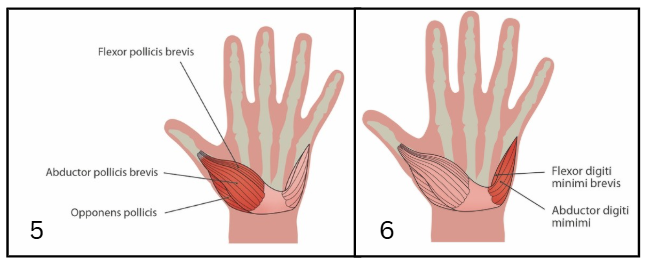
Thenar eminence (see Figure 5)
- Opponens pollicus
- Abductor pollicus brevis
- Flexor pollicus brevis
Hypothenar eminence (see Figure 6)
- Flexor digiti minimi brevis
- Abductor digiti minimi
- Opponens digiti minimi
Finally, in the hand we also have:
- Four lumbrical muscles
- The dorsal and palmar interossei
- Adductor pollicus
- Palmaris brevis
Measuring grip strength
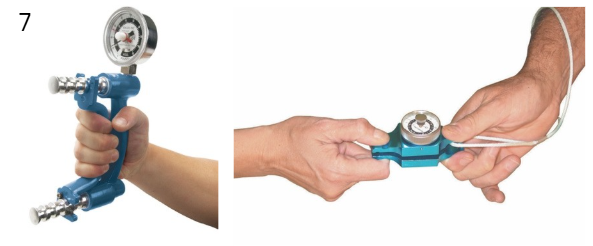
Grip strength can be measured using a handheld dynamometer (see Figure 7). A typical protocol is to measure 5-second maximal contractions with the arm in three different positions: neutral, 90⁰ abduction, and 90⁰ abduction with 90⁰ external rotation. The wrist is kept in neutral and the elbow at 90⁰ flexion in all positions. Subjects should stand with the feet approximately shoulder width apart, with a wall behind to add stability and to prevent trunk rotation and help maintain arm position. Usually, three measurements are taken and the average of the three is used. Pincer strength (Figure 7) is measured with a pinch meter and is a measure of individual finger to thumb strength usually measured with the fingers in relative extension.
Improving grip strength
There are numerous types of grip positions that we can use when training. The most common grip is a cylindrical grip (which is part of the power grip series). A cylindrical grip is where you clasp your hands around a barbell or a dumbbell to a point where the first pad of the thumb can be placed over the index and ring finger. This is the most common grip variation in typical strength training using standard barbells and dumbbells.
Common ways to develop this cylindrical grip strength are exercises such as:
- Deadlift holds
- Milk can carries (strongman exercise)
- Hanging chin up with a closed grip (thumb opposing the index finger)
- Towel chin ups with a hold
The problem with this grip is that while it can build a lot of strength, sometimes this strength doesn’t cross over into other positions/environments where grip is required.
Battling ropes
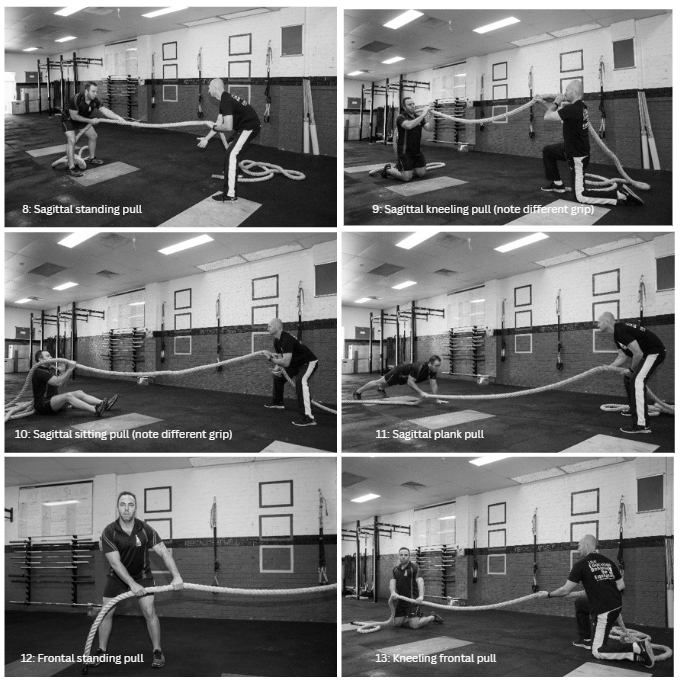
The ‘battling ropes’ is an effective training tool to develop grip strength, primarily through the strongman pulling exercises performed across all three planes of motion (see Figures 8-15). Additionally, the different grip positions affect the way grip strength is developed - i.e. neutral grip and the classical overhand or pronated grip.
There are numerous muscles involved in movement of the forearm and hand (see above), with many of these involved in gripping activities like strongman pulls. Other positive crossovers relate to how strongman pulls can help facilitate stronger lifts - e.g. barbell deadlifts and pull-ups, where often it is the grip muscles that fail before the (larger) target muscles. There are also benefits for recreational activities like rock climbing, wrestling, tennis, and golf, all of which need strong flexor muscles whilst also maintaining good stability of the extensor muscles.
Developing grip in training can produce massive benefits in everyday life and sport. For example, shaking somebody’s hand you may notice that the power in the grip is predominantly from the thumb, index and middle finger. You may not notice that the ring and pinky finger don’t do too much work at all. In this scenario, we find someone is more prone to radial deviation (where the thumb is brought towards the inside of the elbow). This can lead to dysfunctions such as medial epicondylitis.
Powerbags and the Hook grip
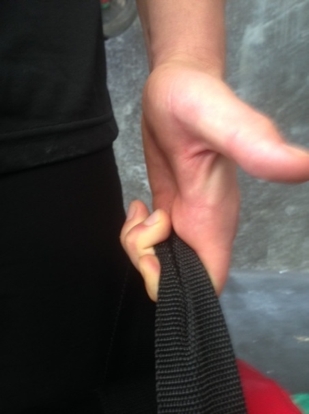
When power bags are used in training, the benefit is the strap that can be used to grip in all a ‘hook’ grip (see Figure 14). This has a huge impact on the flexor digitorum muscles in the forearm. When the pollicis muscles/tendons (or the muscles involved with the thumb) are taken omitted from the grip action, there is greater variability as to how the upper arm and shoulder joint is utilised.
Other grips
- Spherical grip - this is similar to a cylindrical grip, but the object is thicker, so the thumb cannot reach the index and middle finger. With this grip, the whole kinetic chain from fingers through to the shoulder changes, and many people will feel much weaker.
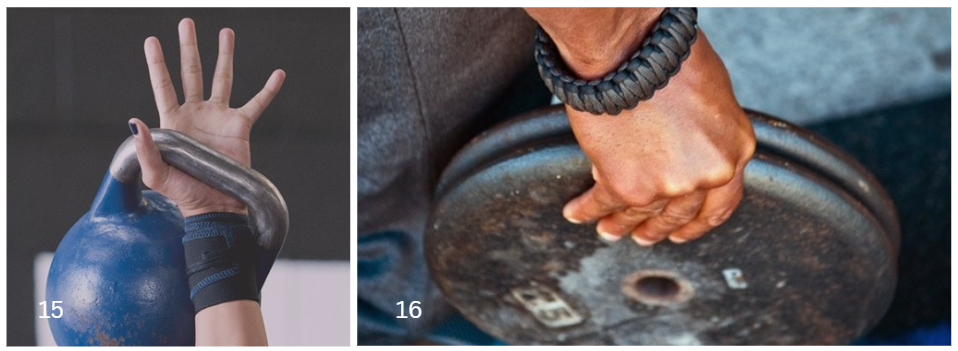
- Lateral prehesion grip - an example of this is the use of Kettlebells, where the bell is held overhead with open hand positions (see Figure 15). In this grip, the adductor pollicis muscle of the thumb is drawn in towards the index finger, creating tension to keep that kettlebell in position. This grip position can also be seen can be seen in the overhead position in the kettlebell snatch and also in the starting position when performing the ‘Turkish get up’ exercise.
Pincer grip strength
Pincer grip positions usually involve the fingers being kept in some degree of extension (straight fingers). The muscles used in this grip sequence usually eliminate the strong extrinsic finger flexors and require more intrinsic muscle action such as the lumbricals. Due the extension of the fingers in these positions, the strong finger flexors need a position of active tension to effectively work. Therefore, it is common to see this grip posture involving 10-20 degrees of wrist extension. The wrist extensor muscles are therefore utilised to hold this wrist extensor position. A classic way to develop this pincer grip is by performing a ‘plate pinch’ (see Figure 16) for a specified time. The variations to a ‘plate pinch’ are:
- Number of plates to make a thicker plate or thinner plate.
- Holding the plates by the side or in front. This will change scapular stability posture.
- Plates with ridges vs smooth plates (changes the coefficient of friction).
Summary
Grip strength is not only a fundamental component of successful skill execution and performances of strength ‘feats’ in sport, it is also linked to rotator cuff and shoulder pathologies. Therefore, actively training grip strength components can help as part of a strength and conditioning program - as well as in rehabilitation programs.
There are a host of muscles that contribute to a strong and powerful grip. Overall strength can be easily measured with commercial grip and pincer strength dynamometers. Many alternative methods of grip strength training exist such as barbells, dumbbells, Kettlebells, Ropes and plates.
Guest authors:
Tarek Michael Chouja is a strength coach and international course presenter in the fitness industry with 15 years experience. Tarek is the co-founder of the Functional Training Institute, which educates trainers and coaches worldwide.
Nathan Quinn is an exercise scientist working across numerous health sectors, winning the OH&S award for his work with Fairfax Media, writing and delivery numerous courses for Body-Brain Integration, Functional Training Institute and PTAGlobal. Nathan also runs the Mindset & Performance Coach podcast on iTunes.
References
- J Appl Physiol 2003; 94: 1092–107.
- J Electromyogr Kinesiol 2011; 21: 478–82.
- Age Ageing 1994; 23: 132–7. 18.
- Arch Phys Med Rehab 1991; 72: 280–3.
- J Body Mov Ther 2012; 16: 275–80.
- J Body Move Ther 2010; 14: 19–26.
- J Hand Ther 2005; 18: 387–8.
- J Hand Surg 2004; 29: 1154–9.
- Eur J Appl Physiol 1995; 71: 485–92.
- Acta Orthop Scand 1996; 67: 485–90.
- Orthop Res 1999; 17: 546–53.
- J Electormyog Kinesiol 2009; 17: 578–86.
- Eur Sci J 2014; 36: 290–301.
- Shoulder & Elbow 2016, Vol. 8(2) 124–129
- Br J Sports Med 2009; 44: 333–40.
- J Shoulder Elbow Surg 2008; 17(1 Suppl): 87S–92S.
- J Shoulder Elbow Surg 2005; 14: 32–8.
- J Electromyogr Kinesiol 2012; 22: 186–90.

Latest Issue

Subscribe Today
Newsletter Sign Up
Subscriber Testimonials
Dr. Alexandra Fandetti-Robin, Back & Body Chiropractic
Elspeth Cowell MSCh DpodM SRCh HCPC reg
William Hunter, Nuffield Health
Subscribe Today




Newsletter Sign Up
Coaches Testimonials
Dr. Alexandra Fandetti-Robin, Back & Body Chiropractic
Elspeth Cowell MSCh DpodM SRCh HCPC reg
William Hunter, Nuffield Health
Subscribe Today
Latest Issue

Be at the leading edge of sports injury management
Our international team of qualified experts (see above) spend hours poring over scores of technical journals and medical papers that even the most interested professionals don't have time to read.
For 17 years, we've helped hard-working physiotherapists and sports professionals like you, overwhelmed by the vast amount of new research, bring science to their treatment. Sports Injury Bulletin is the ideal resource for practitioners too busy to cull through all the monthly journals to find meaningful and applicable studies.
*includes 3 coaching manuals
Get Inspired
All the latest techniques and approaches


Sports Injury Bulletin brings together a worldwide panel of experts – including physiotherapists, doctors, researchers and sports scientists. Together we deliver everything you need to help your clients avoid – or recover as quickly as possible from – injuries.
We strip away the scientific jargon and deliver you easy-to-follow training exercises, nutrition tips, psychological strategies and recovery programmes and exercises in plain English.
