
 close
close


 LOGIN
LOGINLower Back Pain in Field Hockey
Marianke Pienaar examines hockey-specific postural demands, sex differences, assessment strategies, and evidence-based prevention approaches to help clinicians optimize their management in field hockey athletes.


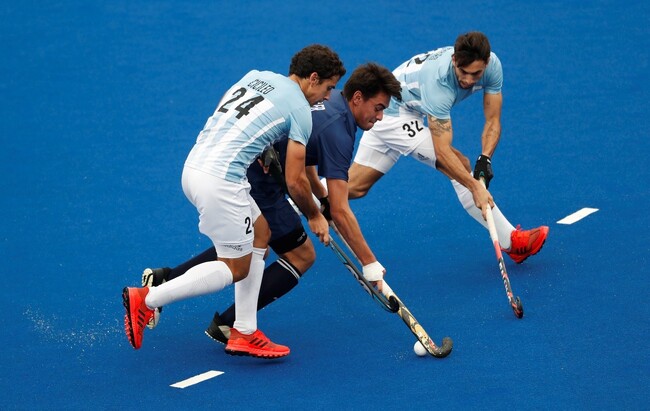
Unlike many field-based sports, field hockey requires all players to compete right-handed, irrespective of hand dominance. This rule enforces repeated asymmetrical movement patterns and prolonged thoracolumbar flexion during high-intensity skills such as dribbling, passing, tackling, and striking(1, 2). These sport-specific demands expose the thoracolumbar region to substantial mechanical stress, contributing to the high prevalence of lower back pain (LBP) reported across ages, playing levels, and positions(2, 11, 12). Prevalence rates range from roughly 33% to over 60%, highlighting LBP as a common issue in the sport(10). Over time, these stresses may exceed tissue tolerance, particularly in younger athletes.
Biomechanics
Prolonged adoption of a semi-crouched playing position is a defining feature of field hockey (see Figure 1). Players frequently maintain thoracolumbar flexion to optimize stick–ball control, defensive reach, and visual tracking of play. During both training and competition, they have to sustain this posture for extended periods, often exceeding one hour during matches and up to two hours during training sessions(6). Over time, this sustained flexed position may lead to postural adaptations, including flattening of the normal thoracolumbar curvature in the sagittal plane (see Figure 2)(5, 6). Clinicians describe this phenomenon as the “hockey player’s back” and reflect chronic exposure to flexion-dominant spinal loading.
"Prolonged adoption of a semi-crouched playing position is a defining feature of field hockey..."
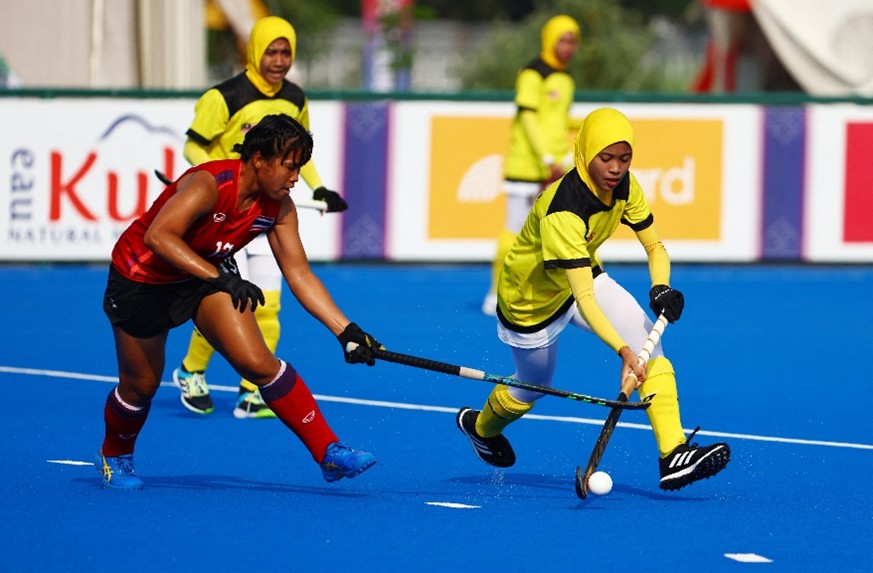
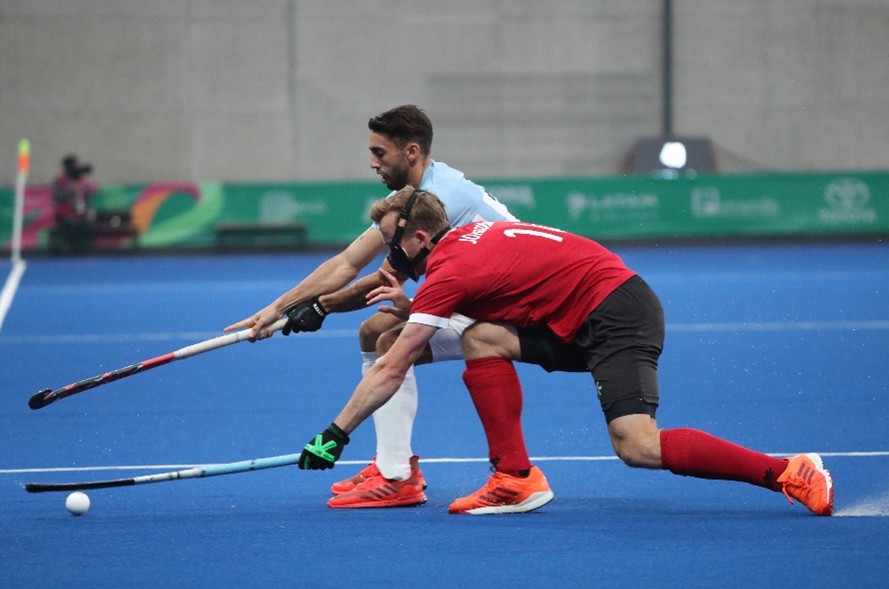
Additional adaptations include asymmetrical development of the erector spinae musculature, particularly on the dominant side, and compensatory changes in the upper thoracic spine and shoulder girdle(6). These adaptations likely arise from repetitive unilateral stick use and the rotational demands imposed by striking and drag-flick techniques. Postural scoliosis is more prevalent in female players, while male players may present with functional leg-length discrepancies that alter pelvic alignment and spinal loading patterns(6). Although such adaptations may initially represent functional responses to sport-specific demands, they may become maladaptive when combined with high training volumes, insufficient recovery, and impaired neuromuscular control, thereby increasing susceptibility to LBP.
The thoracolumbar junction is subject to increased stress during hockey-specific tasks(4). Repeated flexion combined with axial rotation increases shear forces on intervertebral discs, facet joints, and passive spinal structures. Over time, this loading profile may exceed tissue tolerance, particularly in adolescent athletes whose musculoskeletal systems are still developing and who experience rapid increases in training load(11).
Mechanical Loading
Modern field hockey is now faster and more physically demanding. Rule changes, including unlimited substitutions and the removal of the offside rule, increase game intensity while reducing opportunities for passive recovery during match play(5). Players must perform repeated high-intensity efforts with minimal rest, maintaining technically demanding postures for extended periods. This exposes them to sustained flexion and spinal rotation.
Furthermore, synthetic turf surfaces amplify mechanical demands. Compared to natural grass, artificial turf requires players to maintain lower body positions to optimize ball control and stick contact(7). This increases the muscular endurance requirements of the trunk and hip musculature while simultaneously elevating compressive and shear forces acting on the lumbar spine. Musculoskeletal injury patterns differ between artificial and natural surfaces, with artificial surfaces increasing lower-limb and spinal loading(7).
Dribbling and running with the ball are particularly demanding tasks. For example, dribbling for as little as seven minutes can result in measurable spinal height reduction, indicative of intervertebral disc compression(5). Also, energy expenditure during ball-carrying is significantly higher than during normal running, increasing cumulative fatigue(8). When running with the ball, the thoracolumbar spine is often positioned near end-range flexion, placing the hamstrings under sustained tension and increasing posterior chain loading(6). When practitioners increase the frequency of high-volume technical training sessions, athletes may be susceptible to LBP in the absence of adequate capacity.
Contributing Factors
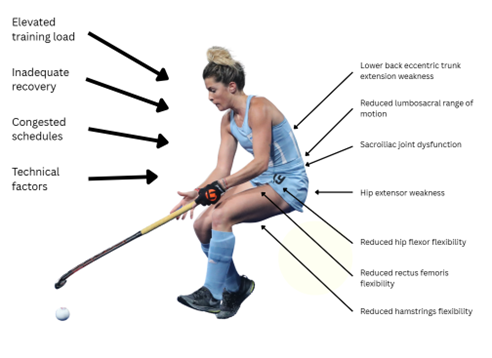
Lower back pain in field hockey is multifactorial, arising from interactions among biomechanical, muscular, and load-related factors (see Figure 3). These factors include:
- Hip extensor weakness and impaired hip muscle control(5),
- Reduced flexibility of the hip flexors, hamstrings, and rectus femoris limits hip mobility, increasing the demands on the lower back(5),
- Sacroiliac joint dysfunction(5),
- Reduced lower back eccentric trunk extension strength(9),
- Reduced lumbosacral range of motion(5).
The coordination and strength of the gluteus maximus, latissimus dorsi, and erector spinae are critical for effective load transfer through the thoracolumbar fascia during trunk rotation and force generation(5). Weakness of these muscles disrupts the kinetic chain, increasing reliance on passive spinal structures. In particular, gluteus maximus weakness may lead to compensatory overactivity of the hamstrings and thoracolumbar extensors during hip extension, altering force transmission from the lower-limbs to the spine(5).
Training load and competition density are additional considerations. High cumulative workloads, inadequate recovery, and congested schedules increase the likelihood of overuse-related LBP(8). Technical factors, such as repeated drag-flicking, especially when performed with shorter sticks, significantly increase lumbar loading and the odds of non-specific LBP(10).
Gender Considerations
The prevalence of lower back pain is high in both sexes, with up to 50–60% of adolescent female players experiencing LBP during their teenage years, with comparable or slightly higher prevalence reported in male adolescents(11, 12). The lower back is the most prevalent site of musculoskeletal pain in both elite and recreational players, although prevalence varies by playing position and competitive level(12).
Gender differences in mobility, strength, and movement strategies may influence the presentation of LBP in field hockey players. Female athletes generally demonstrate greater sagittal-plane mobility, whereas male athletes tend to exhibit greater rotational mobility and longer holding times during trunk flexion tasks(6). Despite increased flexibility, female players may exhibit greater side-to-side differences in hip extension strength and are at risk of reduced lumbosacral range of motion(5).
"The prevalence of lower back pain is high in both sexes..."
Assessment and Clinical Evaluation
Given the complex and multifactorial nature of LBP in field hockey, a comprehensive assessment is essential. The initial evaluation should include detailed postural observation from anterior, posterior, and lateral views to identify spinal curvatures, asymmetries, and muscular imbalances(6). Validated back pain questionnaires provide valuable insight into injury history, aggravating factors, chronicity of pain, and functional impact(11).
Clinicians must assess lumbar mobility and flexibility in the sagittal and transverse planes, as well as hamstring flexibility, using tests such as the straight leg raise(6). Isokinetic testing of trunk musculature is more reliable than isolated spinal mobility or isometric strength tests for identifying deficits associated with LBP(5). Furthermore, clinicians can assess gluteal and hamstring strength using isokinetic dynamometry or kinetic control assessments. Observation of hip extension movement patterns in the prone position may provide clinically relevant information regarding muscle activation sequencing and motor control(5).
Prevention and Management Strategies
Prevention of LBP in field hockey requires a multifaceted and ongoing approach. Strengthening and mobility programs should target the trunk, lumbar spine, hip extensors, hip flexors, and hamstrings to support efficient force transfer and reduce compensatory lumbar movement(6). Clinicians may complete preseason musculoskeletal screening to identify existing imbalances and guide individualized intervention strategies(5).
They should prioritize core and posterior chain strengthening throughout the preseason and in-season phases(11). Load management is equally important; practitioners must monitor training volume and intensity to prevent excessive cumulative loading and ensure adequate recovery(8). Conditioning programs should prepare players for aerobic and anaerobic demands, enabling them to tolerate repeated high-intensity efforts while maintaining movement quality.
Coaching strategies, including player rotation during matches, technical modification where appropriate, and structured recovery sessions. In selected cases, addressing lower-limb asymmetries, such as through targeted strength programs or shoe lifts, may reduce rotational and bending torque acting on the lumbar spine and lower the likelihood of LBP symptoms(6).
Lower back pain is highly prevalent in field hockey and is strongly influenced by the sport’s unique postural demands, enforced asymmetrical movement patterns, and increasing physical intensity. A wide range of muscular, biomechanical, and load-related factors contribute to LBP development, underscoring the importance of comprehensive assessment and targeted prevention strategies. Continuous evaluation of muscle strength, motor control, and training load, combined with year-round conditioning and mobility programs, is essential in reducing the burden of LBP and supporting long-term athlete health and performance.
References
- Sports Med Open. 2019 Jun 24;5:26.
- J Back Musculoskelet Rehabil. 2015;28(1):67-73.
- Thongtrangan I, Le HN, Park J, Kim DH. Thoracic and thoracolumbar fractures. In: Surgical Anatomy & Techniques to the Spine. Saunders, 2006.
- McGill SM. Low Back Disorders: Evidence-Based Prevention and Rehabilitation. Human Kinetics; 2007.
- South African Journal of Physiotherapy [Online], 62.3 (2006): 21-26.
- Australian Journal of Physiotherapy. Vol. 34, No. 3; 1988.
- Am J Sports Med. 2023 May;51(6):1615-1621.
- Journal of Education and Training Studies. 6. 126. 10.11114/jets.v6i12.3605.
- PLoS ONE 12(6): e0180130.
- PLoS ONE 19(7): e0305879.
- J. Clin. Med. 2025, 14(10), 3309
- Int J Of Community Medicine And Public Health. 12. 3107-3112. 10.18203/2394-6040.ijcmph20252104.

Latest Issue

Subscribe Today
Newsletter Sign Up
Subscriber Testimonials
Dr. Alexandra Fandetti-Robin, Back & Body Chiropractic
Elspeth Cowell MSCh DpodM SRCh HCPC reg
William Hunter, Nuffield Health
Subscribe Today


Newsletter Sign Up
Coaches Testimonials
Dr. Alexandra Fandetti-Robin, Back & Body Chiropractic
Elspeth Cowell MSCh DpodM SRCh HCPC reg
William Hunter, Nuffield Health
Subscribe Today
Latest Issue

Be at the leading edge of sports injury management
Our international team of qualified experts (see above) spend hours poring over scores of technical journals and medical papers that even the most interested professionals don't have time to read.
For 17 years, we've helped hard-working physiotherapists and sports professionals like you, overwhelmed by the vast amount of new research, bring science to their treatment. Sports Injury Bulletin is the ideal resource for practitioners too busy to cull through all the monthly journals to find meaningful and applicable studies.
*includes 3 coaching manuals
Get Inspired
All the latest techniques and approaches


Sports Injury Bulletin brings together a worldwide panel of experts – including physiotherapists, doctors, researchers and sports scientists. Together we deliver everything you need to help your clients avoid – or recover as quickly as possible from – injuries.
We strip away the scientific jargon and deliver you easy-to-follow training exercises, nutrition tips, psychological strategies and recovery programmes and exercises in plain English.
