
 close
close


 LOGIN
LOGINPractical Tools for Screening Female Athletes
Elite athletes receive comprehensive health monitoring through regular screenings, but semi-elite and recreational athletes often compete with minimal systematic health evaluation. This screening gap creates a silent barrier to performance and long-term health. Cory Dugan, Heather Bytheway, Darsiha Balakirishnan, Fanija Dukovski, and Wiebke Hensen discuss how evidence-based tools can bridge this divide.



The Screening Divide
Elite athletes operate within sophisticated support systems providing regular, comprehensive health monitoring. Research from UK Athletics demonstrates how integrated performance health management models deliver systematic screening across cardiovascular, metabolic, nutritional, and psychological domains(1). These athletes undergo periodic health evaluations every two to three years, with annual focused assessments between cycles to detect emerging issues. The infrastructure typically includes full-time sports medicine physicians, physiotherapists, nutritionists, and sport psychologists.
Semi-elite and recreational athletes face a starkly different reality (see Table 1). Most compete with minimal systematic health evaluation beyond basic preparticipation screenings. Even common conditions affecting performance remain largely undetected in athletic populations. For example, a study examining 300 exercising women at a national fitness festival found that 12% had anemia, 43% reported a history of iron deficiency, and 43% experienced heavy menstrual bleeding; conditions that directly impact athletic performance(2). The absence of regular, comprehensive monitoring means such performance-limiting conditions persist unrecognized, silently compromising training adaptation and competitive capacity.
This screening disparity creates tangible consequences. For example, ~30% of exercising females have a history of anemia, and ~50% have used iron supplements, yet only a minority (~22%) had sought medical advice(3). Similarly, unidentified cardiovascular abnormalities, psychological distress, and metabolic dysfunction silently erode performance capacity while increasing injury risk. The gap between elite and semi-elite screening represents more than a resource issue; it reflects broader disparities in access to comprehensive health monitoring.
Table 1: Elite vs Semi-elite Screening Comparison
| Screening | Elite athletes | Semi-elite athletes |
| Frequency | Annual to biannual comprehensive screening | Often, only pre-season or no formal screening |
| Menstrual health | Extremely variable | Rarely performed |
| Physiological biomarkers | Regular monitoring (iron, vitamin D, vitamin B12, folate, other metabolic | Rarely performed unless symptomatic |
| Cardiovascula | ECG, echocardiogram, periodic cardiac screening | Basic questionnaire only |
| Physiological | Systematic mental health screening with validated tools | Minimal to no formal screening |
| Performance testing | Regular standardized assessments (4-8 times/year) | Inconsistent or coach-directed only |
| Recovery monitoring | Daily tracking via apps/questionnaires | Usually, athlete self-reported only |
| Nutritional assessment | Periodic evaluation by a sports dietitian | Rarely assessed |
| Cost per athlete | $2,000-5,000 annually | $0-300 annually |
| Medical support | Full-time team physician, physiotherapist, psychologist | Part-time or volunteer practitioner coverage |
Beyond One-dimensional Screening
Even when screening occurs systematically, critical blind spots persist. Research from Johns Hopkins Medical Institutions reveals that routine athlete screenings frequently focus on isolated physical parameters while neglecting interconnected health domains(4). For example, blood work may assess hemoglobin but overlook ferritin, allowing iron depletion to progress undetected. Cardiovascular evaluation may identify structural abnormalities but miss functional limitations. Physical screening occurs in isolation from psychological well-being assessment.
This pattern extends particularly to mental health. For example, 20% of Collegiate athletes experience significant psychological problems annually(5). However, fewer than half of collegiate sports medicine departments administer screening instruments for mental health concerns. An athlete might complete comprehensive musculoskeletal and cardiovascular screening yet receive no formal evaluation of psychological well-being.
The consequences extend beyond subjective well-being. There is an elevated injury risk and diminished performance among athletes experiencing depression symptoms or eating disorders. Researchers from the University of Melbourne emphasize that the transition into elite-level sport exposes young athletes to risk factors, including increased performance expectations and public scrutiny pressures(6). Without systematic psychological screening, these stressors accumulate silently until they manifest as performance decrements, injuries, or burnout.
A multidimensional screening framework acknowledges that optimal performance emerges from the synergistic interaction of multiple health domains. Integrating physical, psychological, nutritional, and recovery assessments into unified protocols will improve athletic performance. This approach recognizes that iron deficiency affects both oxygen-carrying capacity and cognitive function; that sleep deprivation affects both injury risk and decision-making; and that psychological distress affects both immune function and muscular recovery.
"The gap between elite and semi-elite screening represents more than a resource issue..."
Implementing Multidimensional Screening
Translating research-based screening protocols into practical tools for semi-elite settings requires careful consideration of feasibility, cost-effectiveness, and time efficiency. The challenge lies in adapting comprehensive assessment frameworks to resource-limited environments while preserving their ability to detect performance-limiting conditions. There are eight domains that require screening to create meaningful interventions. In this article, we will discuss screening the menstrual cycle. The other domains include:
- Physiological biomarkers,
- Cardiovascular,
- Psychological,
- Performance testing,
- Recovery monitoring,
- Nutritional assessment,
- Social, ethical, and environmental considerations.
Part I: Menstrual Cycle Monitoring
The menstrual cycle should be a primary consideration in comprehensive screening protocols. All active females, regardless of their sport, should consider menstrual cycle dysfunction, as it serves as a critical indicator of underlying energy deficiency and hormonal disruption. Despite this, systematic monitoring remains uncommon outside elite environments. Researchers from the United Kingdom examined elite British track and field athletes over five years, and found that 76.8% reported their menstrual cycle negatively impacted performance, with the late luteal and early follicular phases identified as the most detrimental periods(7).
Menstrual blood loss is a primary cause of iron deficiency and anemia in women of reproductive age. As such, athletes experiencing heavy menstrual bleeding (HMB) are significantly more likely to be diagnosed with anemia and iron deficiency. Approximately 30% of exercising women experience HMB, and symptoms extend beyond performance, with elevated stress levels and reduced mental quality of life observed compared to those with normal menstrual patterns(8,9). Despite these documented impacts, barriers, including shame and a lack of communication opportunities, prevent effective dialogue between athletes and support staff regarding cycle-related concerns.
Strategies for Implementation and Monitoring
Establishing baseline protocols
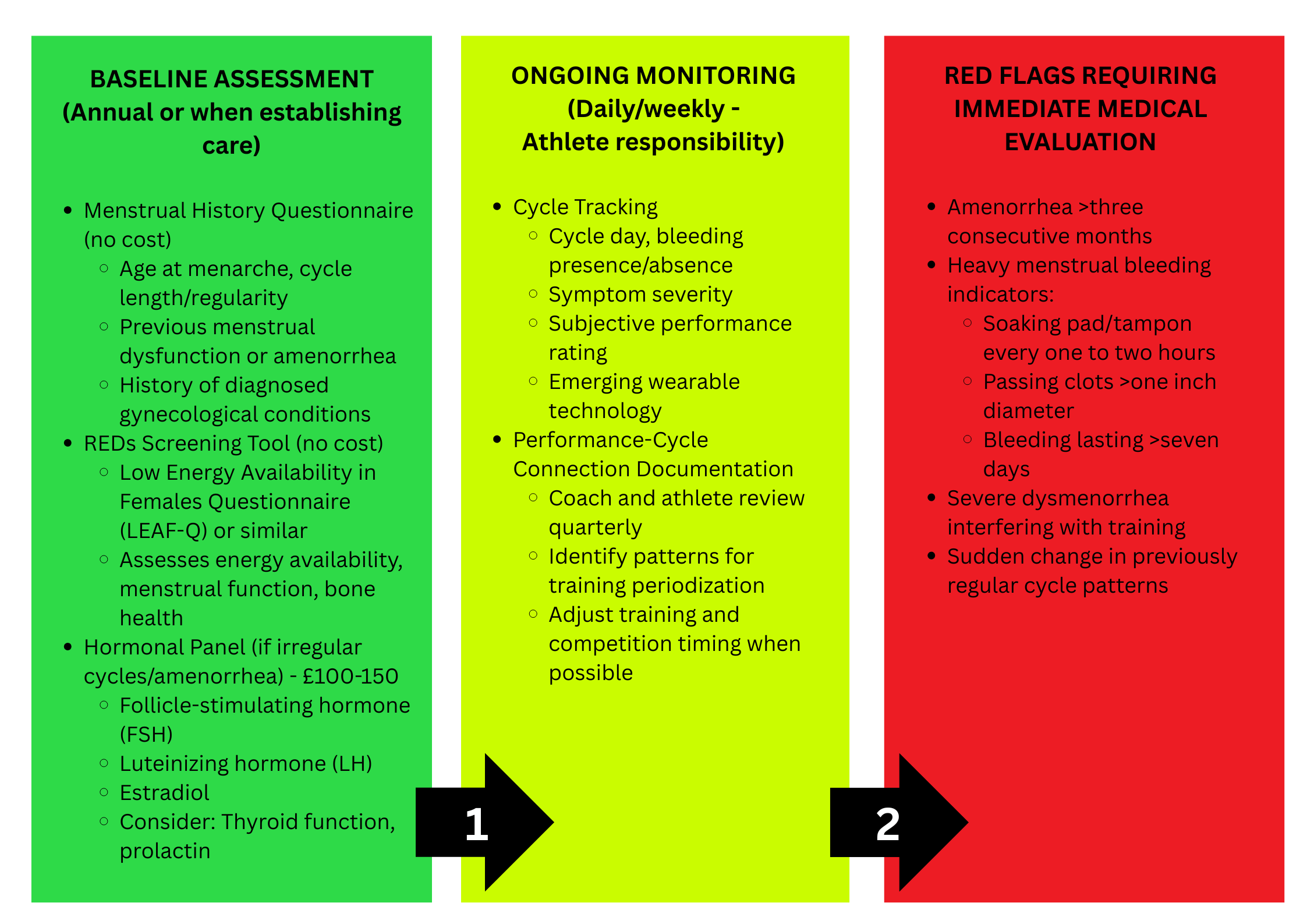
Clinicians should consider establishing a baseline menstrual health assessment, in conjunction with daily monitoring of cycle phases and symptomatology, as standard practice. The baseline assessment should include a comprehensive menstrual history (age at menarche, cycle regularity, prior dysfunction), screening for Relative Energy Deficiency in Sport (REDs) using validated questionnaires, and hormonal panel testing when cycles are irregular or amenorrhea is present (see Figure 1). This foundational information can help identify athletes who require immediate medical referral versus those suitable for ongoing monitoring.
Daily tracking: The minimum standard
Daily tracking is the minimum requirement for identifying individual patterns of symptom recurrence (e.g., abdominal cramping or performance fluctuations) and for facilitating informed communication between athletes and coaches. Coaches may instruct athletes to record cycle day, presence/absence of menstruation, symptom severity (using 0-10 scales), and subjective performance ratings. While calendar-based tracking provides a useful starting point, this simple approach enables pattern recognition over two to three cycles without requiring technological investment.
Wearable technology
Wearable tracking technology (WTT) is a practical tool for cycle monitoring that provides physiological data beyond subjective symptom reporting. Devices such as smart rings utilize skin temperature sensors and heart rate variability to detect physiological shifts associated with the menstrual cycle. For example, the Oura Ring has demonstrated 96.4% accuracy in ovulation detection (within ±3 days) compared to 66.5% for calendar methods, while the Ava bracelet identified the fertile window in 90% of cycles versus 53% for traditional tracking methods(10). This enables athletes to more accurately anticipate cycle phases and adjust training or competition strategies accordingly. These devices typically cost £200-400, making them accessible for semi-elite athletes investing in performance optimization.
Emerging hormonal monitoring technologies
Novel biosensor technologies are advancing beyond passive tracking toward active hormonal monitoring. For example, wearable nanobiosensors (patches) are being developed to monitor estradiol levels noninvasively. These sensors use microscopic sensors to detect estradiol (a key form of estrogen) in sweat, providing a direct correlation to serum estradiol levels to confirm hormonal status(11). Such technology could eventually enable athletes to verify ovulation or identify hormonal dysregulation without clinical blood draws. While still in the research phase, these developments signal a future in which athletes can monitor hormonal status as easily as heart rate.
Quantifying heavy menstrual bleeding
Effective HMB screening relies on both qualitative and quantitative assessments to identify risk factors for iron deficiency (ID) and anemia. A specific qualitative protocol used in Australia utilized a four-item clinical screener(12).
Women are considered to have HMB if they answer "yes" to two or more of the following during their period:
- Flooding through clothes or bedding,
- Need for frequent changes of sanitary towels or tampons (every two hours or less, or using >12 items per period),
- Need for double sanitary protection (using tampons and towels simultaneously),
- Passing large blood clots.
"The menstrual cycle should be a primary consideration in comprehensive screening protocols."
Quantitatively, HMB is defined as >80 mL per cycle. New "smart menstrual cups" incorporate embedded sensors to address the challenge of measuring blood loss. These devices automatically measure menstrual fluid volume and flow patterns, and are capable of identifying abnormal menstrual flow (with 97% accuracy) and alerting the user to disposal(13). While commercial pricing remains undisclosed, the technology has attracted significant investment. For instance, UK biotech start-up company Emm recently secured $9 million in seed funding and reports a 30,000-person waitlist ahead of its 2026 launch(14). If commercially accessible to semi-elite and recreational athletes, this could enable earlier detection of iron deficiency and anemia, which is seen in ~50% of HMB-positive athletes(8).
Other Considerations
Privacy and data security concerns
The proliferation of commercial menstrual tracking apps raises significant privacy concerns. Many apps collect extensive personal data without adequate transparency or protection. As such, clinicians should counsel athletes on privacy settings and on using apps with robust data protection policies. Additionally, public health bodies must develop transparent, non-profit tracking apps to protect user data from commercial exploitation. Athletes should retain control over their reproductive health data, with explicit consent required before sharing with coaches, sports medicine staff, or team management. Creating organizational policies that protect menstrual health data as confidential medical information (rather than performance metrics available to coaching staff) is essential for encouraging honest disclosure and utilization of tracking tools.
"Daily tracking is the minimum requirement for identifying individual patterns..."
Summary
Clinicians and athletes may neglect menstrual cycle monitoring as a component of comprehensive screening for female athletes. The evidence demonstrates that menstrual dysfunction serves as a vital sign of underlying health issues, with direct implications for performance, iron status, and psychological well-being. Simple daily tracking combined with emerging wearable technologies enables monitoring without requiring extensive resources. However, a key dimension overarching this topic is the "taboo" nature of discussing menstrual health.
Clinicians must create environments in which athletes feel safe discussing cycle-related concerns with coaches and medical staff, as well as with the screening tools themselves.
Integrating menstrual health assessment into standard screening protocols, particularly within semi-elite cohorts, will close the gap between health and performance and ensure comprehensive physiological monitoring.
References
- Chew S, Wolman R. Sport and exercise medicine. Medicine (Baltimore) 2014;42:2204.
- Medicine (Baltimore). 2021 Oct 1;100(39):e272713.
- PLoS One. 2016 Feb 22;11(2):e0149881
- Am Heart J Plus Cardiol Res Pract 2024;44:100413.
- Yoon JJ, Petrie T. Barriers to and Facilitators of Collegiate Athletes Seeking Mental Health Services. 2023 [cited 2026 Feb 4]; Available from: nata.kglmeridian.com/view/journals/attr/58/9/article-p715.xml
- Sports Med Open. 2024 Mar 9;10(1):24.
- Front Sports Act Living 2024;6:1296189.
- J Sci Med Sport. 2024 Jul;27(7):437-450.
- Reprod Sci 2020;27:888–94.
- Brahmbhatt R. Accuracy of Wearable Technology in Menstrual Cycle Tracking. 2025
- Nat Nanotechnol Nature Publishing Group; 2024;19:330–7.
- Int J Gynecol Obstet 2015;128:196–200.
- Artif Intell Rev 56, 6705–6722 (2023).
- Emm raises $9m to market connected menstrual cup [Internet]. IoT M2M Council. [cited 2026 Feb 4]. Available from: iotm2mcouncil.org/iot-library/news/connected-health-news/emm-raises-9m-to-market-connected-menstrual-cup/

Latest Issue
Subscribe Today
Newsletter Sign Up
Subscriber Testimonials
Dr. Alexandra Fandetti-Robin, Back & Body Chiropractic
Elspeth Cowell MSCh DpodM SRCh HCPC reg
William Hunter, Nuffield Health
Subscribe Today


Newsletter Sign Up


Coaches Testimonials
Dr. Alexandra Fandetti-Robin, Back & Body Chiropractic
Elspeth Cowell MSCh DpodM SRCh HCPC reg
William Hunter, Nuffield Health
Subscribe Today
Latest Issue

Be at the leading edge of sports injury management
Our international team of qualified experts (see above) spend hours poring over scores of technical journals and medical papers that even the most interested professionals don't have time to read.
For 17 years, we've helped hard-working physiotherapists and sports professionals like you, overwhelmed by the vast amount of new research, bring science to their treatment. Sports Injury Bulletin is the ideal resource for practitioners too busy to cull through all the monthly journals to find meaningful and applicable studies.
*includes 3 coaching manuals
Get Inspired
All the latest techniques and approaches


Sports Injury Bulletin brings together a worldwide panel of experts – including physiotherapists, doctors, researchers and sports scientists. Together we deliver everything you need to help your clients avoid – or recover as quickly as possible from – injuries.
We strip away the scientific jargon and deliver you easy-to-follow training exercises, nutrition tips, psychological strategies and recovery programmes and exercises in plain English.
