
 close
close


 LOGIN
LOGINWhen Injury Rewrites the Brain: A Neuroscience-Informed Perspective
Carl Bescoby explores how injury extends beyond tissue damage to influence brain function, behavior, and identity. He outlines how clinicians can integrate neuroscience-informed approaches to better support recovery, rebuild confidence, and facilitate return to performance.


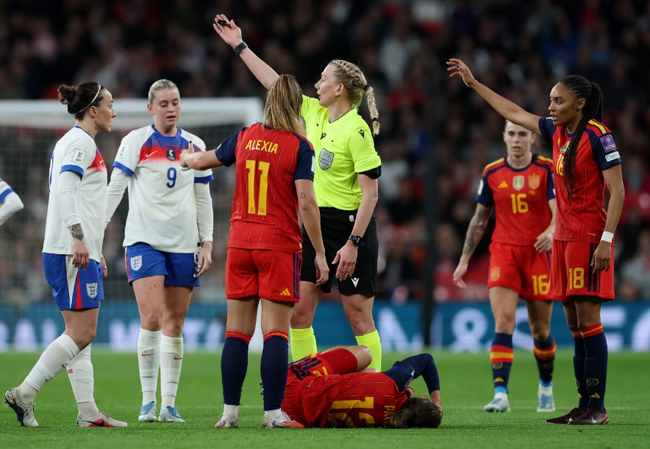
In many clinical and performance environments, clinicians continue to frame injury as a disruption to tissue integrity, something to be measured, progressively loaded, and restored through structured rehabilitation. While this perspective remains important, contemporary neuroscience invites a broader understanding. Injury is a system-wide challenge that influences how the brain predicts movement, evaluates safety, and organizes behavior under conditions of uncertainty. Emerging models across pain science, motor control, and stress physiology highlight the central role of the brain in shaping recovery. This offers a useful lens for understanding a common paradox in practice: why biomechanically sound rehabilitation programs may still be accompanied by fear, guarded movement, fluctuating engagement, or emotional strain. Rather than viewing these responses as problematic or resistant, it is more accurate to understand them as adaptive outputs of a nervous system attempting to maintain safety. Within this context, hesitation and hypervigilance are not signs of failure, but reflections of an organism learning to navigate uncertainty.
Why is Injury so Disruptive?
To understand the impact of injury, it is helpful to consider the brain as a prediction system. According to predictive processing frameworks, the brain is continuously engaged in generating and refining predictions about incoming sensory information, updating these models considering new evidence to minimize error and maintain efficient interaction with the environment(1,2). The brain continuously generates expectations about load, position, and outcome, allowing movement to feel smooth, efficient, and controlled.
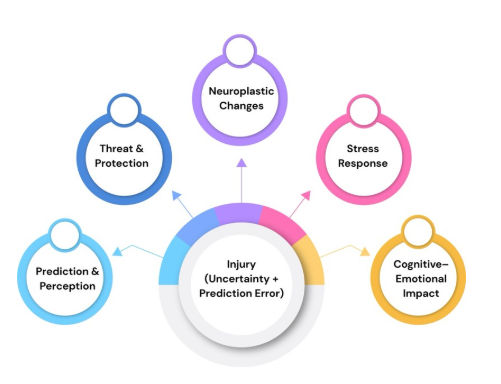
Injury disrupts this process, and movements that were once predictable and safe begin to produce pain, instability, or unfamiliar sensations. This creates a mismatch between expectation and experience. Neuroscientists call this a prediction error, which the brain interprets as a potential threat (see Figure 1). In response, neural systems involved in threat detection become more active, prioritizing protection over performance(3). Crucially, these threat responses can persist well beyond the point of tissue healing, particularly in cases where prediction errors continue to be reinforced during the rehabilitation process through repeated experiences of pain, inconsistency, or lack of perceived control.
This framework provides a compelling explanation for a frequently observed clinical challenge: why reassurance based solely on structural findings, imaging, or tissue-healing timelines often proves insufficient to reduce fear or restore confidence in movement(4). Without directly addressing the brain’s predictive models and its ongoing assessment of threat, athletes may remain caught in a cycle in which the body is physically capable. Yet, the nervous system continues to signal caution.
Injury and Brain Changes
Neuroimaging research has increasingly demonstrated that injury, pain, and periods of immobilization are not confined to local tissue changes but are accompanied by measurable alterations in motor and somatosensory cortical representations. Clinicians can observe such changes across a range of conditions highly relevant to clinical practice, including anterior cruciate ligament injury, chronic ankle instability, and persistent pain presentations(5,6). When cortical representations become less precise, the consequences extend directly into movement planning, proprioceptive accuracy, and the athlete’s sense of trust in the injured limb. Experiences frequently described by patients, such as the leg feeling unfamiliar, unreliable, or “not quite my own”, are therefore better understood as reflections of altered cortical mapping rather than simple psychological avoidance or lack of confidence.
Alongside these neuroplastic changes, pain functions as a particularly powerful learning signal. Through associative learning processes, specific movements, environments, or loading patterns can become linked to threat, gradually strengthening protective neural pathways over time(7). As a result, avoidance behaviors and altered motor strategies may begin as short-term protective responses yet become encoded as long-term safety behaviors that persist well beyond the point of tissue recovery. Importantly, the nervous system does not inherently distinguish between adaptive short-term protection and longer-term maladaptive patterns. Without deliberate and graded re-exposure, these protective strategies can remain highly resistant to change even when physical capacity has objectively returned.
This process is further complicated by the physiological stress response that often accompanies injury and performance disruption. Elevated levels of stress hormones such as cortisol and noradrenaline, commonly observed in athletes navigating uncertainty, loss of routine, and performance pressure, impair both motor learning and cognitive flexibility(8). Consequently, mechanically well-designed rehabilitation may still prove neurologically inefficient if undertaken within a chronically stressed system, highlighting the importance of addressing both the biological and psychological contexts in which recovery occurs.
The Social Brain
From a neurobiological perspective, the brain is fundamentally organized around social connection, with neural systems underpinning reward, motivation, and self-concept closely intertwined with experiences of belonging and role identity. Within athletic populations, these systems are deeply embedded in the routines, structures, and relational environments of training and competition. Consequently, injury represents not only a physical disruption but also a significant challenge to identity coherence, removing access to valued sources of reward such as participation, progression, and team inclusion. This disruption has measurable neural consequences, such as social exclusion, reduced status, or disconnection from the team environment, which activate neural pathways that overlap with those involved in physical pain processing, thereby amplifying the overall experience of distress.
In this context, emotional reactivity, withdrawal, or apparent disengagement from rehabilitation reflect the brain’s integrated response to both social and physical threat. For clinicians and practitioners, this offers an important lens, even when physical recovery is progressing as expected, the athlete’s internal experience may remain shaped by loss, uncertainty, and social disconnection, all of which meaningfully influence engagement and behavior within rehabilitation.
Cognitive and Emotional Consequences
Within the context of injury and perceived threat, several interacting neurocognitive processes begin to shape behavior in ways that are often misinterpreted within rehabilitation settings. Attentional systems, for example, become increasingly narrowed under threat, with a heightened focus on bodily sensations and potential signs of danger, which, in turn, reduces the available cognitive bandwidth for task execution and learning. At the same time, diminished prefrontal regulation under stress contributes to greater emotional reactivity, making it more difficult for individuals to modulate frustration, anxiety, or low mood in response to setbacks(9). Motivation may also fluctuate due to reduced dopaminergic reward associated with training, progress, and goal attainment, leading to less consistent engagement over time(10).
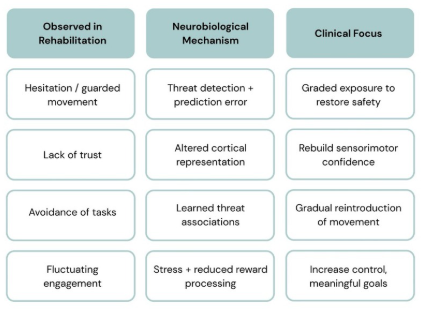
Compounding this, fear-conditioning processes can bias memory and future expectations of movement toward threat, reinforcing protective responses and eroding confidence even in the absence of ongoing tissue risk. Taken together, these mechanisms illustrate how cognitive, emotional, and motivational shifts during injury are deeply rooted in neurobiology, shaping how an individual attends, feels, and acts throughout the rehabilitation process (see Table 1).
Clinical Insights
In practice, these processes tend to show up in ways that are easy to observe but often misinterpreted. Athletes may start to overthink movements that were once automatic, moving more cautiously or hesitantly than expected. They might avoid certain tasks despite having the physical strength to perform them, or their engagement with rehab may fluctuate from one session to the next. You may also notice increased reassurance-seeking, with repeated questions about safety or readiness, alongside language that reflects a lack of trust in the body, such as describing a limb as unreliable or unpredictable, rather than simply weak. Rather than viewing these behaviors as poor compliance or low motivation, it is more helpful to see them as signs that the nervous system still perceives threat. From a practical standpoint, this means shifting the focus toward rebuilding a sense of safety and confidence through consistent messaging, graded exposure to feared movements, and creating predictable, successful movement experiences that help restore trust in the body over time.
Clinical Implications
Recovery from injury is most effective when rehab supports not just the tissues, but also the athlete’s sense of safety, control, and understanding of the process. One key approach is graded exposure to movements or tasks that feel threatening or uncomfortable. By reintroducing these movements gradually and in a controlled way, the nervous system can relearn that they are safe, helping to reduce fear and hesitation over time(11). Alongside this, education about pain and fear is essential, explaining that these responses are protective rather than harmful allows athletes to make sense of their experience, reducing anxiety and building confidence in their body’s ability to perform.
Another important strategy is collaborative goal setting, where the athlete and clinician work together to define achievable, meaningful objectives. This helps athletes feel a sense of control and involvement in their recovery, while also reducing the perception of threat that can make engagement inconsistent. Finally, incorporating variability and contextual loading, practicing movements in different situations and under slightly changing conditions, helps the brain improve its predictions about what is safe, restoring trust in the body and its capacity to perform. Taken together, these approaches emphasize that successful rehabilitation involves retraining both the body and the nervous system, creating an environment in which athletes can rebuild confidence, reduce fear, and engage more consistently in their recovery journey.
Conclusion
Injury is far more than a local tissue problem; it represents a complex, system-wide disruption that reaches into the brain, the nervous system, and the athlete’s sense of self. Neuroscience shows that the effects of injury extend beyond structural damage, altering movement predictions, cortical maps, and emotional and cognitive processes. Fear, hesitation, fluctuating engagement, and emotional reactivity are adaptive responses of a nervous system learning to navigate uncertainty and potential threat. Recognizing this allows clinicians to interpret behaviors accurately, compassionately, and clinically usefully.
Effective rehabilitation must therefore address both the body and the brain. Gradual, controlled re-exposure to previously feared movements, education that reframes pain and fear as protective rather than harmful, collaborative goal setting, and varied, context-rich practice all work together to retrain the nervous system, restore confidence, and rebuild trust in the injured limb. Social and identity factors also play a critical role, as disruption to team roles and daily routines can amplify distress and reduce engagement. By integrating an understanding of predictive processing, cortical reorganization, stress physiology, and social neuroscience into everyday practice, clinicians can create recovery environments that are safer, more predictable, and meaningful for the athlete.
Ultimately, recovery is not just about restoring tissue integrity; it is about retraining the nervous system, rebuilding confidence, and supporting the athlete to feel capable, safe, and motivated again. When rehabilitation considers these wider neurobiological and psychological factors, it becomes possible to break cycles of fear and hesitation, helping athletes return to movement, performance, and participation with greater resilience and long-term success.
References
-
Nature Reviews Neuroscience, 2010. The free-energy principle.
-
Behavioral and Brain Sciences, 2013. Whatever next.
-
Neurocognitive aspects of pain perception. 2008, 12(8), 306-313.
-
J of Phys. Pain neuroscience education. 2011
-
The American journal of sports medicine, 2009, 37(12), 2419-2426.
-
Grieve’s Modern Musculoskeletal Physiotherapy E-Book, 2024, 179.
-
Physical therapy, 2018, 98(5), 315-324.
-
Progress in brain research, 2007, 167, 3-15.
-
Nature Reviews Neuroscience, Stress signaling pathways, 2009.
-
Brain, 2016, 139(5), 1325-1347.
-
Pain Research and Management, 2002, 7(3), 144-153.

Latest Issue

Subscribe Today
Newsletter Sign Up
Subscriber Testimonials
Dr. Alexandra Fandetti-Robin, Back & Body Chiropractic
Elspeth Cowell MSCh DpodM SRCh HCPC reg
William Hunter, Nuffield Health
Subscribe Today


Newsletter Sign Up


Coaches Testimonials
Dr. Alexandra Fandetti-Robin, Back & Body Chiropractic
Elspeth Cowell MSCh DpodM SRCh HCPC reg
William Hunter, Nuffield Health
Subscribe Today
Latest Issue

Be at the leading edge of sports injury management
Our international team of qualified experts (see above) spend hours poring over scores of technical journals and medical papers that even the most interested professionals don't have time to read.
For 17 years, we've helped hard-working physiotherapists and sports professionals like you, overwhelmed by the vast amount of new research, bring science to their treatment. Sports Injury Bulletin is the ideal resource for practitioners too busy to cull through all the monthly journals to find meaningful and applicable studies.
*includes 3 coaching manuals
Get Inspired
All the latest techniques and approaches


Sports Injury Bulletin brings together a worldwide panel of experts – including physiotherapists, doctors, researchers and sports scientists. Together we deliver everything you need to help your clients avoid – or recover as quickly as possible from – injuries.
We strip away the scientific jargon and deliver you easy-to-follow training exercises, nutrition tips, psychological strategies and recovery programmes and exercises in plain English.
