
 close
close


 LOGIN
LOGINStressed Loading: Second Metatarsal Stress Fracture - Part II
In part one of this article on second metatarsal stress fractures, Chris Mallac explored how these injuries occur, and the pathogenesis of second metatarsal stress fracture development. In part two, Chris considers the principles of second metatarsal stress fracture rehabilitation, including return to running, progressive loading and other aspects the clinician needs to consider.
Stress fractures of the second metatarsal are most common in ballet dancers, and thus the majority of the literature on the management of these conditions stems from these ballet-related research reports. The few series published in the orthopaedic literature report a quick recovery of these fractures after nonoperative treatment(1-3). For example, in a series of 64 stress fractures of the base of the second metatarsal in classic ballet dancers, these all healed with conservative care(2). If nonoperative management fails, surgery seems to give good results in most patients(4).
Stress fracture management
Management begins immediately after an abnormal reaction to stress or a stress fracture is suspected. Often plain film x-ray may not be positive for 10–21 days after the onset of symptoms. However, delaying intervention at this point may potentially accelerate the process to progress to a true stress fracture and frank fracture through the second metatarsal. Therefore, early diagnosis is very important if the athlete complains of foot pain related to exercise.
It is widely accepted that the first priority is a period of rest from the stress or activity that is causing the symptoms. Zelko and DePalma describe the rest as ‘active’, allowing the athlete to exercise in a pain-free manner, prevent muscle atrophy and to maintain as much fitness as possible(5). Pain should be used as a guideline to treatment intensity, as pain during an activity may indicate exacerbation at the injury site.
Romani et al describe a 3-phase rehabilitation process that takes advantage of the physiologic healing process of the bone(6):
- Phase I - should allow time for the maturing of the periosteum, healing of damaged blood vessels to prevent ischemic injury to bone, and maturing of osteocytes(5,7).
- Phase II - should include general conditioning and strengthening specific to the injured extremity.
- Phase III - Functional weight bearing in phase III should allow for gradual remodelling of the bone and a return to the original level of activity. In the 3-phase protocol, gradually increased stress in phase III is alternated with periods of rest to let new osteocytes and periosteum mature during periods of remodelling, when the bone is weakest.
The case of the footballer
A 21 year-old elite football player who plays as an attacking midfielder presented with acute onset, right-midfoot pain sustained in a training session. He described a sudden clicking sensation on the dorsum of the midfoot over the 2ndand 3rdmetatarsals. The injury was caused by a sudden change in direction. He was able to continue training for ten more minutes; however he noticed the pain in the foot was increasing. He denied any previous sensations of midfoot pain leading up to this injury, and had spent the previous 11 weeks of pre-season training completely injury free. His rehabilitation followed the 3-phase process.
Phase I
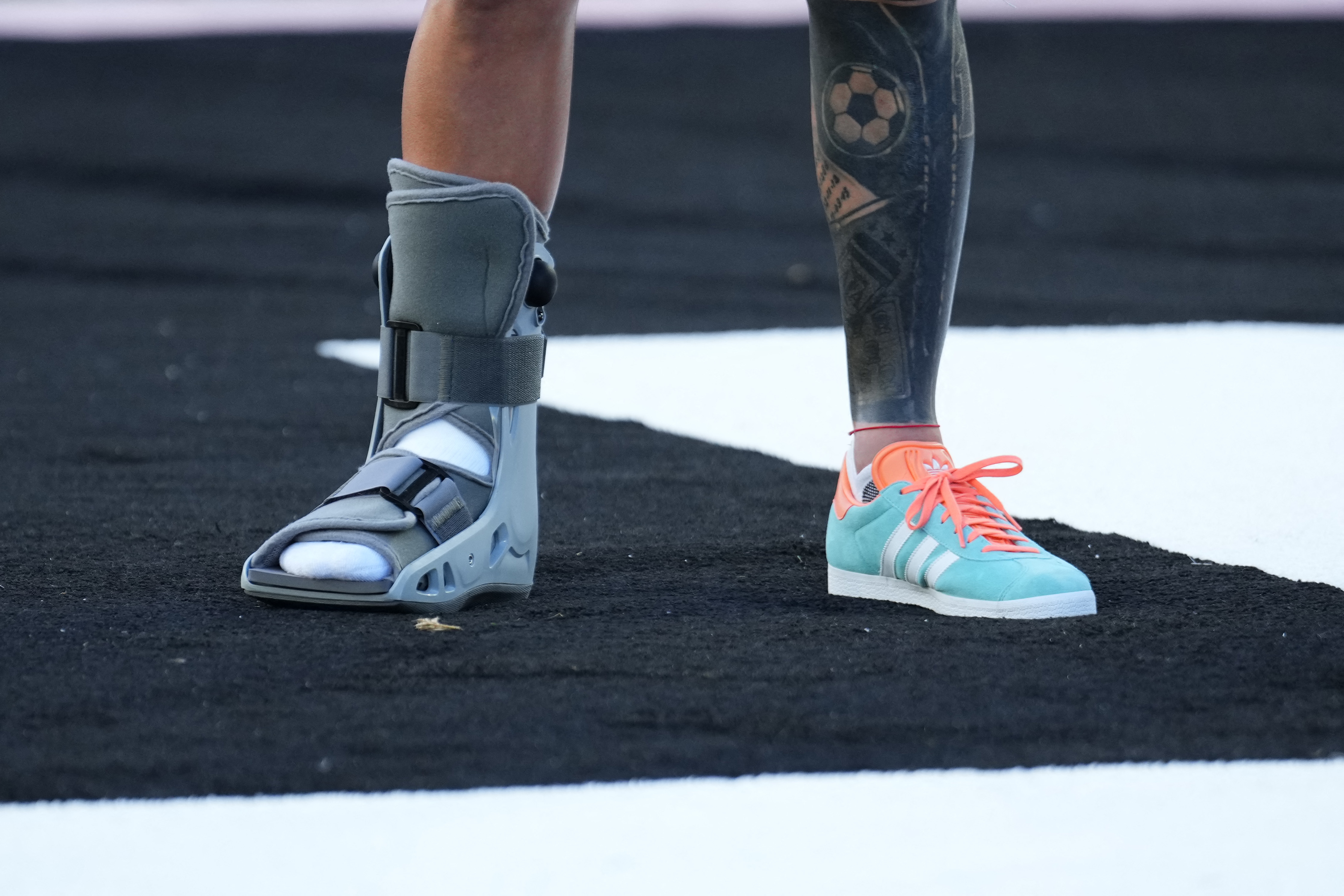
This phase focuses on removing the stress from the injured area (through use of a de-loading ‘moon boot’ – see Figure 1), controlling pain, and preventing deconditioning (through cross-training). Physiologically, it is during this phase (usually up to 21 days) that the haversian canals in the bone are forming, the osteoblasts are laying down new cells, and the periosteum is maturing to buttress the weakened area of bone(8,9). Therefore, a period of initial de-loading is necessary to allow this physiological process to occur.
Acute symptoms should no longer occur with normal activities. A functional ‘moon boot’ with crutch walking is a preferable to plaster casting as the boot can be removed to exercise in a non-weight bearing manner. If poor foot alignment is present, orthotics should be fitted to correct it.
Ambulation should progress from crutch walking to full weight bearing as soon as it can be tolerated without pain. This footballer was initially non-weight bearing for the first three weeks and then progressed to touch weight bearing and then partial weight bearing over the next three weeks. This was all achieved in the absence of pain.
Condition the involved lower extremity daily with towel scrunches, ankle isometrics (calf, peroneals and tibialis posterior/anterior), and sitting range-of-motion movements on a wobble board (see Figure 2). These all need to remain free of pain. Exercises can be progressed by adding weight to the towel scrunches, and allowing active-range strengthening with rubber tubing.
Strength training for the upper extremity and leg conditioning for the unaffected side should continue. Cardiovascular fitness can be maintained by using the upper body ergometer or stationary bicycle or treading water in the deep tank of the pool. This player was conditioned on alternate days with upper body circuits (boxing, ropes and weights) and then swimming on the next (no kicking).
You need to be logged in to continue reading.
Please register for limited access or take a 30-day risk-free trial of Sports Injury Bulletin to experience the full benefits of a subscription. TAKE A RISK-FREE TRIAL

Latest Issue

Subscribe Today
Further reading
Newsletter Sign Up
Subscriber Testimonials
Dr. Alexandra Fandetti-Robin, Back & Body Chiropractic
Elspeth Cowell MSCh DpodM SRCh HCPC reg
William Hunter, Nuffield Health
Subscribe Today

Newsletter Sign Up
Coaches Testimonials
Dr. Alexandra Fandetti-Robin, Back & Body Chiropractic
Elspeth Cowell MSCh DpodM SRCh HCPC reg
William Hunter, Nuffield Health
Subscribe Today
Latest Issue

Be at the leading edge of sports injury management
Our international team of qualified experts (see above) spend hours poring over scores of technical journals and medical papers that even the most interested professionals don't have time to read.
For 17 years, we've helped hard-working physiotherapists and sports professionals like you, overwhelmed by the vast amount of new research, bring science to their treatment. Sports Injury Bulletin is the ideal resource for practitioners too busy to cull through all the monthly journals to find meaningful and applicable studies.
*includes 3 coaching manuals
Get Inspired
All the latest techniques and approaches


Sports Injury Bulletin brings together a worldwide panel of experts – including physiotherapists, doctors, researchers and sports scientists. Together we deliver everything you need to help your clients avoid – or recover as quickly as possible from – injuries.
We strip away the scientific jargon and deliver you easy-to-follow training exercises, nutrition tips, psychological strategies and recovery programmes and exercises in plain English.
