
 close
close


 LOGIN
LOGINYou are viewing 1 of your 1 free articles
Medial collateral ligament strain: back to activity


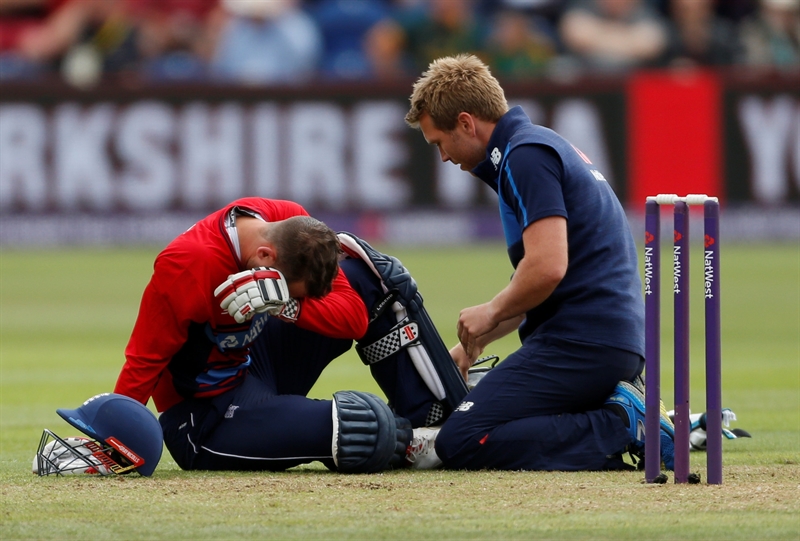
In sports that require sudden changes of direction and/or direct contact to the outside of the knee, strong valgus forces may be encountered by the athlete. These forces may be damaging to the superficial medial collateral ligament (s-MCL). Higher valgus forces may also be associated with more severe injuries to the deeper medial knee structures such as deep medial collateral ligaments (d-MCL) and posterior oblique ligament. The majority of these MCL tears are isolated and occur typically in sports such as skiing, ice hockey, rugby, and soccer, which require knee flexion and valgus loading and potential of direct contact to the outside of the knee.
Return to play time frames
Some authors have quantified the number of days it typically takes for conservatively-managed athletes with MCL injuries to return to sport. Below is a summary of some of these findings:- Derscheid and Garrick (1981) found that grade I injuries returned at an average of 10.6 days and grade II injuries at 19.5 days(1).
- Indelicato et al (1990) (2) found that in classic grade III injuries the return to sport was an average of 9.2 weeks(2).
- Miyamato et al (2009) (3) found that grade I injuries take 10-11 days to return and grade II injuries take in average 20 days to return(3).
From personal experience, this author feels that the time frame described above for grade II injuries is a little ambitious. In elite athletes, three weeks is often not enough time to feel comfortable after typical grade II injuries - unless they are heavily braced and prepared to withstand some discomfort and apprehension. In this author’s experience, typical grade II injuries usually take nearer 5-6 weeks to resolve.
In clinical practice, the decision to return to play is not exclusively determined by a predictable time frame. Many confounding variables may be present, which can extend this time significantly. These include:
- Athletes in sports that require much more of a skill-based focus with the lower limb (such as soccer) seem to take longer to feel confident and comfortable to return to full competition compared with athletes that do not need such motor skill in the lower limbs, such as rugby players.
- Anecdotally, it is found that in certain rugby playing parts of the world, players from a Polynesian background (Tongan, Maori, and Samoan) seem to be more prone to MCL injury and also seem to take longer to return to play than matched players from non-Polynesian backgrounds. This phenomenon may be a genetic trait but has never been formally studied. It may simply be an anecdotal observation from this author after many years working with elite Rugby Union players.
- Athletes with a previous grade-II injury who display some clinical laxity on testing when uninjured (this would be picked up in a pre-season screen) seem to take longer (more likely to extend past 14 days) than athletes not previously injured after a simple grade-I strain. These previously uninjured athletes usually respond in 10 days as discussed above.
This last point is important; often, this delay in return to sport may not be caused by the athlete’s lack of confidence – but rather by the medical staff, who may assess and feel a clinical grade II injury (due to previous laxity from an older injury) and then misinterpret a new grade I on pre-existing grade II injury as being a fresh grade II injury. Staff may then conservatively decide to brace the athlete for extended periods of time, thus delaying return to sport. If possible, therefore, it is important that in a pre-season screening, the degree of laxity in the knee is noted in the event that this athlete suffers another MCL injury in-season.
Non-operative treatment
Although the medial knee structures are the most commonly injured knee ligaments, controversy exists regarding how to best manage high-grade ligament disruption on the medial side of the knee. Historically, conservative treatment with brace immobilization and controlled and graduated weight bearing has led to good functional outcomes, without the need for surgery(2,4-11).On the balance of evidence, there is a consensus that non-operative management with early protected range-of-motion exercises and progressive strengthening should be the first step in the treatment of acute isolated grade-I or II injuries. This because excellent clinical outcomes and a high rate of return to sport with conservative management are expected(5-7,12-14). It is also important to note that the success of non-operative treatment of complete tears of the medial knee structures relies on an intact anterior cruciate ligament and posteromedial complex of the knee(7).
There can be confusion about the management of acute grade-III medial knee injuries. This is caused by the overlapping classification scheme based on the typical amount of joint laxity seen at 30 degrees of knee flexion(15-17) versus the Fetto and Marshall(18)grade III injuries that are unstable even at 0 degrees of knee flexion (indicating posteromedial instability with or without ACL disruption - refer to issue 166 where this classification system was discussed in the first part of this series)(15).
Phistikul et al(15) have made the point that conservative treatment works well in the Fetto and Marshall grade II injuries and the typical grade III at 30-degree flexion laxities(18). However, for Fetto and Marshall’s grade-III injuries, the long-term outcome of non-operative treatment may be much worse than grade I and II, with a high frequency of persistent medial instability, secondary dysfunction of the ACL, muscle weakness, and post-traumatic osteoarthritis of the injured knee. This supports the recommendation to opt for operative treatment of all isolated type III injuries(18).
Damage to the posteromedial corner may be best visualized with MRI imaging, and this may assist in highlighting the exact location of injury so that treatment decisions can be made based on the anatomic location of the MCL failure. Operative treatment has been recommended for situations where there is injury over the whole length of the superficial layer or a complete injury of both the s-MCL and d-MCL from the tibia(19,20). Furthermore, in the event of repeat MCL strains and the development of functional instability, surgical intervention may be required. For the purposes of this article, surgical management of serious grade-III injuries with or without ACL will not be discussed.
Rehabilitation protocol
The typical features of a conservative post-injury rehabilitation program are highlighted below:- Early management
- NSAIDS are usually not recommended in the first four days post injury, as they have the ability to delay ligament healing. They are generally reserved for any ongoing knee-joint inflammation after the first four days if necessary(21).
- Ice and compression for 20 minutes every hour for the first eight hours. This is then reduced to 20 minutes every three hours for the next two days.
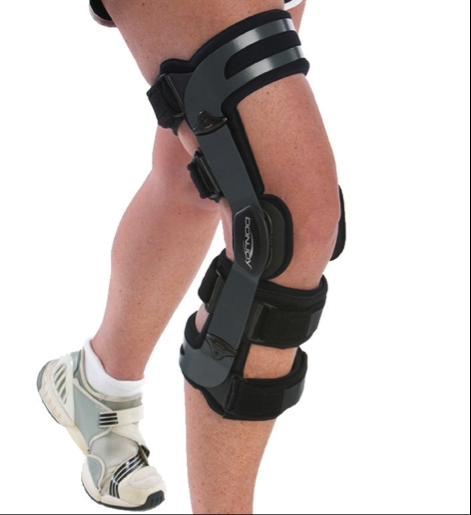
- Crutches may be required in grade-II and grade-III injuries until the athlete feels comfortable walking with a hinged knee brace in situ (see figure 1).
- Use of electrical muscle stimulation (EMS) in the atrophy mode is recommended, with exercises such as straight leg raise and inner range quads or protected weight bearing squats, if EMS is available. This will maintain quadriceps bulk whilst the athlete is recovering in a protected range knee splint.
- Knee bracing
- Grade-I injuries: Hinged knee bracing (see figure 1) is usually unnecessary; however the clinician may decide to brace the knee in 15 to 100-degree range for the first 3-4 days purely for comfort and protection.
- Grade I+ injuries with slight medial knee joint gapping:
- Brace at 30-90 degree for the first 5-7 days.
- 15-100 degrees for the next 5-7 days.
- Overall, the patient may be braced for 10-14 days.
- At day 5, the clinician assesses the end feel of the valgus stress test and if it has improved, the brace may be opened up to 15 to 100 degrees at day 5. If it still has similar residual laxity then it is left at the chosen angle until day 7.
- Grade-II injuries:
- 30 to 90 degrees for 10-14 days.
- 15 to 100 degrees for 10-14 days.
- Fully opened after 14 days.
- Brace removed after a maximum of 4 weeks.
- Grade-III injuries.
- 30 to 90 degrees for 15-28 days.
- 15 to 100 degrees for 15-42 days.
- Fully opened after this stage.
- Brace removed after a maximum of 8 weeks.
- In the knee brace, quads activation and gentle adduction exercises with a Theraband may commence early. With adduction exercises, light-load valgus force on the knee can increase collagen deposition in the MCL in the early rehabilitation stage.
Figure 1: Hinged knee brace.
- Strengthening exercises
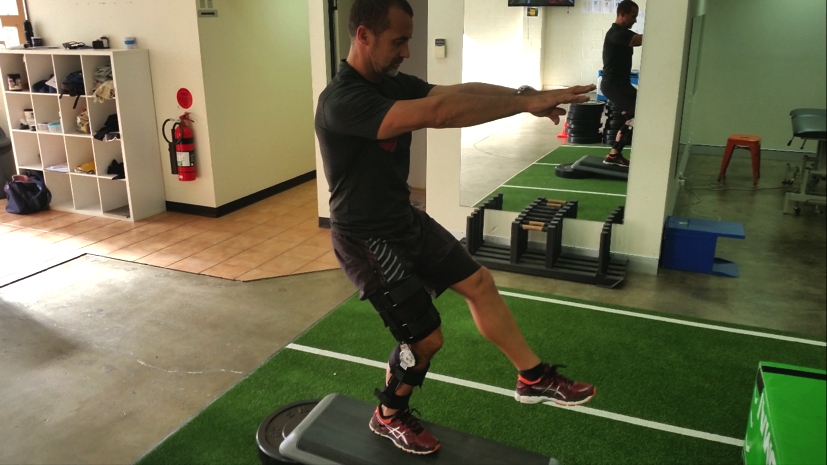
- With the hinged brace in situ, the athlete can be progressed safely through leg press (see figure 2), single-leg squat (see figure 3), leg extension, split squat and single-leg Romanian deadlifts early in the rehabilitation process. The range is limited by the brace. This can start as early as the athlete feels comfortable with the pain.
- Calf and ankle strengthening exercises can be unlimited.
- Unlimited core exercises can be performed with the brace in situ.
- When the brace is removed, generally deep knee flexion movements (such as deep squat) should be avoided until return to competition, as the knee may experience a valgus force in deep squat positions.
- It is appropriate in the early stages to incorporate occlusion training and muscle stimulation to facilitate type-2 muscle fiber hypertrophy (see issue I57 of Sports Injury Bulletin for a detailed description of occlusion training).
- Specific knee-strength exercises incorporating slight valgus forces can be incorporated with slide boards, Swiss ball kicks and (in the late stages) side planks, with the affected limb supported on an elevation.
Figure 2: Single leg press with a brace on
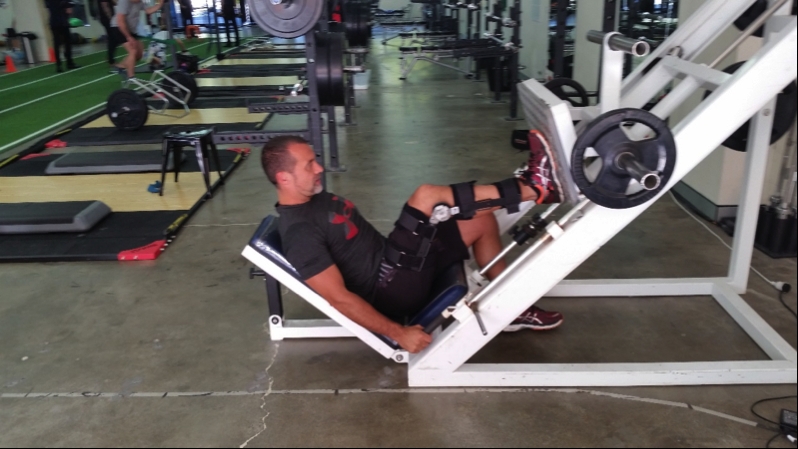
Figure 3: Quadricep dominant single leg squat on slant board
- Balance and proprioception
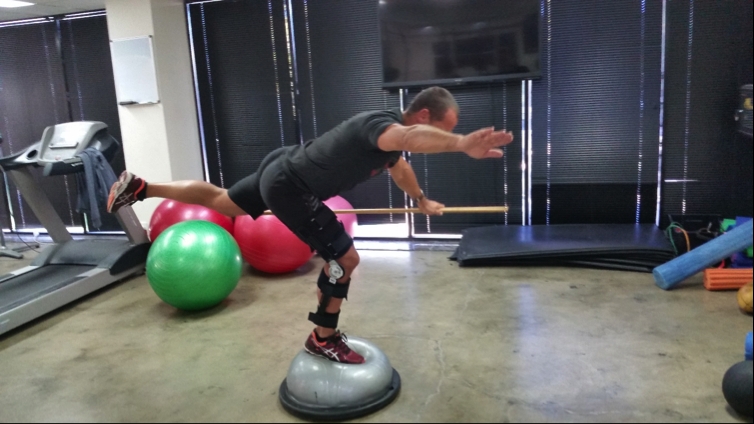
- In brace, single-leg balance exercises can be started early on balance/wobble/rocker boards. This can be progressed to more challenging movements such as an ‘Arabesque’ on a BOSU ball (see figure 4).
- In brace, gentle jumps and lands may be performed off boxes 6 to 12 inches in height.
- When the brace is removed, higher level proprioception on trampolines and in sandpits may commence.
Figure 4: High-level proprioception drill ‘Arabesque’ on BOSU ball
- CV exercise
- Maintain upper body fitness with upper limb ergometer, seated boxing, swimming (no kicking) in the early braced stage.
- In the second brace stage (as the brace is opened up to 100 degrees), the knee will have enough motion to perform stationary bike and stair climber training.
- Straight-line running may commence immediately after brace removal. It is generally preferred that this is performed with the knee protectively strapped. The typical progression in running is:
- A straight line 10 x 50m. Build speed as able. Build over a few sessions to get to full speed.
- ‘S’ runs in a 5m x 60m rectangle. Build to 6 repeats of 60m with comfortable speed, and eventually attempting full speed when able.
- Side shuffles over 5m with forwards acceleration/deceleration over 10m. These are added together in a forward direction to resemble a zigzag motion over 60m.
- Hard stepping and cutting with no opposition.
- Hard cutting and pivoting drills in pressure situations with opposition.
Return-to-sport guidelines
The decision to return to sport following an injury to the MCL is determined by the sport played and meeting the exit criteria suggested below. This decision may be made with the athlete wearing protective strapping - assuming they intend to compete with the strapping in place. These guidelines are:- May return to competition if the athlete has minimal pain, close to full range of motion, and 90 percent of normal strength.
- Crossover hop test score reaches 90% of the unaffected side (see Sports Injury Bulletin issue 141).
- Athlete feels confident in skills and change of directions.
- Continue to use brace/strapping for all sports participation for the remainder of the season.
As mentioned above, in certain sports and in certain positions in those sports, the decision may be made to risk the knee if the athlete does not encounter significant change of direction forces on the knee. For example, a front row forward in Rugby Union may have little need to perform hard changes of direction in a game, as this position does not require this as much as would be needed in a more mobile position such as center or winger.
Conclusion
Injuries to the medial collateral ligament (MCL) are a common injury in sports that require aggressive change of direction and cutting actions, and in contact sports where valgus forces to the knee are often encountered. The majority of these injuries are managed conservatively with aggressive rehabilitation, using a motion limiting brace in place until ligament healing has occurred. This article outlines in detail the key features that need to be factored in when rehabilitating the athlete back to full function following this injury.References
- Am J Sports Med 1981;9:365-368
- Clin Orthop Relat Res. 1990;256:174-7
- J Am Acad Orthop Surg. 2009; 17(3); 152-161
- J Bone Joint Surg Am. 1974; 56:1185-90
- Arch Orthop Trauma Surg. 1988; 107:273-6
- J Bone Joint Surg Am. 1983;65:323-9
- Orthop Rev. 1989;18:947-52
- Knee Surg Sports Traumatol Arthrosc. 1993;1:93-6
- Am J Sports Med. 1994;22:470-7
- Sports Med 1996;21(2):147-56
- Am J Sports Med. 1995;23:380-9
- Clin Orthop Relat Res. 1988;226:103-12
- Am J Sports Med. 1983; 11:340-4
- Am J Sports Med. 1996;24: 160-3
- Iowa Orthop J. 2006;26:77-90
- Sports Med Arthrosc. 2006; 14:12-9
- Prim Care. 2004;31:957-75, ix
- Clin Orthop 1978;132:206-18
- Orthopedics 2004;27(4):389-93
- Am J Sports Med 2003;31(2):261-7
- Sports Med. 1999;28:383–8
Latest Issue

Subscribe Today
Newsletter Sign Up
Subscriber Testimonials
Dr. Alexandra Fandetti-Robin, Back & Body Chiropractic
Elspeth Cowell MSCh DpodM SRCh HCPC reg
William Hunter, Nuffield Health
Subscribe Today

Newsletter Sign Up
Coaches Testimonials
Dr. Alexandra Fandetti-Robin, Back & Body Chiropractic
Elspeth Cowell MSCh DpodM SRCh HCPC reg
William Hunter, Nuffield Health
Subscribe Today
Latest Issue
Be at the leading edge of sports injury management
Our international team of qualified experts (see above) spend hours poring over scores of technical journals and medical papers that even the most interested professionals don't have time to read.
For 17 years, we've helped hard-working physiotherapists and sports professionals like you, overwhelmed by the vast amount of new research, bring science to their treatment. Sports Injury Bulletin is the ideal resource for practitioners too busy to cull through all the monthly journals to find meaningful and applicable studies.
*includes 3 coaching manuals
Get Inspired
All the latest techniques and approaches


Sports Injury Bulletin brings together a worldwide panel of experts – including physiotherapists, doctors, researchers and sports scientists. Together we deliver everything you need to help your clients avoid – or recover as quickly as possible from – injuries.
We strip away the scientific jargon and deliver you easy-to-follow training exercises, nutrition tips, psychological strategies and recovery programmes and exercises in plain English.
