
 close
close


 LOGIN
LOGINSacral Stress Fracture in Runners: A Sneaky Cause of Low Back Pain?
Patrick Gillham investigates the cause of stress fractures in runners, focusing on sacral stress fractures, which are less common and trickier to diagnose and treat.


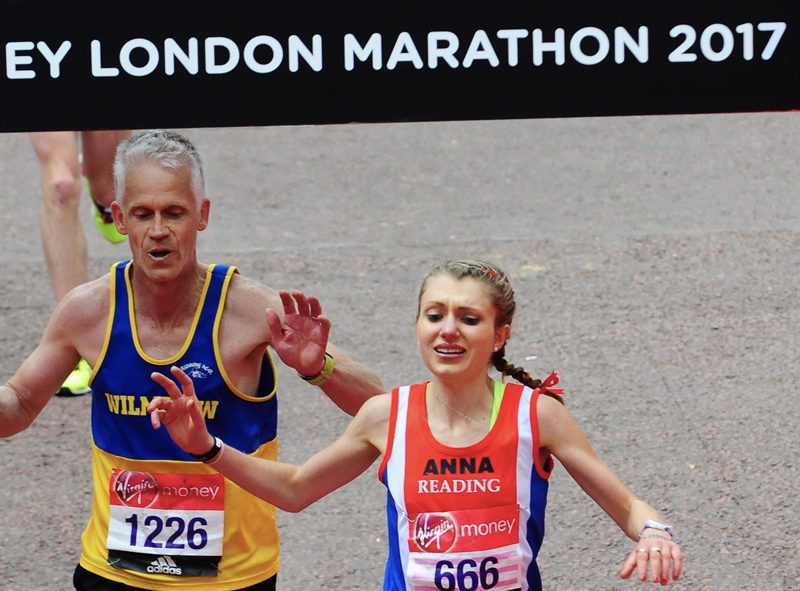
Stress fractures occur in a broad spectrum of athletes. Runners, however, are particularly at risk with stress fractures accounting for 15-20% of all musculoskeletal-related injuries(1, 2). In runners, 95% of stress fractures occur in the lower extremities (see Table 1)(2). The most common site is the tibia (16-49.1%), which is also most common for male runners. Female runners meanwhile have the highest proportion of foot and ankle fractures(3).
| Site | Stress fracture (%) | Predominant sporting associations |
|---|---|---|
| Metatarsals | 8-24.6 |
|
| Tarsals | 7-25.3 |
|
| Tibia | 16-49.1 |
|
| Fibula | 1.3-12.1 |
|
| Femur | 4.2-48 |
|
| Pelvis | 1.3-5.6 |
|
Risk factors associated with stress fractures
The cause of stress fractures can be multifactorial. The consensus in the literature is that there are commonly extrinsic and intrinsic risk factors for runners. Examples include(1-4):
- Extrinsic factors – a change in training regimen; a change in nutrition or eating habits; a change in footwear; alterations in running technique; a change in running terrain.
- Intrinsic factors – gender; race; a previous history of stress fractures; bone mineral density; menstrual characteristic for women; smoking; general conditioning/ health.
There is controversy within the literature however as to whether there is sufficient evidence to properly validate the majority of these risk factors(1,2). Instead, the two most reliable factors to consider with runners who are at risk are those with a previous history of stress fractures and females. Female runners appear to be 2.3 times more at risk of stress fractures compared to their male counterparts(1). Conflicting findings may link this to the traditional ‘female athlete triad’ paradigm or the issue of ‘relative energy deficit in sports (RED-S – see this link)’(1). There are also associations with later age of menarche (≥15years) and current amenorrhoea, which increases the risk of stress fractures by five times and nearly three times respectively(5).
Types of stress fracture and their physiological cause
There are commonly two types of stress fracture: insufficiency and fatigue fractures(2-4, 6, 7):
- Insufficiency – when normal muscular stress is applied to the bone that is deficient in mineral content or elastic resistance. There are often predisposing factors, such as osteoporosis, metabolic disorders, prolonged corticosteroid use, or Paget’s disease.
- Fatigue – caused by abnormal muscular stress or mechanical torque to a bone that has normal elasticity and mineral content. Commonly reported in athletes and account for 5-6% of overuse injuries.
Existing theories regarding the physiological cause of stress fractures are based on Wolff’s law(4). In this instance, the repeated stress placed on the skeletal structure does not allow enough time for appropriate remodeling; therefore the proposed adaption, according to mechanotransduction, doesn’t occur(4, 8). Hence the stress fracture.
Why the sacrum?
Sacral stress fractures are uncommon and can be tricky to diagnose, but they don’t want to be missed! They account for 1.3-5.6% of all stress fractures in athletes, particularly in runners(3). They have also been reported in hockey players, basketball players, tennis players, and volleyball players(3, 9).
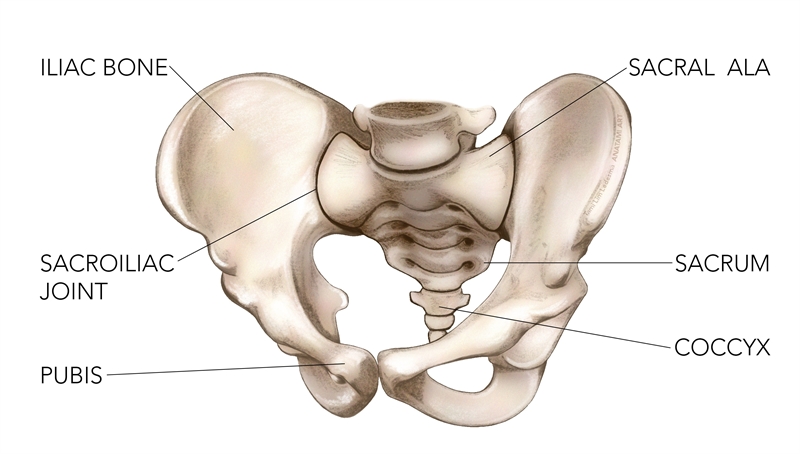
Anatomically, the sacrum is a triangular-wedge shaped structure which absorbs axial forces from the spine and transmits them laterally through the pelvic girdle via the sacroiliac joints (SIJ – see Figure 1)(7). Sacral stress fractures usually occur vertically, parallel to the SIJ and in line with the lateral margins on the lumbar spine. They are diagnosed using the Denis classification system (see Figure 2)(6, 7).
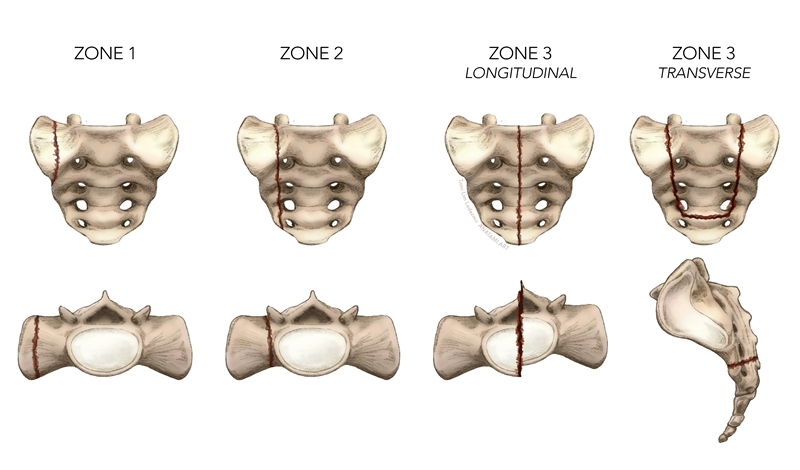
Zone 1 (most common) - Involves the sacral wings or ala without extension to the foramina or central sacral canal. Can affect the lumbosacral nerve roots.
Zone 2 - Involves the sacral foramina but no impingement on the central sacral canal.
Zone 3 - Involves the central sacral canal. Often presents with saddle anesthesia and loss of sphincter tone. High incidence of cauda equina. Not to be missed!
What is the best way to diagnose?
Diagnosis can be challenging due to difficulty differentiating pathologies with common symptoms. Similarly, published case reports of sacral stress fracture describe a wide range of symptoms(2, 4, 9). The most common, however, are as follows:
- Diffuse pain located at the sacrum, lower back, or pelvis/ buttock area
- Posterior hip and buttock pain in unilateral cases
- Localized tenderness on palpation
- Antalgic gait
- Normal ROM of hip
- Normal lumbar spine ROM
- More pronounced with training, and may prevent running
- Relieved by rest and then returns with impact
- Night pain
- Radiculopathy
As well as a detailed patient history, special tests that may also help the diagnosis include:
- Single leg hop test (2, 10)
- Flexion-abduction and external rotation (FABER) test (6, 10)
- Gaenslen’s test(6)
- SIJ distraction and compression tests(6)
Imaging is useful in conjunction with patient history and physical examination. MRI for stress fractures is currently the gold standard, largely due to the ability to display soft tissue and bone edema. Radiographs lack the ability to determine acute stress fractures since it may take three weeks for cortical irregularities and periosteal reactions to become evident(2). Computer tomography (CT) scanning is useful in diagnosis but lack the sensitivity of MRI to provide a concurrent evaluation of soft tissue(2). Bone scans (scintigraphy) are highly sensitive; however, the incur undesirable radiation exposure.
Sacral fracture treatment
Once a firm diagnosis has been established, load modification should be the initial intervention(2, 9, 10). This may entail simply ceasing running. However, it may also mean more drastic off-loading with the use of crutches, if pain continues with weight bearing.
Sacral stress fractures can take 7-12 weeks to allow sufficient healing(2, 10). This process is vital to prevent non- or delayed-union, which is the only time when surgical intervention is necessary(2). Anti-inflammatory medication should be avoided as it is associated with non-union due to the impact on prostaglandin (E2 specifically) activity during the initial stages of healing(2, 6).
Minimal-impact cardiovascular exercise should be initiated to maintain cardiovascular conditioning, such as cycling, pool running, antigravity treadmill running, and swimming(2, 9-11). These should be guided by symptoms and can help promote the ideology of ‘mechanotherapy’ where relative load accelerates healing(8).
Although research is limited, it seems logical to consider a biomechanical cause of sacral stress fractures. There are suggestions that treatment should include rehabilitation, targeting trunk, and pelvic girdle stability, muscle endurance training, balance/ proprioception training, flexibility, and gait retraining (2, 9, 10). However, specific examples are not given.
Therapeutic exercises
The following exercises target common areas (trunk, pelvis, hip, knee, and ankle positional control as well as load), and are therefore useful to consider when rehabilitating a runner back to impact tolerance. They should be completed 3-4 times per week:
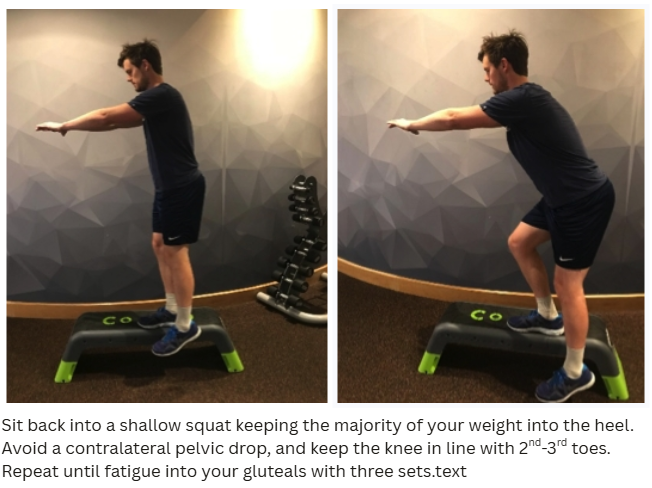
- Single-leg squat off a box (Figure 3)
- Split squat with or without step (Figure 4)
- Single-leg soleus heel raise (Figure 5)
- Cable pallof press (Figure 6)
- Bird dog with resistance band (Figure 7)
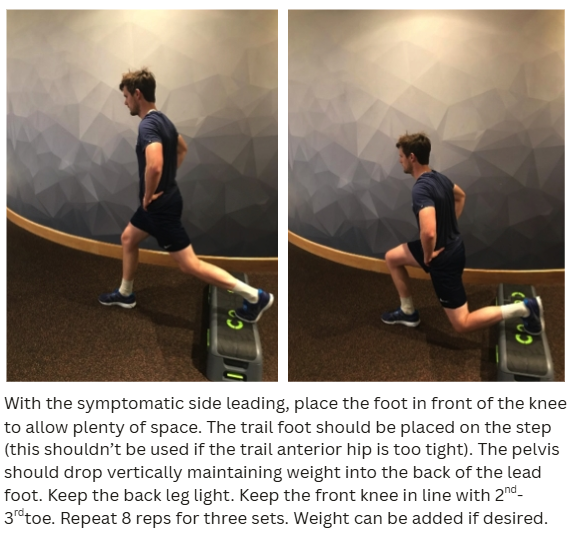
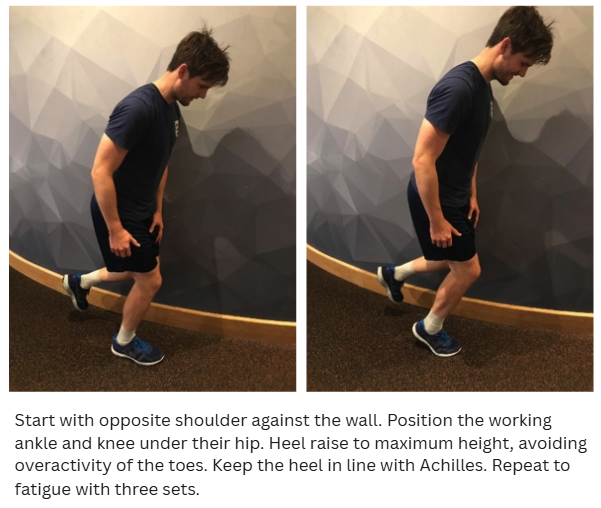
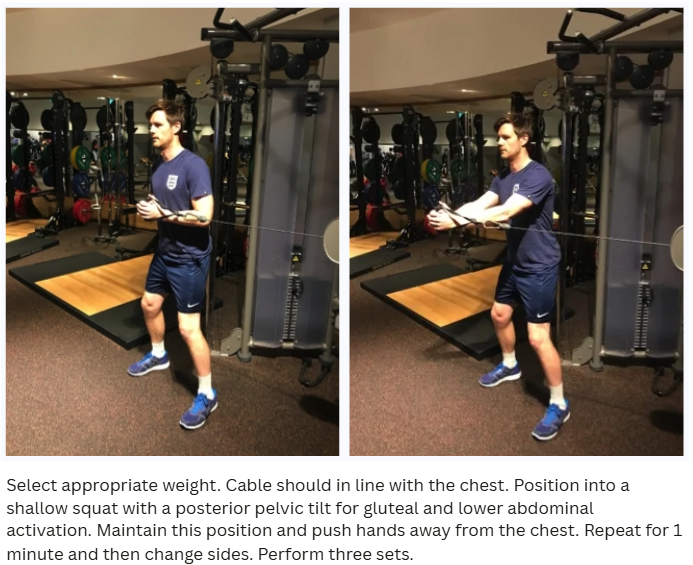
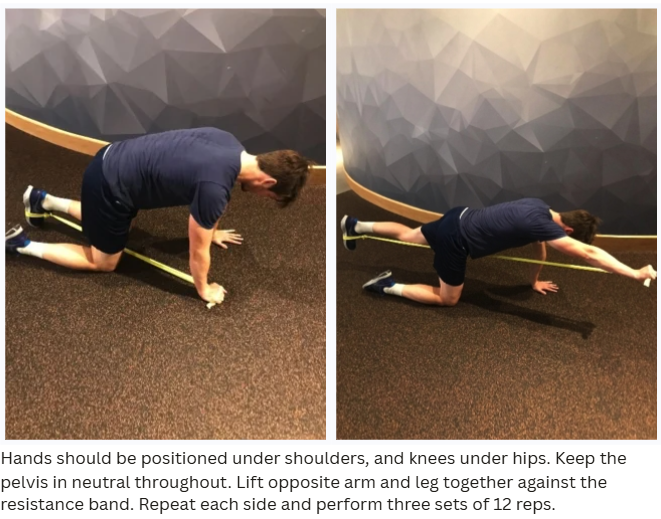
Given the healing time frames mentioned above, the progression of returning to running should be gradual and guided by pain provocation. A walk-to-run (4mins:1mins) program should be instilled initially, or progressive tolerance to load using an Anti-gravity treadmill. Once continual running is tolerated, mileage and intensity should increase by no more than 10% per week(2). Re-imaging is not necessary unless pain exceeds expected time-frames. Any concerns regarding intrinsic and extrinsic risk factors should be tackled for future prevention.
References
- Wright, A.A et al. Br J Sports Med 2015; 49:1517-1523
- Kahanov, L. et al. J Sports Med 2015; 6: 87-95
- Liong, S.Y. & Whitehouse, R.W. Br J of Radiology 2012, 85: 1148-1156
- Boissonnault, W.G. & Thein-Nissenbaum, J.M. J Orthop Sports Phys Ther 2002, 32(12): 613-621
- Tenforde, A.S. et al. Med Sci Sports Exerc 2013; 45: 1843-51
- Longhino, V. et al. Clin Cases Mineral Bone Metabolism 2011; 8)3):19-23
- Zaman, F.M. et al. Curr Sports Med Reports 2006; 5(1): 37-43
- Kahn, K. M. & Scott, A. Br J Sports Med 2009; 43: 247-251
- Liimatainen E. et al. J Research Sports Med 2016; 1(1): 20-26
- Harris, C.E. et al. Curr Sports Med Reports 2016; 73
- Tenforde, A.S. et al. J Injury Function Rehab 2012; 4(8): 629-31

Latest Issue

Subscribe Today
Newsletter Sign Up
Subscriber Testimonials
Dr. Alexandra Fandetti-Robin, Back & Body Chiropractic
Elspeth Cowell MSCh DpodM SRCh HCPC reg
William Hunter, Nuffield Health
Subscribe Today

Newsletter Sign Up




Coaches Testimonials
Dr. Alexandra Fandetti-Robin, Back & Body Chiropractic
Elspeth Cowell MSCh DpodM SRCh HCPC reg
William Hunter, Nuffield Health
Subscribe Today
Latest Issue

Be at the leading edge of sports injury management
Our international team of qualified experts (see above) spend hours poring over scores of technical journals and medical papers that even the most interested professionals don't have time to read.
For 17 years, we've helped hard-working physiotherapists and sports professionals like you, overwhelmed by the vast amount of new research, bring science to their treatment. Sports Injury Bulletin is the ideal resource for practitioners too busy to cull through all the monthly journals to find meaningful and applicable studies.
*includes 3 coaching manuals
Get Inspired
All the latest techniques and approaches


Sports Injury Bulletin brings together a worldwide panel of experts – including physiotherapists, doctors, researchers and sports scientists. Together we deliver everything you need to help your clients avoid – or recover as quickly as possible from – injuries.
We strip away the scientific jargon and deliver you easy-to-follow training exercises, nutrition tips, psychological strategies and recovery programmes and exercises in plain English.
