
 close


 LOGIN
Beyond the Plank: Assessing Lumbopelvic Stability in Young Athletes
The McGill core endurance tests are quick, cheap, and reliable, which explains their popularity. Yet hold times alone predict injury poorly, and in growing athletes the numbers shift with maturation and body size. Eurico Marques reinterprets the evidence and builds a tiered lumbopelvic testing battery that tracks performance and guides return to play after injury.


Chelsea’s Maxence Lacroix attempts to clear the ball as Mike Penders scores an own goal, Tottenham Hotspur’s first, at Stamford Bridge, London, October 24, 2026. Credit: REUTERS/Isabel Infantes
Ask a room of physiotherapists how they assess ’core stability’ in a 14-year-old footballer, and most will describe some version of a plank. The appeal is obvious. The tests need no equipment, take under 10 minutes, and produce a number that athletes, parents, and coaches understand. Researchers at George Mason University in Virginia used this approach, applying McGill’s four-test endurance battery alongside hip strength and Star Excursion Balance Test (SEBT) scores in 40 female collegiate lacrosse and soccer players(1).
Their findings deserve more attention than they received. Hip strength, not trunk endurance, predicted dynamic balance, and the only meaningful link between trunk and hip came from extensor endurance correlating with hip extensor strength(1). The score spread was also striking: trunk flexor hold times averaged 57 seconds, with a standard deviation of almost 38 seconds. In other words, ’normal’ covered almost everything. For practitioners working with younger athletes, that raises a fundamental question: what exactly do these tests demonstrate, and when should practitioners trust them?
What the McGill Battery Actually Measures
The battery comprises four isometric holds: the trunk flexor test (a 60-degree supported sit-up position held after the backrest moves away), the left and right side bridges, and the Biering-Sørensen extensor test (see figure 1). Researchers at the University of Waterloo in Canada established the original normative database and argued that the relationships between tests matter more than any single time(2). McGill later turned these normative ratios into the guidelines many clinicians still use: right and left side bridge times should be within about 5% of each other, flexor time should not exceed extensor time, and side bridge time should not exceed roughly 75% of extensor time(2).
“The plank still has a place…”
This ratio approach is the battery’s real strength. A single hold time blends motivation, pain tolerance, body size, and muscle endurance. A ratio partially cancels those factors and highlights imbalances between trunk muscle groups, which matter more clinically than a raw number. The battery remains, however, a measure of static, low-load endurance. It does not show how well an athlete controls trunk position during change of direction, a landing or a tackle.
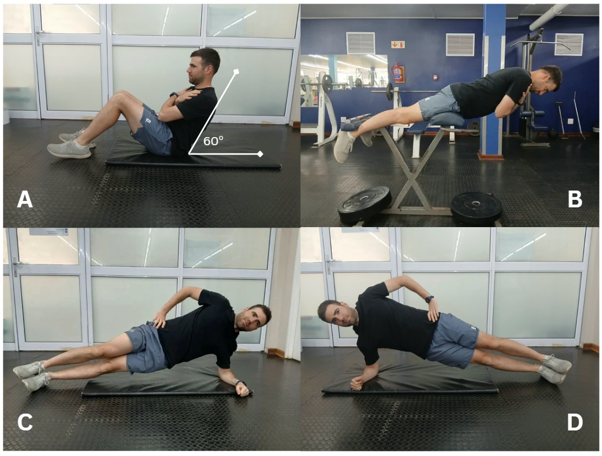
(A) anterior trunk flexor test positions; (B) Biering-Sørensen trunk extensor test; (C, D) left and right side bridge
Standardizing the McGill Battery for Young Athletes
• Test in a fixed order (flexor, right side bridge, left side bridge, extensor).
• Allow adequate rest between efforts.
• Use identical verbal cues and stop criteria every time: the trial ends when the athlete loses the test position, e.g., the hips drop in the side bridge or the trunk falls below horizontal in the extensor test.
• Record height and body mass on the day of testing.
• Note why each test stopped – fatigue, pain, loss of form, or loss of focus.
Growth Changes the Numbers
Young athletes are not small adults, and their trunk endurance profiles prove it. Scientists in Serbia and Canada tested 753 children aged seven to 14 and found that endurance times rose steadily with age; back extensor holds in boys climbed from around 111 seconds at age seven to 181 seconds at 14(3). However, lateral endurance relative to extensor endurance dipped at ages 11 and 12 before recovering, and at age 12 girls’ side bridge times fell to just 30–32% of their extensor times(3). Girls also outperformed boys on sagittal-plane tests, while boys held side bridges longer.
“…stop asking it to predict the future...”
The timing of that lateral dip coincides with peak height velocity (PHV), when limbs lengthen quickly and the trunk’s lever arms change. A 2025 New Zealand review found that ’adolescent awkwardness’ remains poorly defined: some studies show a dip in sensorimotor function during the growth spurt, while others show steady improvement or wide individual variation(4). Body size compounds the issue. Researchers in Spain found that heavier, broader-framed athletes held the side bridge for less time, and recommend adjusting normative values for body size(5).
The practical implication is significant. Adult ratio thresholds applied to a 12-year-old in the middle of a growth spurt may flag a ’deficit’ that simply reflects normal development. Comparing an athlete with age- and sex-specific percentiles, and above all with their own previous scores, gives a far more honest picture. The same Spanish study found that the Biering-Sørensen and side bridge tests need extensive familiarization and carry a typical error of 12–24%, so athletes should practice the tests first, and clinicians should treat only changes larger than about 20% as real(5).
Endurance is Not the Same as Control
The case for trunk testing rests largely on injury prevention, and here the evidence needs careful reading. Researchers at Yale University measured trunk displacement after a sudden release of force in 277 collegiate athletes and found that poor trunk control predicted subsequent knee injury, particularly ligament injury in women(6). That study measured dynamic, reactive control, not endurance.
When researchers have measured endurance, the results look less convincing. Scientists at Ghent University in Belgium followed 139 physical education students for 18 months and found that poor abdominal endurance, along with side-to-side asymmetry in dynamic balance and a low hip extension-to-flexion strength ratio, increased the risk of lower limb overuse injury(7). Yet even combined, the tests predicted injury with only 53% accuracy. In US collegiate track-and-field and cross-country athletes, prone and side plank times showed no association with overuse injury(8). An Australian-led systematic review later concluded that the evidence offers only limited support for trunk and hip deficits as risk factors for knee injury(9).
These findings do not render the tests useless; they define their job. Static endurance tests describe capacity and imbalance. They should not serve as stand-alone screening tools for predicting who will get injured – a role no single musculoskeletal test has convincingly filled.
A Proxy for Performance?
The relationship between trunk capacity and athletic performance follows a similar pattern. A meta-analysis from the University of Potsdam in Germany found only small associations between trunk muscle strength and physical fitness or athletic performance in trained individuals(10). However, trunk training appears to transfer better than testing would suggest. A 2022 Norwegian-led meta-analysis reported moderate effects of trunk training on sprint speed, change-of-direction speed, and sport-specific performance, with children showing large gains in change-of-direction ability(11).
For young athletes, this suggests that trunk endurance scores work best as a training-response marker rather than a predictor of performance or talent. If an athlete’s side bridge symmetry improves alongside their agility times, the program is probably working. If endurance scores climb but movement quality during cutting stays the same, the training has not transferred.
“Young athletes are not small adults…”
Building a Tiered Battery
The evidence points toward a layered approach that combines static capacity, dynamic control, and sport-related performance (see table 1). Each tier answers a different clinical question, and no tier is sufficient on its own. Clinicians can run the first two tiers in about 20 minutes with a stopwatch and a phone camera. Repeating the battery every three to four months, or more often during a rapid growth phase, alongside height measurements, turns a one-off screen into a monitoring tool.
Table 1: A tiered lumbopelvic assessment battery for young athletes
| Tier | Tests | What it tells you | Interpretation tips |
| 1. Static capacity | McGill flexor test, left and right side bridge, Biering-Sørensen test; prone bridge | Trunk muscle endurance and balance between muscle groups | Use ratios and the athlete’s own baseline; compare with age- and sex-specific percentiles; record height and body mass |
| 2. Dynamic control | Single-leg squat, lateral step-down, drop vertical jump, cutting task (filmed front and side) | Trunk and pelvic position under load | Look for lateral trunk lean, pelvic drop, and excessive trunk flexion; allow pre-adolescents more trials |
| 3. Performance transfer | Single-leg hop, Y-balance test or SEBT, change-of-direction test | Whether capacity and control show up in athletic tasks | Track limb symmetry and change over time; interpret alongside growth status |
Using the Battery After Injury
Many youth return to sport protocols, including some for adolescent spondylolysis, still rely on ’good core stability’ as judged by the clinician rather than any objective benchmark. Researchers in Ireland found excellent intra-tester reliability for the McGill endurance tests in Gaelic games athletes with and without low back pain, and the Biering-Sørensen test discriminated between the two groups(12). The pilot study included only nine athletes, but extensor endurance looks like a sensible marker for athletes returning from back pain.
After lower limb injury, dynamic trunk control becomes the priority. A US clinical framework for youth athletes after anterior cruciate ligament reconstruction recommends observing lateral trunk lean and excessive trunk flexion or extension during single-leg tasks, trunk lean during cutting, and strength and hop testing(13). The authors also note that pre-adolescent athletes need more trials because their movement varies more from rep to rep(13). Practical benchmarks drawn from this evidence can guide progression and return to play (see table 2).
Table 2: Suggested lumbopelvic benchmarks for return to play in young athletes
| Criterion | Target | Rationale |
| Side bridge symmetry | Right and left within 5–10% | Flags lateral imbalance; allows the wider margin around PHV |
| Flexor-to-extensor ratio | Below 1.0 | Extensors should outlast flexors |
| Extensor endurance (after back pain) | Back to pre-injury baseline, or at least the 50th percentile for age and sex | The Biering-Sørensen test discriminates athletes with back pain |
| Dynamic trunk control | No visible lateral trunk lean or pelvic drop on single-leg squat and cutting | Trunk control influences knee loading |
| Symptom response | Pain-free during testing and for 24 hours after | Endurance holds load the lumbar spine |
Note: these targets are clinical guidelines drawn from the cited evidence, not validated cut-offs.
The Take-home Message
Lumbopelvic testing in young athletes works best when clinicians stop asking it to predict the future and start using it to track change. First, establish a pre-season baseline on all three tiers, recording height and body mass so that scores can be read against growth. Second, judge McGill results by ratios and by the athlete’s own history rather than adult norms, and expect lateral endurance to wobble around the growth spurt. Third, after injury, replace ’good core stability’ with explicit, measurable criteria: symmetry, ratios, return to baseline and observable trunk control during sport-specific tasks.
Used this way, a stopwatch and a phone camera become a credible proxy for performance and a defensible guide to return to play. The plank still has a place; it just should not be the whole assessment.
References
1. Int J Sports Phys Ther. 2014 Oct;9(5):604-616.
2. Arch Phys Med Rehabil. 1999 Aug;80(8):941-944.
3. Arch Phys Med Rehabil. 2012 Dec;93(12):2295-2301.
4. Int J Sports Sci Coach. 2025 Oct;20(5):2257-2267.
5. PLoS One. 2025 Jun;20(6):e0324787.
6. Am J Sports Med. 2007 Jul;35(7):1123-1130.
7. Am J Sports Med. 2019 Jun;47(7):1713-1721.
8. Sports (Basel). 2022 Mar;10(3):45.
9. J Orthop Sports Phys Ther. 2020 Sep;50(9):476-489.
10. Sports Med. 2016 Mar;46(3):401-419.
11. Sports Med. 2022 Jul;52(7):1599-1622.
12. Physiother Pract Res. 2026 Feb;47(1):75-85.
13. Int J Sports Phys Ther. 2026;21(10):1017-1033.


Latest Issue
Subscribe Today
Newsletter Sign Up
Subscriber Testimonials
Dr. Alexandra Fandetti-Robin, Back & Body Chiropractic
Elspeth Cowell MSCh DpodM SRCh HCPC reg
William Hunter, Nuffield Health
Subscribe Today
Newsletter Sign Up
Coaches Testimonials
Dr. Alexandra Fandetti-Robin, Back & Body Chiropractic
Elspeth Cowell MSCh DpodM SRCh HCPC reg
William Hunter, Nuffield Health
Subscribe Today
Latest Issue

Be at the leading edge of sports injury management
Our international team of qualified experts (see above) spend hours poring over scores of technical journals and medical papers that even the most interested professionals don't have time to read.
For 17 years, we've helped hard-working physiotherapists and sports professionals like you, overwhelmed by the vast amount of new research, bring science to their treatment. Sports Injury Bulletin is the ideal resource for practitioners too busy to cull through all the monthly journals to find meaningful and applicable studies.
*includes 3 coaching manuals
Get Inspired
All the latest techniques and approaches


Sports Injury Bulletin brings together a worldwide panel of experts – including physiotherapists, doctors, researchers and sports scientists. Together we deliver everything you need to help your clients avoid – or recover as quickly as possible from – injuries.
We strip away the scientific jargon and deliver you easy-to-follow training exercises, nutrition tips, psychological strategies and recovery programmes and exercises in plain English.
