
 close


 LOGIN
Strength and Conditioning for Female Fast Bowlers
Female fast bowlers are match winners, yet players are still physically prepared on models built for male fast bowlers. The female-specific evidence has now arrived, and it points to a distinct set of physical characteristics. Jolandi Jacobs highlights the evidence and sets out the big rocks for strength and conditioning for female fast bowlers.
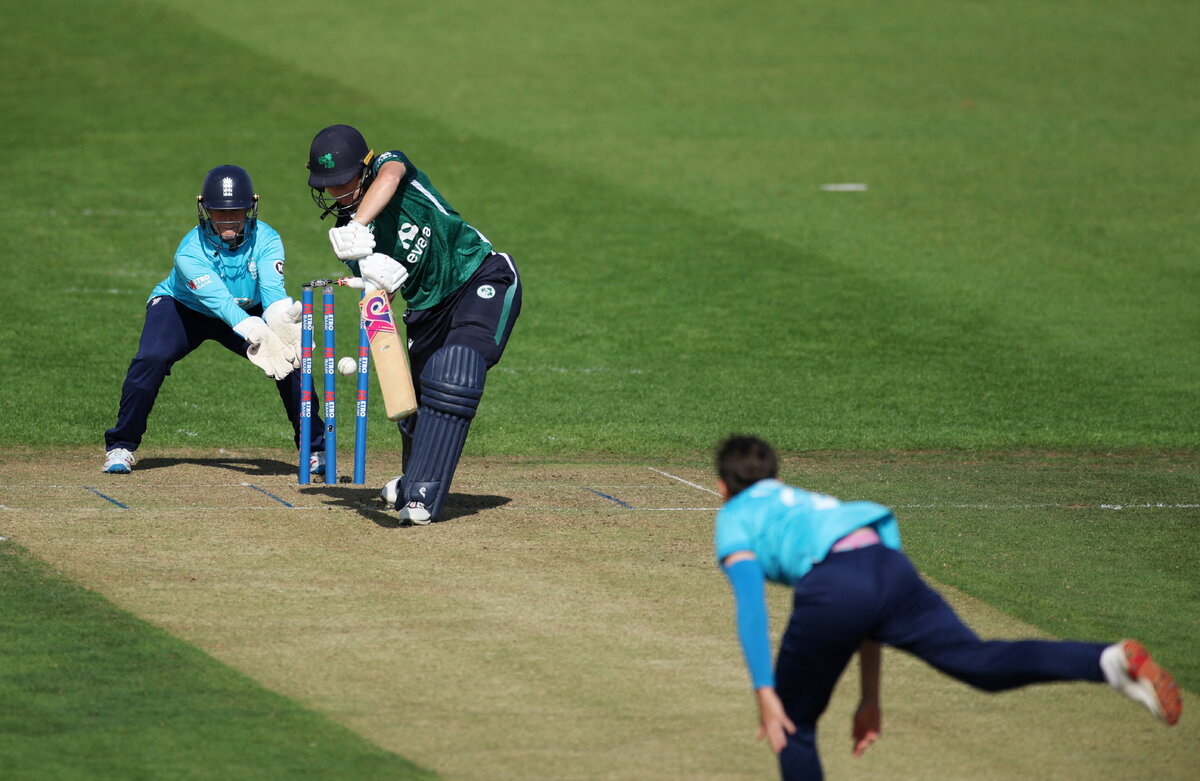
Ireland’s Arlene Kelly in action bowling. Action Images via Reuters/Andrew Boyers.
Unique Female Bowling Biomechanical Model
Women’s cricket professionalized faster than the science needed to support players adequately. A scoping review published in 2025 found 179 studies investigating applied sports science and medicine in female cricket players, of which 60 addressed physical performance(1). That is a thin base on which to prepare an athlete for the most physically demanding role in the game.
Fast bowling drives a team’s success, restricting runs and taking wickets. Fast bowlers deliver the ball at high speeds through a sequence of multi-segmental movements(2). Elite female fast bowlers can achieve average ball release speeds of approximately 100 to 105 km/h(3-5). Swing and seam bowling add to the batter’s problem, but pace is the physical quality that athletes have to build and then maintain through the season.
Fast bowling requires the bowler to transfer force generated during the run-up through the lower limbs, across the trunk, and out to the upper limb, while maintaining ball release accuracy and pace(2,3). Front foot contact is where that momentum transfer happens. In 15 elite Australian female fast bowlers, the mean peak vertical ground reaction force reached 3.49 kN and the mean peak horizontal braking force 2.13 kN(6). The shoulder also absorbs substantial distraction force through the delivery stride, which highlights the need for upper limb strength, control and endurance(7).
Generating Speed
The biomechanical demand at the crease is to convert horizontal momentum into angular momentum under control (see table 1). Female bowlers generate ball release speed from whole-body angular momentum, rotating the pelvis and torso about the longitudinal axis(3,5). Faster female fast bowlers hold a more side-on pelvis at back foot contact and a more upright trunk, with less lateral trunk flexion at front foot contact(8). Because a large share of a female bowler’s ball speed comes from rotating the pelvis and trunk against a braced front leg, rotational strength and power belong among the main building blocks of the program.
Physical Demands
Female fast bowlers benefit from progressive, role-specific development, with strength and performance capacities improving alongside age, maturation and training exposure(9). Younger fast bowlers, averaging 18 years, produce lower isometric mid-thigh pull (IMTP) and one-repetition maximum (1RM) bench-pull values than older players, but can make meaningful in-season strength gains. Across seven seasons of contracted Australian pace bowlers, females improved bench pull by 35% between the ages of 18 and 30, against 19% in men, while repeated-sprint performance changed far less over the same period(9).
Table 1: Bowling demand and the physical quality it requires
| Bowling demand | Physical quality | Significance | Exercise suggestion |
| Front-foot braking and vertical forces | Lower limb maximal and eccentric strength | Supports force absorption and redirection | Split squat, squat, step-up; hinge, Romanian deadlift |
| Force transfer through pelvis and trunk | Trunk and rotational capacity | Transfers force while controlling spinal motion | Anti-extension, anti-lateral-flexion and rotational work |
| High velocity upper limb action | Shoulder strength and upper limb control | Builds tolerance to repeated shoulder loading | Rows, press, rotator cuff strength and control |
| Run-up speed | Acceleration and high-speed running capacity | Supports speed into the delivery stride and repeat exposures | Acceleration drills, runs-2 and run-3 shuttles, planned high-speed running |
| Repeated bowling spells | Aerobic and repeat-effort capacity | Supports recovery between efforts and sessions | Aerobic intervals or selective off-feet conditioning |
Similar maturation-related improvements appear in adolescent female cricketers(10). Fast bowlers also differ physically from other roles in muscle mass, height, and peak power, supporting role-specific rather than squad-wide physical preparation(11,12).
The female fast bowling program should focus on lower body strength, anaerobic capacity, and upper body pulling strength, built on general strength, plyometric, and change of direction and trunk control work(1,13).
Among 54 female cricket players tested on broad jump, countermovement jump, IMTP, 20 m sprint, a cricket-specific run-of-two, and the Yo-Yo Intermittent Recovery Test Level 1, seam bowlers were taller and heavier than their teammates but jumped shorter, produced lower normalized IMTP peak force, and covered less Yo-Yo IR1 distance(11). In 44 sub-elite female cricketers, bowlers’ body composition and strength profile were compromised relative to batters and all-rounders(12). The players carrying the greatest mechanical load are often the least prepared to carry it (see table 2).
Table 2: What separates faster from slower bowlers
| Physical quality | Effect size, female (n-31) |
| Repeated sprint, relative average | 1.22 (large) |
| Repeated sprint, relative best | 1.12 (large) |
| Repeated sprint, absolute best | 0.40 (small) |
| Isometric mid-thigh pull, relative | 0.77 (moderate) |
| Isometric mid-thigh pull, absolute | 0.68 (moderate) |
| 1RM bench pull, absolute | 0.45 (small) |
| 1RM bench pull, relative | Not discriminating |
| Countermovement jump height, relative | Not discriminating |
Summarized from a study comparing faster with slower bowlers in 31 elite Australian female pace bowlers(13)
The strength findings are the most useful for programming, with relative IMTP and absolute 1RM bench pull separating faster from slower female bowlers. The repeated-sprint effects are the largest in the table, although they are expressed relative to body mass, while countermovement jump height did not separate the groups.
Conditioning for Repeat Spells
The most commonly underestimated demand is repetition under fatigue. A bowler asked for a new spell late in a session, again the next morning, and again three days into a tournament, must hold pace and accuracy every time.
“The most commonly underestimated demand is repetition under fatigue.”
Speed work is an important aspect of the physical preparation program. The run-up is a maximal acceleration repeated 24 times in a Twenty20 (T20) innings and up to 60 times in a one-day innings, so short acceleration exposures over 10 to 30 meters are a good repeatable conditioning option (see table 3). Competition format shapes the dose, because short-format cricket delivers frequent high-intensity actions, while 50-over cricket produces longer time on feet and greater total movement(14). The weekly question for clinicians is what quality still needs a stimulus once they calculate bowling, fielding, and match loads.
Table 3: Aerobic and speed conditioning
| Context | Primary aim | Conditioning option |
| Early pre-season | Build aerobic and running tolerance |
Progressive on-feet aerobic intervals (ideally 20 m intervals at intensity) |
| Low match density | Maintain speed qualities | Acceleration efforts plus controlled high-speed exposure |
| Match week | Top up what match load does not provide | Short, low-volume conditioning |
| Multi-match week | Limit extra mechanical stress | Off-feet aerobic work, or no additional conditioning |
Training Age Sets the Program
Young female fast bowlers build control before increasing load in strength programs. Entry-level lifts such as bodyweight squats, lunges, hinge variations and push-pull variations should be executed well before more weight is added, and barbell work enters only once the basic movements are taught and repeatable. The running base should sit predominantly in aerobic conditioning, developing the cardiovascular capacity that power and speed are later built on. Timing matters; across 105 female academy cricketers, physical performance improved through the junior age groups but showed no further difference between under 15 and under 18 squads, suggesting that growth slows down as natural maturation and deliberate training take over(10).
A more mature athlete has usually completed four to five years of progressive strength training and holds the strength and motor control that barbell work requires. Once those foundations are in place, the emphasis shifts toward power and toward exercises tailored to fast bowling and to her own strength deficits. Strength in contracted female pace bowlers keeps improving into the late twenties(9).
A senior athlete with more than five years of consistent strength work and bowling should be running a genuinely individual program, built around her own profile, bowling load and deficits rather than a squad template, while returning to the foundational strength qualities that hold it up. Conditioning deserves equal priority at this stage, since intermittent endurance and turning speed separate professional from non-professional female cricket players(11).
Staying Available
Availability lets an athlete express her preparation, and injury profiles in women’s cricket differ from men’s. Injury surveillance across the England and Wales women’s pathway identified the lumbar spine as the highest injury prevalence, while the thigh ranked in the top three for time-loss injury incidence(15).
“Availability lets an athlete express her preparation...”
Load indicates injury risk more reliably than most screening tests, although the female-specific evidence remains scarce. A 2026 meta-analysis of six prospective cohorts found elevated acute:chronic workload exposure associated with injury at a pooled risk ratio of 2.45, but females were underrepresented, and no female-specific threshold exists(16). The closest female-relevant data come from a cohort of 98 youth bowlers, 23 of them girls, in which previous lumbar bone stress injury was the only factor still associated with new injury risk after adjustment for sex and maturity(17). Bowling volume (count) alone is a weak variable, because the same number of deliveries carry different loads at different intensities and speeds.
Strength training remains the best-evidenced prevention tool available, reducing sports injuries at a risk ratio of 0.338 with a clear dose-response relationship(18). Recovery also needs managing within and between sessions. Fueling for training and matches sustains energy through the work and supports the adaptation that follows it, and sleep drives the rest. Massage, compression garments and cold water immersion can reduce muscle soreness after exercise, with massage the most effective, whereas stretching has shown no benefit(19). No recovery modality can compensate for a poorly scheduled week.
A typical training week for a female fast bowler
- Maximal strength, twice weekly; 3-5 sets of 3-5 reps at 80-90% of 1RM, across squat, hinge, horizontal and vertical pulling.
- Rotational power, twice weekly; 3-5 sets of 4-6 reps of rotational medicine ball throws and cable work performed when feeling fresh and at maximal intent.
- Intermittent endurance, once or twice weekly; 20 m shuttle intervals at high intensity, progressing volume before speed.
- On-feet loading; retain some running every week throughout the season, counted alongside bowling and fielding, rather than adding extra running on high-load weeks.
- Recovery; plan recovery days between strength and power sessions, and off-feet days to allow for optimal bone recovery after high on-feet loading days.
This is an applied example rather than a validated prescription. The female fast bowling literature supports the physical qualities targeted here, but does not establish one optimal exercise routine or loading guidelines.
You need to be logged in to continue reading.
Please register for limited access or take a 30-day risk-free trial of Sports Injury Bulletin to experience the full benefits of a subscription. TAKE A RISK-FREE TRIAL

Latest Issue
Subscribe Today
Newsletter Sign Up
Subscriber Testimonials
Dr. Alexandra Fandetti-Robin, Back & Body Chiropractic
Elspeth Cowell MSCh DpodM SRCh HCPC reg
William Hunter, Nuffield Health
Subscribe Today


Newsletter Sign Up
Coaches Testimonials
Dr. Alexandra Fandetti-Robin, Back & Body Chiropractic
Elspeth Cowell MSCh DpodM SRCh HCPC reg
William Hunter, Nuffield Health
Subscribe Today
Latest Issue

Be at the leading edge of sports injury management
Our international team of qualified experts (see above) spend hours poring over scores of technical journals and medical papers that even the most interested professionals don't have time to read.
For 17 years, we've helped hard-working physiotherapists and sports professionals like you, overwhelmed by the vast amount of new research, bring science to their treatment. Sports Injury Bulletin is the ideal resource for practitioners too busy to cull through all the monthly journals to find meaningful and applicable studies.
*includes 3 coaching manuals
Get Inspired
All the latest techniques and approaches


Sports Injury Bulletin brings together a worldwide panel of experts – including physiotherapists, doctors, researchers and sports scientists. Together we deliver everything you need to help your clients avoid – or recover as quickly as possible from – injuries.
We strip away the scientific jargon and deliver you easy-to-follow training exercises, nutrition tips, psychological strategies and recovery programmes and exercises in plain English.
