
 close


 LOGIN
Same Drug, Different Body: GLP-1s in Female Athletes
Cory Dugan presents a practical framework for psychological screening in semi-elite settings, built from existing tools.


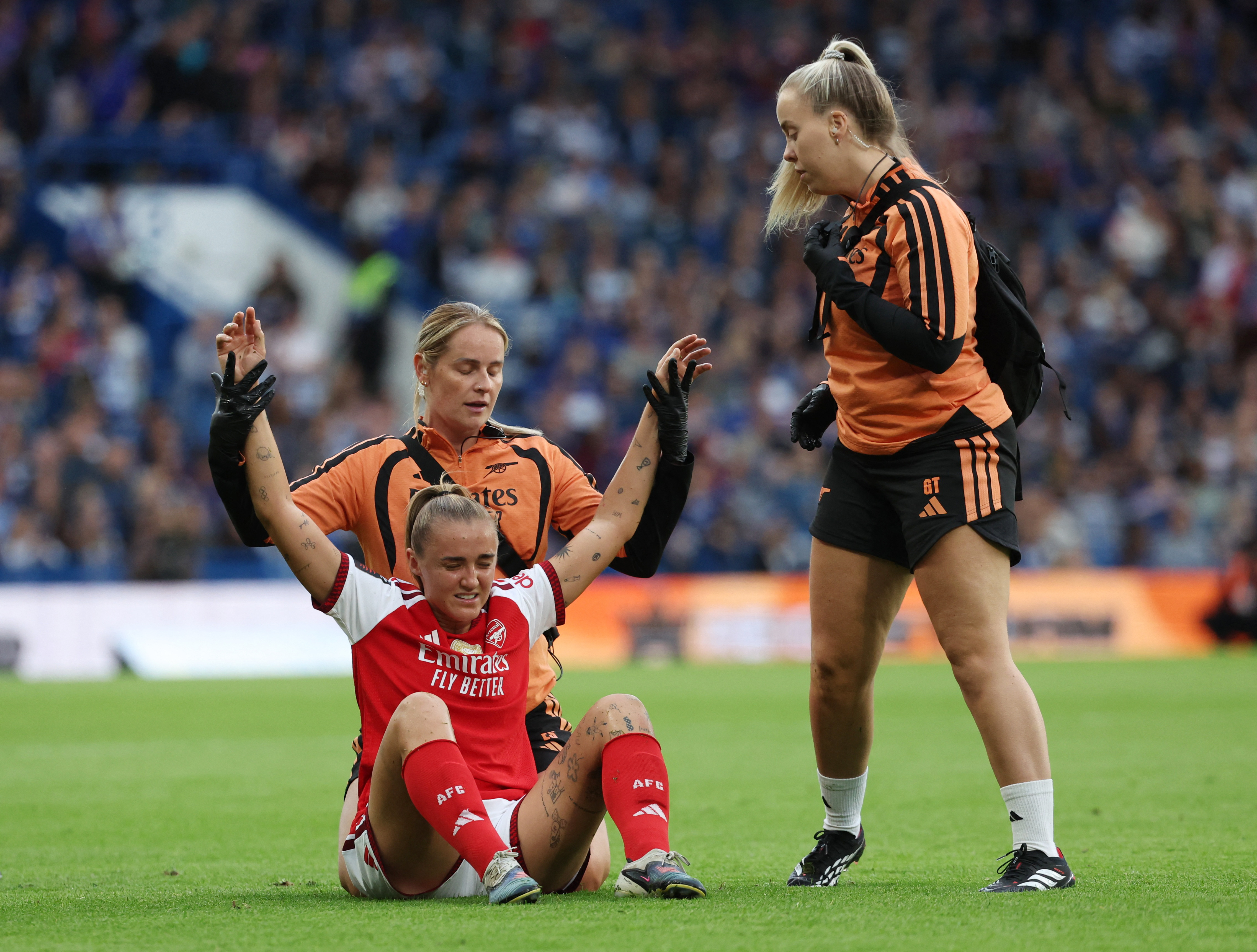
Arsenal’s Georgia Stanway receives medical attention after sustaining an injury. Action Images via Reuters/Cat Goryn.
The Missing Pieces
A 29-year-old club marathon runner starts tirzepatide for insulin resistance. Her prescriber is thorough, her indication is legitimate, and her early training numbers improve. Four months later she presents with a bone stress injury, a ferritin of 14 ng/mL, and a positive pregnancy test. Nothing in her care was negligent; everything that went wrong sat between general GLP-1 guidance and female physiology.
The clinical trials describing the effects of GLP-1 receptor agonists on the body enrolled adults with obesity or type 2 diabetes. Sports medicine has absorbed the first translation problem: those participants were not trained competitors, so extrapolating to athletes is potentially unsafe. A second problem sits underneath it, and attracts far less attention. Even within those trials, the outcomes that matter most to a female athlete were rarely the outcomes measured.
Four physiological realities separate a female athlete from the average trial participant in this context, and each changes how these drugs affect her (see figure 1). She may depend on an oral contraceptive that one of them interferes with, she carries a micronutrient reserve often depleted before treatment begins, and she starts with less absolute lean tissue, so the same proportional loss costs her more. Appetite suppression also destabilizes the energy and hormonal environment governing her skeletal health.
“Four physiological realities separate a female athlete from the average trial participant in this context...”
None of this argues for withholding a medically indicated treatment; where the indication is genuine, these drugs may improve her metabolic health and her capacity to train. The argument is narrower: the standard monitoring advice is insufficient here, and the gaps are predictable enough to close. What follows takes each divergence in turn, then addresses the assumption most commonly made about these drugs and bone.
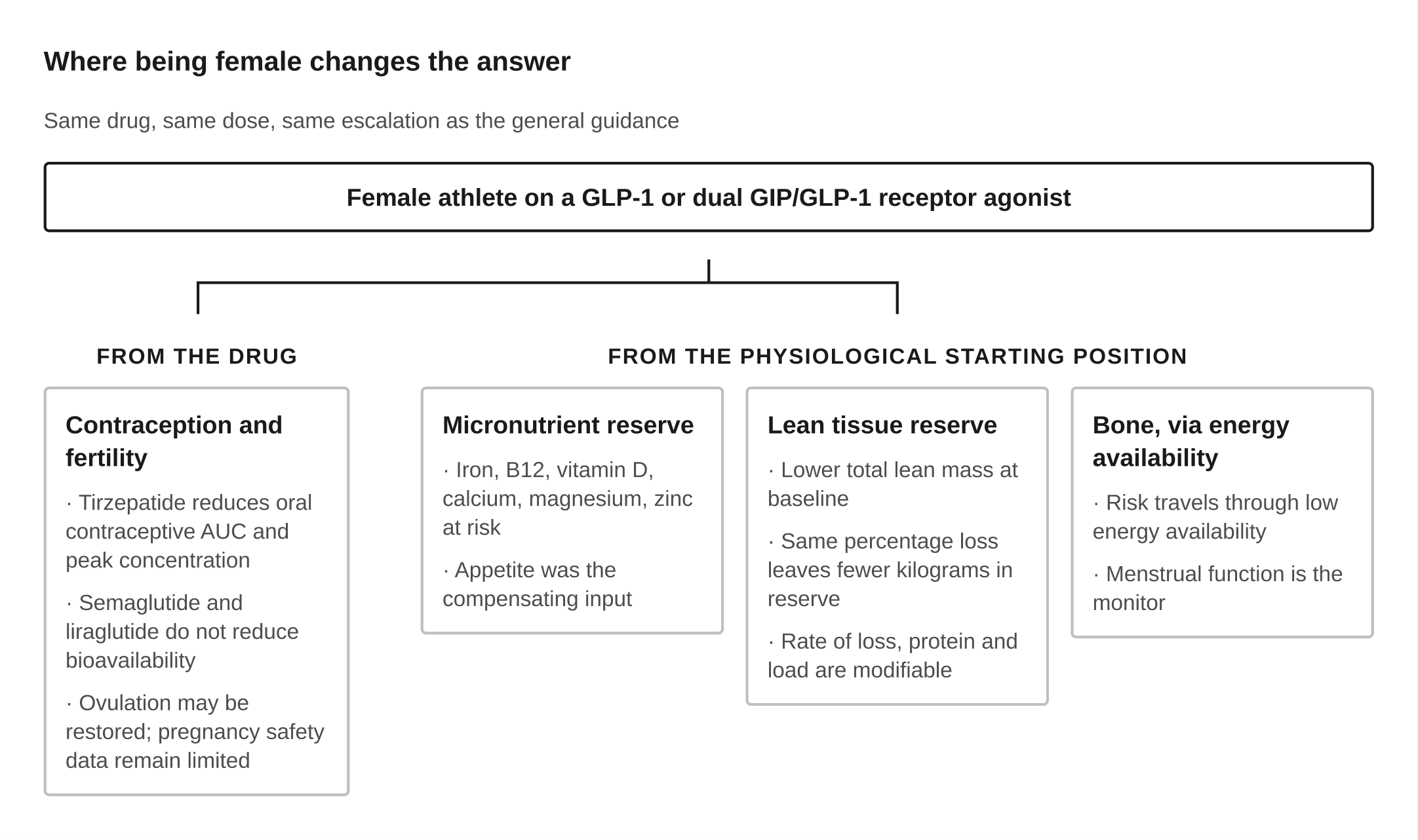
The same medication, at the same dose, diverges from the general athlete guidance at four points: contraceptive and fertility effects, micronutrient reserve, lean tissue reserve, and the energy-availability pathway to bone. Only the first is drug-specific; the remaining three follow from the physiological starting position.
Fertility
Delayed gastric emptying drives almost every meaningful interaction between these medications and other oral drugs. A pharmacokinetic review from South Korea found most such interactions clinically insignificant, and found only two exceptions: oral contraceptives with tirzepatide, and levothyroxine with oral semaglutide(1). Only one of those reaches most female athletes.
The practical consequence is that brand familiarity is not enough. A review of six clinical trials found that tirzepatide significantly reduced both the area under the curve and peak concentration of an oral hormonal contraceptive, while the five studies of GLP-1 receptor agonists showed no significant effect(2). Manufacturer crossover trials in Germany and Denmark reached the same conclusion for semaglutide and liraglutide, neither of which reduced contraceptive bioavailability(3,4). Tirzepatide differs because its rapid escalation and stronger delay in gastric emptying bite hardest after the first dose(2). A practitioner who knows only that an athlete is “on a weight loss injection” cannot answer the contraceptive question.
Fertility runs in the opposite direction and is easier to miss. A narrative review from the United Arab Emirates found that these medications may improve ovulatory function and menstrual regularity, particularly in women with obesity or polycystic ovary syndrome (PCOS), potentially increasing the likelihood of conception(5). Work from Lebanon on PCOS reviews the same possibility(6). That effect should not be generalized to athletes with menstrual disturbance related to low energy availability, whose reproductive physiology requires a different assessment.
Pregnancy safety data remain thin. Current evidence does not consistently demonstrate a strong teratogenic signal, but the samples are small and the study designs are heterogeneous, and the reviewers explicitly flag unintended pregnancy as the practical concern(5). For a female athlete, this converts a metabolic prescription into a reproductive planning conversation. That conversation belongs with the prescriber before the first dose, not after a missed period.
“Pregnancy safety data remain thin.”
Appetite and Iron Deficiency
The most consequential gap in the guidance is nutritional, and it is not about calories. An international review of micronutrient risk during incretin therapy named the domains at risk: iron, vitamin B12, vitamin D, calcium, magnesium, and zinc(7). Reduced intake, reduced dietary diversity, gastrointestinal intolerance, delayed gastric emptying, and rapid weight loss act together, not singly. Those drivers land on a population that is already depleted.
Consider iron metabolism: menstrual blood loss, foot-strike hemolysis, sweat and gastrointestinal losses, and exercise-induced elevation of the iron-regulatory hormone hepcidin all continue regardless of appetite, and Australian and Canadian reviewers put iron deficiency at 15% to 35% in female athlete cohorts(8).
Blood screening of elite Japanese high-school distance runners found iron deficiency, defined as ferritin below 25 ng/mL, in 37.4% of female athletes and 18.5% of males, and identified low body mass index as a contributor to anemia in women(9). The likely pathway is not direct drug-induced iron depletion. Rather, reduced appetite, dietary variety, or tolerance may lower iron intake in athletes who already have recurrent iron losses and limited reserves. Whether GLP-1–based therapy independently increases iron-deficiency risk in female athletes remains unclear. A woman who eats enough to stay marginally iron-replete while losing iron monthly does nothing differently when her intake falls. Her losses simply go uncovered (see figure 2).
Risk concentrates in identifiable individuals. The reviewers note that most reported abnormalities are subclinical, but that clinically meaningful consequences may occur in susceptible individuals: poor baseline diet quality, gastrointestinal disorders, or prolonged nausea and vomiting(7). Several of those descriptions fit female athletes, and none is visible on a scale.
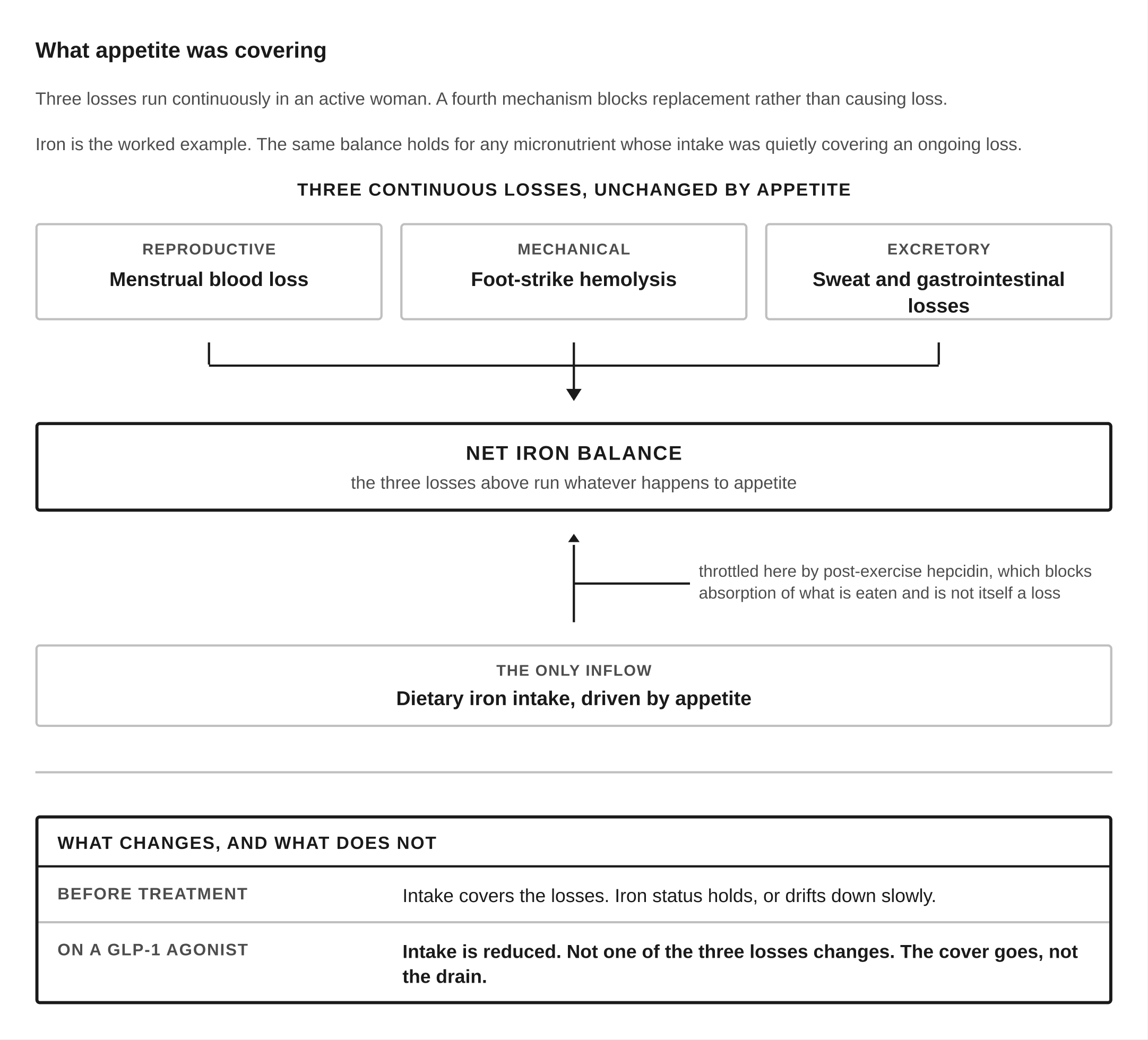
Three iron-loss pathways run continuously in an active woman: menstrual blood loss, foot-strike hemolysis, and sweat and gastrointestinal losses. A fourth mechanism, post-exercise hepcidin elevation, blocks absorption of what is eaten rather than causing loss. Dietary intake, driven by appetite, is the only inflow. Appetite suppression reduces that inflow, and none of the three losses depends on appetite. Iron is the worked example here; the same balance holds for any micronutrient whose intake was covering an ongoing loss.
Which Drug Matters More?
A network meta-analysis of 22 randomized trials (2,258 participants) from Aristotle University of Thessaloniki produced the number now repeated everywhere: lean mass loss comprised approximately 25% of total weight loss(10). Two findings from the same analysis are almost never quoted alongside it. Both matter more to a female athlete than the headline figure.
The first is that relative lean mass, expressed as percentage change from baseline, did not change significantly; the absolute loss averaged 0.86 kg against a 3.55 kg fall in body weight. The second is that the drugs differ substantially, so the answer turns on which drug she takes and at what dose. Tirzepatide at 15 mg weekly and semaglutide at 2.4 mg weekly produced the greatest reductions in weight and fat mass but ranked among the least effective at preserving lean mass, whereas liraglutide was the only GLP-1 receptor agonist in the analysis to produce significant weight loss without a significant fall in lean mass(10).
For a woman, the absolute figure matters more than the proportion because women generally begin with lower absolute lean mass than men; an equivalent absolute loss may represent a more consequential reduction in functional reserve, particularly in sports where force production, sprint capacity, or injury resilience are central. The question is not what proportion of the weight was lean, but how much remains and whether her power output has changed.
Three countermeasures follow directly. The first is rate of loss: researchers at the Norwegian School of Sport Sciences had elite athletes lose either 0.7% or 1.4% of body weight per week alongside resistance training; the slower group gained 2.1% lean body mass, the faster group none(11). The second is protein: intakes of 1.6 to 2.4 g/kg per day are recommended for athletes during energy restriction, toward the upper end when the deficit is steep(12). The third is mechanical loading: researchers in Perth, Western Australia, reviewing incretin therapy make the case for resistance training alongside these drugs, reporting lean mass losses of roughly 10%, or about 6 kg, comparable to a decade or more of aging(13).
Rate of loss, protein intake, and mechanical load are the three variables an athlete controls, and none appears on a scale. The measurement that belongs alongside them is force production, because a jump height or a lifting velocity answers a question body mass cannot. An athlete holding her power output through weight loss sits in a different position from one whose weight has fallen faster.
The Bone Pathway
The prevailing assumption in sport is that these medications drive bone loss and, by extension, stress injury. A scoping review of GLP-1 receptor agonists in orthopedics, conducted across Nepal, India, the United Kingdom, and the United States, does not support it. Liraglutide reduced fracture risk and improved bone formation markers, and use beyond 52 weeks was associated with improved lumbar spine and femoral neck bone mineral density alongside reduced fracture incidence(14).
That synthesis carries real limitations, which the reviewers state plainly: heterogeneous studies, short follow-up, and underrepresentation of non-diabetic populations(14). A Danish randomized trial pulls the other way. Over 52 weeks in 64 adults at increased fracture risk, most of them postmenopausal women, semaglutide produced no rise in the bone formation marker PINP, higher bone resorption, and lower lumbar spine and total hip bone density than placebo(15).
The investigators attributed that resorption signal to the accompanying weight loss rather than to a direct skeletal effect, and the treated group ended 6.8 kg lighter than placebo(15). That distinction is the whole point. Current evidence does not establish a consistent direct skeletal toxicity of GLP-1–based therapy. In an athlete, however, medication-facilitated weight loss and appetite suppression may create or deepen low energy availability: the pathway most plausibly linking treatment to menstrual disturbance, impaired bone health, and bone stress injury.
If the pharmacology is not the threat to bone, the energy deficit is. Low energy availability suppresses endocrine and reproductive function, impairs bone health, and elevates injury risk, and it remains the principal pathway by which rapid weight loss threatens the female skeleton(16). A GLP-1 medication does not damage bone directly so much as it makes an energy deficit easier to sustain without noticing.
The practical implication is clear. Monitoring bone in a medicated female athlete means monitoring menstrual function, energy intake, and training load, because harm arrives through those variables. A normal bone density scan does not exclude an athlete who has stopped menstruating.
The general guidance does not ask female-specific questions
1. 1. Which exact drug, and is it tirzepatide?
2. 2. What contraceptive method is in use, and is it oral?
3. 3. Has the prescriber raised the possibility of restored fertility?
4. 4. What were baseline ferritin, vitamin B12, and vitamin D?
5. 5. Does a record of menstrual function exist from before treatment, and does anyone track it now?
6. 6. Is there a history of disordered eating or bone stress injury?
7. 7. Does dose escalation avoid competition weeks?
Monitoring
The general position on GLP-1 medications in sport is sound: legitimate medicines, not proven ergogenic aids, best used under a documented indication and coordinated with the sports medicine team. The female-specific evidence adds that the standard monitoring list is incomplete. Body composition, strength, and power are necessary but insufficient.
“The general position on GLP-1 medications in sport is sound.”
For a woman, the additions are specific and cheap. Know which drug she is taking, because tirzepatide is not semaglutide once contraception is involved. Know her iron status before her appetite falls, because appetite was covering a monthly loss. And treat her menstrual cycle as the bone monitor it has always been.
None of this is really about GLP-1 medications. All four divergences come back to the same habit: applying evidence generated in one population to another on the unstated assumption that physiology travels intact. Sports medicine already knows not to read a trial in sedentary adults as a trial in athletes. It now has to extend that caution one step further, because a result obtained in women who are not training hard is not yet a result about the woman in front of you. Until we ask that question routinely, the next drug will arrive with the same blind spot attached.
References
1. Drug Des Devel Ther. 2025;19:3509-3537.
2. J Am Pharm Assoc (2003). 2024;64(1):204-211.
3. J Clin Pharmacol. 2015;55(5):497-504.
4. J Clin Pharmacol. 2011;51(12):1696-1703.
5. J Clin Med. 2026;15(9):3204.
6. Ther Adv Endocrinol Metab. 2025;16:20420188251383064.
7. Obes Pillars. 2026;19:100290.
8. Eur J Appl Physiol. 2019;119(7):1463-1478.
9. Phys Sportsmed. 2024;52(4):360-368.
10. Metabolism. 2025;164:156113.
11. Int J Sport Nutr Exerc Metab. 2011;21(2):97-104.
12. Int J Sport Nutr Exerc Metab. 2018;28(2):170-177.
13. Diabetes Care. 2024;47(10):1718-1730.
14. Indian J Orthop. 2026;60(7):1736-1748.
15. EClinicalMedicine. 2024;72:102624.
16. Br J Sports Med. 2023;57(17):1073-1097.

Latest Issue

Subscribe Today
Newsletter Sign Up
Subscriber Testimonials
Dr. Alexandra Fandetti-Robin, Back & Body Chiropractic
Elspeth Cowell MSCh DpodM SRCh HCPC reg
William Hunter, Nuffield Health
Subscribe Today


Newsletter Sign Up


Coaches Testimonials
Dr. Alexandra Fandetti-Robin, Back & Body Chiropractic
Elspeth Cowell MSCh DpodM SRCh HCPC reg
William Hunter, Nuffield Health
Subscribe Today
Latest Issue

Be at the leading edge of sports injury management
Our international team of qualified experts (see above) spend hours poring over scores of technical journals and medical papers that even the most interested professionals don't have time to read.
For 17 years, we've helped hard-working physiotherapists and sports professionals like you, overwhelmed by the vast amount of new research, bring science to their treatment. Sports Injury Bulletin is the ideal resource for practitioners too busy to cull through all the monthly journals to find meaningful and applicable studies.
*includes 3 coaching manuals
Get Inspired
All the latest techniques and approaches


Sports Injury Bulletin brings together a worldwide panel of experts – including physiotherapists, doctors, researchers and sports scientists. Together we deliver everything you need to help your clients avoid – or recover as quickly as possible from – injuries.
We strip away the scientific jargon and deliver you easy-to-follow training exercises, nutrition tips, psychological strategies and recovery programmes and exercises in plain English.
