
 close
close


 LOGIN
LOGINInvictus Participant an Example of Nuances Required to Work with Para-Athletes


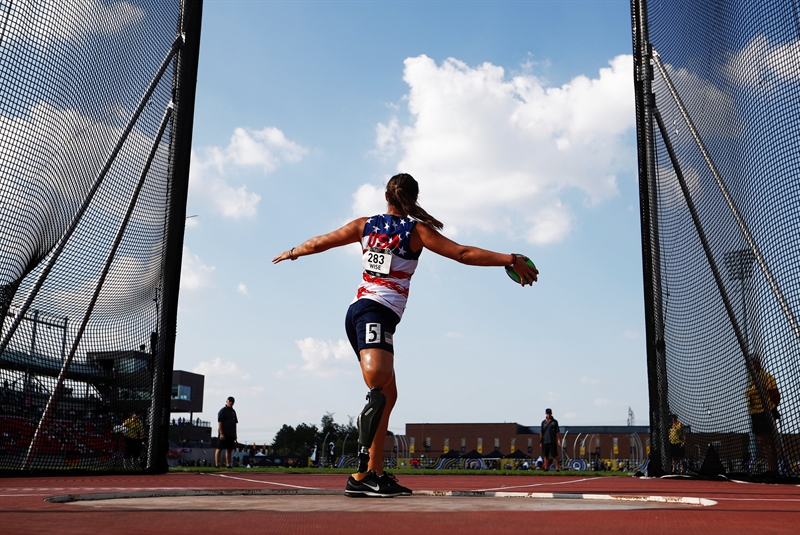
In a recently featured article, physio Sean Fyfe outlined eight key principles to follow when working with an athlete with disabilities. Today’s newsletter highlights some of the research that supports these principles and offers a profile of 2018 Invictus Games athlete Stacey Trottier-Mousseau.
With the 2018 Invictus Games just days away, some major milestones in para-athletic sport have already been achieved. Nike announced days ago that they signed Justin Gallegos, making him the first professional athlete with cerebral palsy. Following on the heels of this announcement, brothers Brent and Kyle Pease became the second push-assist duo in history to complete the Iron Man World Championship in Kona. Advocates for inclusion have long known that what sport does for able-bodied individuals, it does for the disabled as well, namely, improve overall health and well-being. With the rise of inclusive activities, therapists need to know how to treat individuals of all abilities who participate in sport.
Understand the athlete’s disability
As Fyfe explains, knowing the athletes disability and how they react to training is important. For instance, a recent case study following the training of an Italian Paralympic swimmer found that while structured the same as typical swimmers, the program had some significant differences(1). The 23-year-old male with quadriplegic cerebral palsy required a decrease in training load (overall mileage) during training compared to able-bodied swimmers. His training required longer periods of recovery and a longer taper period before a competition. Additionally, during periods of anaerobic training with high intensity for short duration, the athlete required more recovery and close monitoring, as the anaerobic metabolism increased symptoms of his disability such as clonus, hypertonia, pain, and stiffness.
Appreciate the nuances of the sport
Recent research demonstrates how knowing the individual’s sport, Fyfe’s second principle, helps in understanding the mechanism of injury. Researchers in Arizona determined that not all shoulder injuries in wheelchair athletes are due to repetitive motion(2). Rather, the bulk of shoulder injuries may be caused by a lack of support from the lower half of the body. Without the stability of the core and pelvis, athletes must generate greater power from the upper body.
Athletes from the seemingly composed sport of fencing actually had the highest rate of shoulder injuries. Wheelchair rugby, basketball, and tennis followed close behind. All mobility requires stability, even in able-bodied individuals. However, for para-athletes without this grounding, the upper body must work extra hard.
Look for what can compensate
When assessing deficits, it takes a keen eye to look for compensations. Polish scientists evaluated the muscle function of a para-athlete and an able-bodied athlete while performing a competitive bench press(3). They measured the contractions in the pectoralis major, anterior deltoid, and long and lateral heads of the triceps brachii, and found that when the load increased to between 70% to 100% of one repetition maximum (1RM), all four muscles in the para-athlete demonstrated an increase in the activation. However, when the able-bodied athlete lifted 70% to 100% of 1RM, the activity in his pectoralis major and lateral head of the triceps decreased, while the other muscles increased.
Like the wheelchair athletes in the previous study, this athlete lacked the stability offered by placing his feet on the ground and activating his pelvic musculature. In addition, his posture, while supine, lacked the spinal arch demonstrated by the able-bodied athlete. This resulted in the utilization of different muscles to achieve the same functional result. Knowing where compensations assist the movement helps train the strengths and prevent injury.
Individualized treatment
When Stacy Trottier-Mousseau joined the Canadian Armed Forces as an armored crewman, she was in the best physical shape of her life, running marathons and staying strong for her job. She was among the first women to fill this physically taxing position and loved every minute of it. However, while deployed to Afghanistan, she began to notice symptoms of weakness and imbalance. Upon medical repatriation to Canada, she was diagnosed with multiple sclerosis (MS).
Chosen to represent Canada in the 2018 Invictus games in Australia, Trottier-Mousseau began the arduous journey to reclaim her previous identity as an athlete. Her trainer helped her identify her strengths and addressed the particular challenges that MS brings, namely impaired balance, peripheral neuropathy, heat intolerance, and heightened fatigue.
Check your own beliefs
For someone used to being a part of a team of highly motivated individuals like Trottier-Mousseau, sports participation allows them to reclaim part of their identity. “I don’t spend much time thinking about DISability. There are too many things that I CAN do,” she says. When asked about the most meaningful part of the journey toward the Invictus games she adds, “Para sports creates a playing field that I can compete within and test my capabilities. I try to surround myself with people who encourage me to push beyond what seems likely.”
Reference
- J Exerc Rehabil. 2018 Aug 24;14(4):612-620
- J Sport Rehabil. 2018 Oct 11:1-5. doi: 10.1123/jsr.2017-0360. [Epub ahead of print]
- J Hum Kinet. 2017 Dec 28;60:209-215


Latest Issue
Subscribe Today
Newsletter Sign Up
Subscriber Testimonials
Dr. Alexandra Fandetti-Robin, Back & Body Chiropractic
Elspeth Cowell MSCh DpodM SRCh HCPC reg
William Hunter, Nuffield Health
Subscribe Today
Newsletter Sign Up
Coaches Testimonials
Dr. Alexandra Fandetti-Robin, Back & Body Chiropractic
Elspeth Cowell MSCh DpodM SRCh HCPC reg
William Hunter, Nuffield Health
Subscribe Today
Latest Issue

Be at the leading edge of sports injury management
Our international team of qualified experts (see above) spend hours poring over scores of technical journals and medical papers that even the most interested professionals don't have time to read.
For 17 years, we've helped hard-working physiotherapists and sports professionals like you, overwhelmed by the vast amount of new research, bring science to their treatment. Sports Injury Bulletin is the ideal resource for practitioners too busy to cull through all the monthly journals to find meaningful and applicable studies.
*includes 3 coaching manuals
Get Inspired
All the latest techniques and approaches


Sports Injury Bulletin brings together a worldwide panel of experts – including physiotherapists, doctors, researchers and sports scientists. Together we deliver everything you need to help your clients avoid – or recover as quickly as possible from – injuries.
We strip away the scientific jargon and deliver you easy-to-follow training exercises, nutrition tips, psychological strategies and recovery programmes and exercises in plain English.
