
 close
close


 LOGIN
LOGINYou are viewing 1 of your 1 free articles
Cervicogenic Dizziness: Losing Your Equilibrium!
Following on from his article on cervicogenic headaches, Patrick Gilliam explores the causes of cervicogenic-related dizziness in athletes, how to diagnose, and effective treatment options.



Dizziness is a very common complaint in clinical practice, affecting approximately 20-30% of the general population(1). It can manifest as faintness, unsteadiness, a perception of spinning, and disorientation(3). The mechanisms causing these symptoms are multiple and can involve several different organ systems. In particular, dizziness can be experienced from disturbances of the ear, nose and throat; cardiovascular system; and central nervous system (CNS)(1, 2).
More commonly in sport, however, is the association of dizziness in 20-58% of athletes who sustain a traumatic cervical flexion-extension injury or ‘whiplash’ injury(1, 3, 4). This can occur due to dysfunction in the upper cervical spine and sensorimotor control disturbances(1, 5). This specific type of dizziness is referred to as cervicogenic dizziness (CGD)(3).
Table 1: Duration and frequency of common causes of dizziness
| Cause | Common symptoms | Frequency | Duration | Related Factors |
| Benign paroxysmal positional vertigo | Vertigo | Episodic | Seconds | Head position, usually worse in the morning |
| Cervicogenic Dizziness | Dizziness, disequilibrium | Episodic | Minutes to hours | Related to head position |
| Perilymphatic fistula | Disequilibrium, vertigo | Episodic | Seconds to minutes | Vertigo during Valsalva manoeuver |
| Labyrinthine concussion | Vertigo, disequilibrium | Episodic | Hours to days | Increases with fatigue |
| Central vestibular dysfunction | Dizziness, disequilibrium | More constant | Days to weeks | Combined with inner ear pathologies |
Presentation
Table 1 gives an idea of how to distinguish dizziness with cervicogenic origin from that of other causes. In addition, common distinguishing features of CGD include associated neck pain, restricted cervicothoracic range of motion, and headaches(4, 6). Furthermore, hypertonicity to dorsal soft tissue (particularly suboccipital musculature) and positive pain provocation with palpation to cervical zygapophyseal joints are likely(6). Further disturbances with cervical joint positional sense, postural stability, and oculomotor control, such as altered smooth pursuit and saccadic eye movements, can also present with this disorder(5).
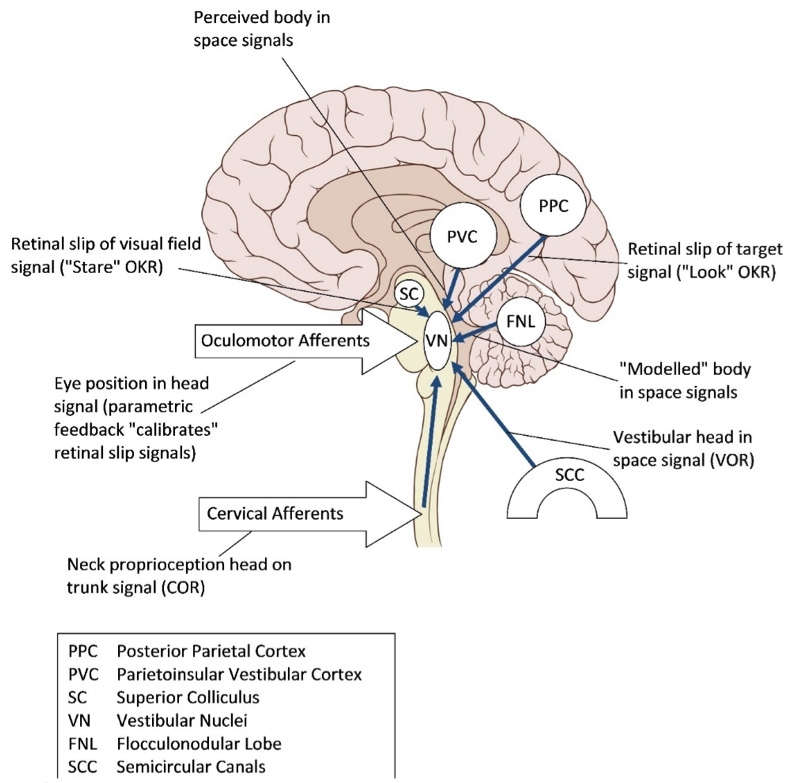
The proposed mechanism for the above-mentioned characteristics is a result of changes to excitation levels of cervical somatosensory receptors. This is caused by neck pain or trauma and leads to a sensory mismatch between vestibular and cervical input(3, 7). Literature supports the presence of a strong connection between cervical dorsal roots and the vestibular nuclei (see Figure 2) particularly at levels C2 and C3(2, 4).
The cervical afferents are also involved in three reflexes influencing head, eye, and postural stability/proprioception: the cervico-collic reflex, the cervico-ocular reflex, and the tonic neck reflex(5). In addition, there is an abundance of mechanoreceptors in the ‘y-muscle’ spindles of the deep segmental upper cervical muscles, which if sensitised by trauma, leads to alterations of proprioceptive signalling to the CNS (see Figure 1)(1, 8). With this in mind, it is understandable that injury or trauma of the neck may be associated with a sense of dizziness or disequilibrium.
Diagnosis
As a result of the previously mentioned competing pathologies, it can be difficult to diagnose the primary cause of dizziness. Obtaining a thorough history from a patient presenting with dizziness is therefore critical to making a decision regarding appropriate care(3-5, 8). To entertain a diagnosis of CGD, the therapist must be able to correlate the onset and diagnosis of the dizziness symptoms with the neck pain or dysfunction (i.e. with cervical movements(4)). Commonly, the most provocative cervical movement is extension; however, CGD can be reproduced with rotation or (more rarely) flexion(7).
Table 2: Co-existing symptoms with dizziness, which indicate additional pathology
| Unexplained symptoms suggestive of CNS pathology (require immediate medical attention): | Symptoms suggestive of vestibular pathology: | Symptoms appropriate for physiotherapy input: |
|
|
|
Table 2 lists co-existing symptoms that should be explored further because they are suggestive of CNS or inner ear (vestibular) pathology. Such symptoms would require further investigation and would not be appropriate for physiotherapy treatment(4).
Another pathology which can cause dizziness and unsteadiness, and which should not be misdiagnosed is damage to the vertebral artery or vertebrobasilar arterial injury. This can be present following head and neck trauma(4, 5). If there is any suspicion of vascular involvement, a clinical framework has been proposed providing an accurate guideline for assessment and management (9). Likewise, it is worth noting that dizziness can be caused by elevated anxiety and medication intake as well(5).
To quantify the functional impact of CGD, the Dizziness Handicap Inventory Questionnaire has been proposed (12). The purpose of this scale is to identify difficulties that someone may be experiencing because of dizziness. Although this assessment is not specific to athletes, it can be helpful as a valid and reliable outcome measure(5, 7, 10).
Other measurable outcomes for symptoms can include a 5-point scale for intensity of dizziness (0=no, 1=mild, 2=moderate, 3=severe, and 4=very severe(6). Similarly, frequency of dizziness can be measured on a 6-point scale (0=no dizziness, 1=dizziness less than once per month, 2=1-4 episodes of dizziness per month, 3=1-4 episodes per week, 4=once daily, and 5=more than once per day or constant)(7).
Assessment
Pain provocation and disruptions to cervico-thoracic range of movement can be assessed using a neuromusculoskeletal objective assessment, while the effect on CGD symptoms is monitored. To gauge any additional sensorimotor control disturbances however, clinical assessment of cervical joint position sense, oculomotor control, and postural instability or balance/ proprioception can be very useful(1, 3, 4, 5).
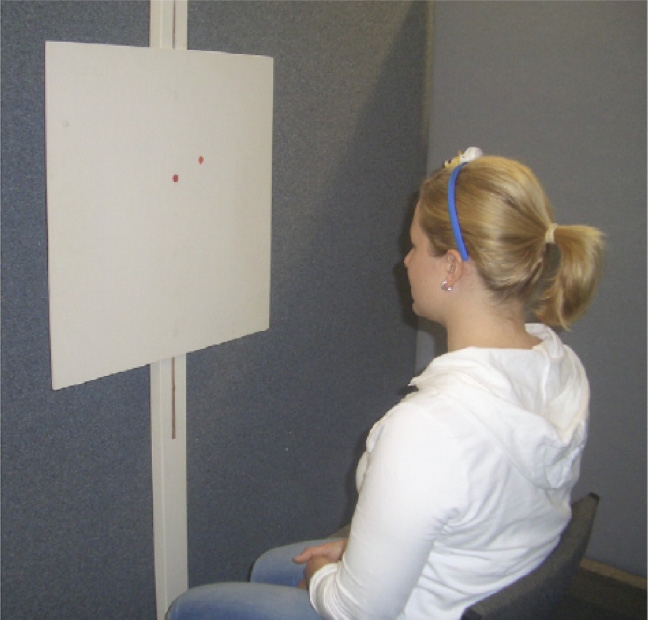
To perform the cervical joint position sense assessment (see Figure 2), a laser pointer is mounted on the patient’s head using a headband. The patient is positioned 90cm from the wall, and a starting point for the laser is marked on the wall in front of them. With eyes closed, the patient is asked to perform the dysfunctional cervical active range of motion and return back to the starter mark. Errors as little as 3-4 degrees (4-5cm) can indicate a deficit in joint positioning sense. With added variances, this procedure can also be used as an effective rehabilitation exercise for the patient (see ‘Sensorimotor disturbances in neck disorders affecting postural stability, head and eye movement control’ by Treleaven for a full description)(5).
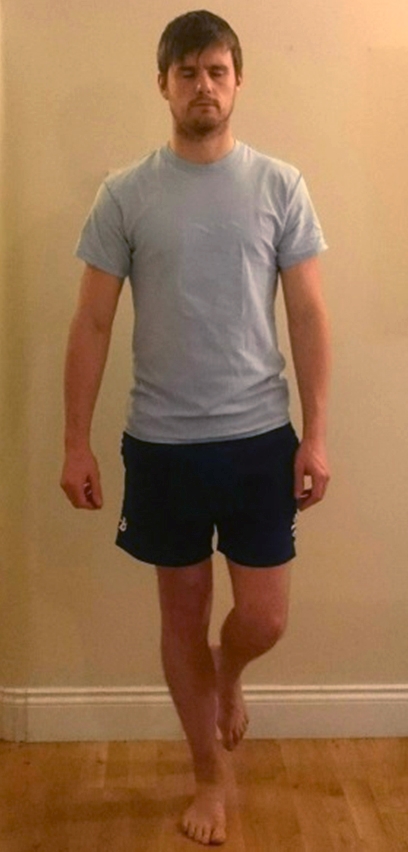
Furthermore, it is important to note that when performing the postural stability assessment (see Figure 3), testing in a narrow, tandem or single-leg stance can be tested with eyes open or closed. Inability to maintain stance for 30seconds, noticeably large increases of sway, slower responses to correct sway or rigidity to prevent sway are considered abnormal responses. Neck disorders are thought to rely more on visual input for balance; therefore, omitting this input will produce obvious deficits(1, 5, 8). Again, practicing balance in challenging positions can be a useful rehabilitation tool.
Oculomotor control assessment
This includes gaze stability (the ability to maintain gaze of a target while the head is moving), smooth pursuit (eyes follow a target whilst keeping the head still), saccadic eye movements (eyes fixed on a target that is moved quickly), and eye/head coordination (maintaining gaze when both the head and eyes are moving in between two targets – leading with the eyes first). Symptom provocation is a positive test, as well as, noting any abnormal coordination of the task(5). Similarly, these tests can be used for rehabilitation, and with appropriate adaptation, can be made more functional to sporting tasks.
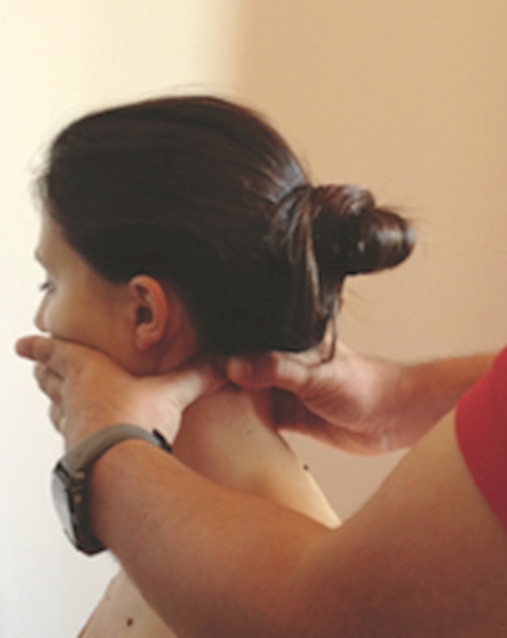
In Figure 4 above, while the patient is sitting, the therapist applies an anterior glide to the transverse process of C1 on the same side of the symptomatic movement. In this example, the patient experiences dizziness when rotating to their left side. The idea being that this is the primary dysfunctional movement simulating an over-rotational of C1 on C2 in this direction. The glide aims to normalise this movement. Therefore, a positive sign would be the relief of symptoms whilst performing this technique. The glide should be in a horizontal direction, along the facet plane. With low severity of pain and dizziness 6-10 repetitions can be applied with further sets. If there is high irritability, then 3 sets of 3 repetitions are recommended as this technique can be very stimulating(2, 7, 10, 11).
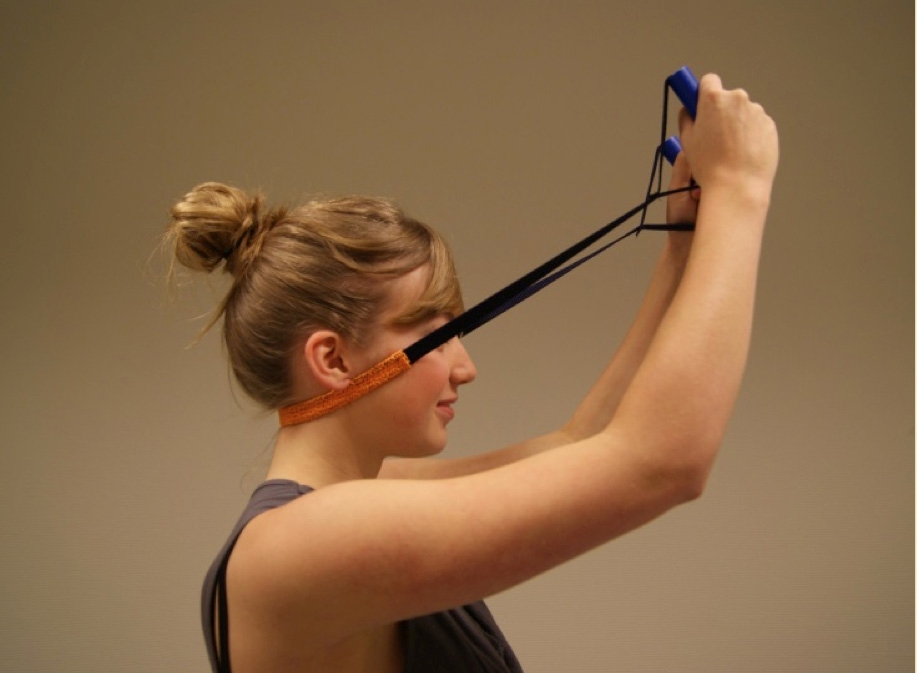
In Figure 5 above, if extension or rarely flexion provokes the symptoms then the therapist should trial central pressure on the C2 spinous process during movement. Because the technique is still trying to affect the C1-2 articulation, the glide should continue to be in a horizontal direction. Repetitions apply as described above. Alternatively, the patient could perform this independently using a belt/ strap as shown.
Treatment
Researchers have argued that once a confident diagnosis has been achieved, management of CGD should be the same as for cervical pain, supporting the role of manual therapy for long-term benefits(1-4, 6-8, 10). Following trauma, it is thought that type 1 cervical articular mechanoreceptor and proprioceptors from dysfunctional joints results in a loss of normal afferent input. This leads to aberrant information being sent to the vestibular nuclei, thus formulating symptoms similar to vestibular disturbances, such as dizziness(2).
With this in mind, cervical spine mobilisation techniques (sustained natural apophyseal glides, and Maitland mobilisations) have been shown to be effective in restoring normal movement of the zygapophyseal joints. The benefits include a reduction in pain and muscle hypertonicity, which helps re-establish normal proprioceptive and biomechanical functioning to the cervical spine(1, 2, 10).
If these techniques described above are successful, then a self-SNAG (as described in issue 159) can be recommended for the patient to try at home using a towel or belt/ strap. In general, it has been proposed that these techniques should be utilised over a course of four to six sessions, which should produce a long-term reduction in symptoms(2, 7, 10). Combining these manual techniques with sensorimotor control rehabilitation, as described previously, is recommended by the majority of literature(1, 5, 6, 8);however, remains inconclusive in a minority of research(3).
Summary
CGD is a diagnosis characterised by dizziness and disequilibrium, which is associated with neck pain, most commonly following neck trauma, such as forced cervical flexion-extension mechanisms in sport. The diagnosis relies on the basis of history and examination and should prioritise the exclusion of other possible causes of dizziness, including involvement of the CNS, cardiovascular, and vestibular systems. Physiotherapy intervention is not appropriate if there is any suspicion of these systems being the source of symptoms. In this instance, onward referral to a clinical specialist should take precedence.
When diagnosed correctly, there is good support for the use of manual therapy techniques to produce a long-term reduction in symptoms. Given the prevalence of sensorimotor control disturbances associated with dysfunction to the upper cervical spine, the addition of sports-specific rehabilitation focusing on regaining this control can be clinically justified.
References
- Pain Phys. 2015. 18: 583-595
- Man Th. 2005. 10: 4-13
- Chiro & Man Th. 2011. 19-21
- JOSPT 2000. 30(12): 755-766
- Man Th. 2008. 13: 2-11
- Dis & Rehab. 2007. 29(15): 1193-1205
- Man Th. 2008. 1-11
- Arch Phys Med Rehabil. 1996. 77: 874-882
- Manual Th. 2014. 19: 222-228
- Phys Th. 2014. 94(4): 466-476
- JOSPT. 2010. 40(4): 225-229
- www.rehab.msu.edu/_files/_docs/ Dizziness_Handicap_Inventory.pdf

Latest Issue

Subscribe Today
Newsletter Sign Up
Subscriber Testimonials
Dr. Alexandra Fandetti-Robin, Back & Body Chiropractic
Elspeth Cowell MSCh DpodM SRCh HCPC reg
William Hunter, Nuffield Health
Subscribe Today


Newsletter Sign Up
Coaches Testimonials
Dr. Alexandra Fandetti-Robin, Back & Body Chiropractic
Elspeth Cowell MSCh DpodM SRCh HCPC reg
William Hunter, Nuffield Health
Subscribe Today
Latest Issue

Be at the leading edge of sports injury management
Our international team of qualified experts (see above) spend hours poring over scores of technical journals and medical papers that even the most interested professionals don't have time to read.
For 17 years, we've helped hard-working physiotherapists and sports professionals like you, overwhelmed by the vast amount of new research, bring science to their treatment. Sports Injury Bulletin is the ideal resource for practitioners too busy to cull through all the monthly journals to find meaningful and applicable studies.
*includes 3 coaching manuals
Get Inspired
All the latest techniques and approaches


Sports Injury Bulletin brings together a worldwide panel of experts – including physiotherapists, doctors, researchers and sports scientists. Together we deliver everything you need to help your clients avoid – or recover as quickly as possible from – injuries.
We strip away the scientific jargon and deliver you easy-to-follow training exercises, nutrition tips, psychological strategies and recovery programmes and exercises in plain English.
