
 close
close


 LOGIN
LOGINYouth Soccer Overuse Injuries: A Biomechanical Approach
Joshua Smith discusses how clinicians can use a biomechanical approach to implement injury prevention strategies in youth soccer.


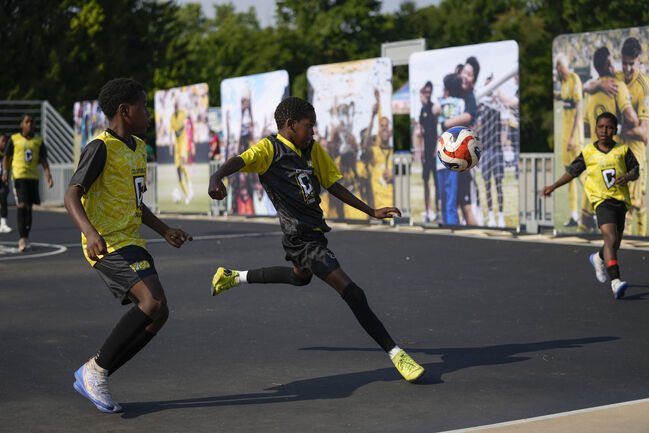
Kids participate in the soccer tournament during MLS All-Star Community Day Presented by BODYARMOR Sports Drink at Northgate Intermediate School. Mandatory Credit: Adam Cairns-USA TODAY Sports
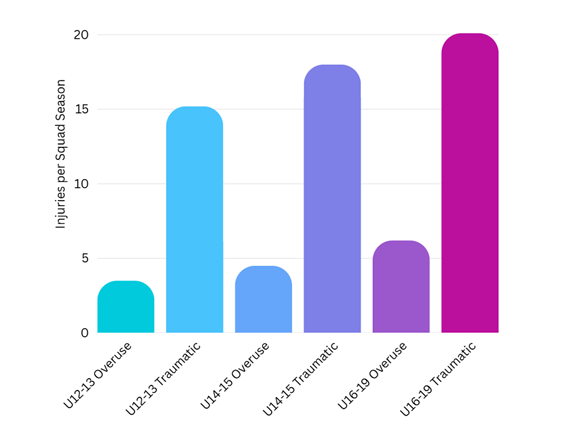
Overuse injuries are among the most significant threats to the health and development of youth soccer players. These injuries occur when repetitive mechanical loading outpaces a young athlete’s capacity for recovery and tissue adaptation, eventually leading to microtrauma accumulation and symptomatic presentation(1). The rising intensity of modern academy football, combined with increased training frequency and the push toward early talent identification, creates an environment in which young players are exposed to high workloads year-round. The result is a pattern of overuse conditions that can impact player development, reduce performance, and compromise long-term participation.
The most common overuse injuries in youth soccer include patellar tendinopathy, Osgood-Schlatter disease, apophyseal irritation, Sever’s disease, and various stress-related injuries of the knee, ankle, and lumbar spine. These conditions frequently emerge during phases of rapid growth when bone, muscle, and tendon adapt at different rates(2). Although many factors contribute to the development of overuse injuries, biomechanical loading patterns play a central role. A clearer understanding of these patterns enables clinicians and coaches to identify modifiable risk factors, implement preventive strategies, and reduce the physical burden placed on young athletes (see table 1).
Biomechanical Mechanisms
Practitioners can understand overuse injuries in youth athletes by considering three broad factors: external loading, tissue capacity, and movement biomechanics. The cumulative effect of these factors determines whether tissues adapt or gradually fail.
- External loading refers to the volume and intensity of training, the frequency of high-stress activities, and the rate at which practitioners progress the workload. Sudden increases in weekly training demands may increase injury risk in young athletes because they do not allow time for tendons and bones to adapt(3). Soccer exposes players to frequent acceleration, deceleration, cutting, and repeated kicking. Each of these movements places substantial mechanical stress on the lower limb, particularly the knee, ankle, and associated tendons. When athletes repeatedly expose themselves to mechanical stress without sufficient recovery, tissues become vulnerable.
- Tissue capacity encompasses the biological ability of muscles, tendons, and bones to absorb and dissipate mechanical loads. During rapid growth phases, the bones of young athletes lengthen more quickly than the surrounding musculotendinous structures can adapt. This mismatch in adaptation rates increases passive tension in muscles and elevates strain within tendons and apophyses(2). Tendons in adolescents are particularly sensitive to repeated loading and exhibit slower stiffness adaptations than adults, making them more susceptible to overload when exposed to high volumes of sprinting and jumping(4).
- Movement biomechanics influence how forces are distributed across joints and soft tissues. Inefficient landing mechanics, poor trunk control, or abnormal joint alignment increase local stress. For example, excessive knee valgus during landing magnifies the load on the patellar tendon and increases frontal-plane stress at the knee. Limited ankle dorsiflexion shifts loading proximally and alters deceleration mechanics, potentially increasing the risk of irritation of the patellar or quadriceps tendon(5,6). These biomechanical patterns do not arise in isolation but often reflect neuromuscular deficits, inadequate strength, or compensatory strategies developed during growth.
Table 1: Overuse injury incidence and characteristics in elite youth soccer academies(2)
| Injury Category | % of all Injuries | Injuries Incidence Rate (per Squad Season) | Mean Time-Loss (Days) | Biomechanical/Growth Link |
| Overuse (General) | 21% | 4.1 | 23.3 | Primarily training-related (92%); repetitive loading in pre-season; lower extremity dominance (84%) |
| Physeal/Growth-Related | 12% | 1.9 | 29.7 | Linked to pubertal growth spurts (beginning/end); musculoskeletal immaturity; no trauma association; requires growth monitoring for load adjustment |
| Ankle/Foot Stress | 30% | 5.9 | 14 | Growth-related vulnerabilities in maturation; proximal load shifts due to immature control |
| Knee Stress Injuries | 19% | 3.7 | 14 | Growth imbalances in young athletes; neuromuscular deficits in stop-and-go movements |
Identifying Risk Factors Through Screening
Effective prevention begins with early identification of players who exhibit characteristics associated with increased risk of overuse injuries. Screening in youth soccer does not predict injury with certainty, but it provides valuable information that can guide coaching practice and targeted intervention (see table 2).
Overall training load is a significant factor for practitioners to consider throughout the season. Players who accumulate high weekly training hours, particularly those who train more hours per week than their chronological age, experience significantly higher rates of overuse injuries(1). The trend toward year-round participation and early specialization intensifies this risk. Players involved in multiple teams or additional individual training sessions may unknowingly exceed appropriate workload thresholds.
“The interaction of external load, tissue capacity, and movement patterns determines injury risk.”
Neuromuscular control represents another important domain. Observational assessments, such as single-leg squats, drop landings, and balance tests, provide valuable insight into how players manage load during dynamic movements. Young athletes who demonstrate poor control, excessive frontal-plane deviation, or asymmetrical movement strategies often experience higher lower-limb stresses during soccer-specific actions(5).
Table 2: Recommended screening battery and indicators of elevated risk(2, 5-9)
| Screening Test | Risk Indicator | Elevated Risk Threshold-Action |
| Single-leg squat | Frontal Plane Knee Deviation | >5° valgus - Refer for neuromuscular training |
| Drop Jump Landing | Peak Knee Valgus Moment | >15% asymmetry - Reduce plyometric volume |
| Ankle Dorsiflexion (Lunge Test) | Weight-Bearing ROM | <35° - Incorporate stretching + monitor growth |
| Y-Balance Test | Anterior Reach Asymmetry | >4 cm difference - Target hip strength |
| Growth Velocity Tracking | Height Change per Month | >2 cm/month - Adjust load during peak velocity |
Strength and tolerance to eccentric loads are also critical. During phases of rapid growth, it is not uncommon to observe temporary reductions in coordination and strength, particularly in muscles spanning rapidly lengthening bones. Players with insufficient eccentric capacity in the quadriceps, hamstrings, or calf muscles often struggle to dissipate landing forces effectively, thereby increasing the demand on passive structures such as tendons and apophyses(4).
Practitioners must monitor growth velocity. Peak height velocity is associated with increased injury vulnerability, and clubs that track growth every four to eight weeks are better positioned to adapt training and reduce loading during sensitive periods. Simple anthropometric tracking allows practitioners to identify when players transition into higher-risk phases and to adjust training prescriptions accordingly(2).
Prevention Strategies Informed by Biomechanics
Preventing overuse injuries in youth soccer requires a multifaceted approach that addresses workload, movement quality, tissue capacity, and the unique developmental characteristics of adolescent athletes.
Managing training load is the most fundamental principle. Effective programs emphasize gradual progression, structured periods of reduced volume, and consistent monitoring of week-to-week changes. Rather than focusing solely on match exposure, monitoring should also include club training, school sport, and external sessions, as cumulative exposure determines risk. Athletes should avoid abrupt increases in running volume or intensity, as biological tissues require time to adapt to new loading patterns(3).
Neuromuscular training occupies a central role in modern preventive practice. When integrated into warm-ups or regular conditioning sessions, these programs improve landing mechanics, enhance trunk control, and refine cutting technique. Neuromuscular training reduces the incidence of lower-limb injuries in youth populations by addressing underlying biomechanical deficits(5,7). The most effective programs involve progressive challenges to balance, controlled plyometric activities, trunk and hip strengthening, and structured technique feedback from coaches or clinicians.
Strength and eccentric conditioning further enhance tissue resilience. Tendons, in particular, respond favorably to slow, controlled eccentric loading, which increases their capacity to tolerate the repeated stretch-shortening cycles characteristic of soccer movements(4). Developing strength across the quadriceps, hamstrings, gluteal muscles, and calf complex not only improves performance but redistributes mechanical stress away from vulnerable sites. These adaptations are especially important for players undergoing rapid growth, who may temporarily experience reduced strength or coordination.
“…injuries occur when repetitive mechanical loading outpaces a young athlete’s capacity for recovery and tissue adaptation…”
Movement technique coaching is another important component. Effective deceleration, safe landing strategies, and efficient cutting mechanics reduce mechanical demand on the knee and ankle joints. Practitioners should aim their instruction at enhancing hip flexion during landing, promoting knee alignment over the foot, and improving trunk stability, which can significantly influence the magnitude and distribution of forces athletes experience during high-speed actions. The use of external cues and visual feedback to accelerate technique acquisition in youth athletes(8).
Growth monitoring provides an additional layer of protection. During periods of rapid height gain, training programs should temporarily prioritize technical quality, neuromuscular control, and moderate strength development over high-volume plyometric or maximal-speed sessions. Adjusting training during peak height velocity reduces both mechanical stress and perceived exertion while maintaining technical development(2).
Finally, educational strategies for parents, coaches, and young athletes reinforce the importance of balanced training and the risks of year-round single-sport participation. Multisport exposure reduces rates of overuse injuries and increases movement variability, both of which support long-term athlete development(1,9).
Practical Implementation
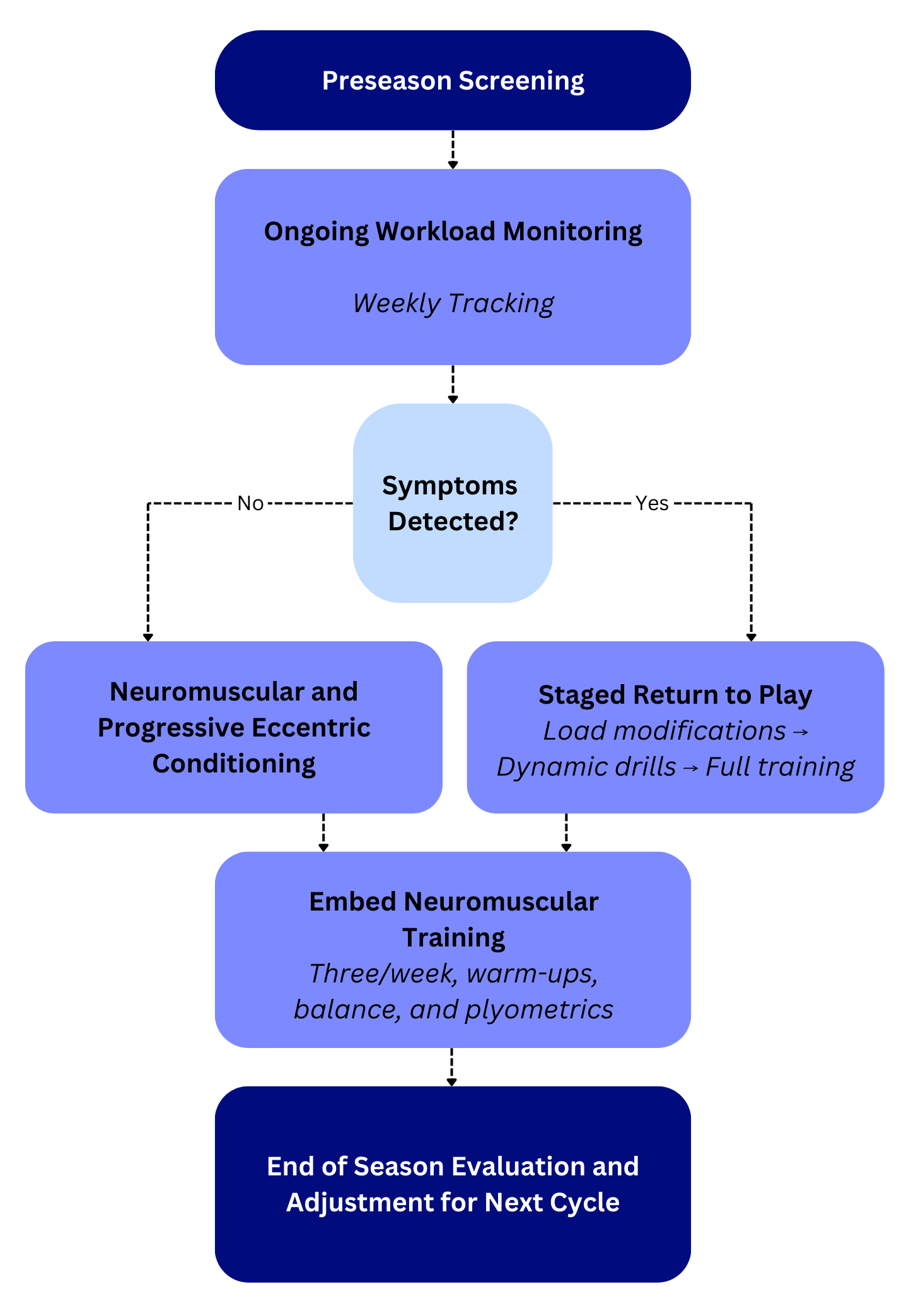
To translate biomechanical insights into meaningful reductions in injury burden, clubs benefit from the structured implementation of these insights throughout the season. A practical approach begins with preseason screening that identifies players who may require additional support. These assessments should be repeated mid-season to evaluate changes in movement quality or the impact of rapid growth.
Throughout the season, consistent monitoring of workload provides early warning signs of risk accumulation (see figure 2). Practitioners can embed neuromuscular training into warm-ups three times per week and reinforce it through coaching staff educated in proper technique instruction. Strength and eccentric conditioning should progress gradually and continue alongside football training to maintain tissue resilience.
When overuse symptoms arise, an early conservative response is essential. Tendon and growth plate injuries respond best to load modification, structured strengthening, and movement retraining rather than rapid return to full training. A staged return that gradually increases running, change-of-direction work, and soccer-specific drills allows tissues to adapt without becoming overloaded again(4,10).
Conclusion
Preventing overuse injuries in youth soccer requires an approach that is grounded in biomechanics and sensitive to the unique demands of adolescent development. The interaction of external load, tissue capacity, and movement patterns determines injury risk. By managing workload, improving neuromuscular control, enhancing strength and eccentric capacity, refining movement technique, and monitoring growth, practitioners can significantly reduce the burden of overuse injuries in young players. These strategies contribute not only to injury prevention but also to the long-term development and enjoyment of youth athletes.
References
- Pediatrics. 2024;153(2):e2023065129.
- J Clin Med. 2023;12(19):6138.
- Sports Health. 2019;11(6):534-541.
- Sports (Basel). 2024;12(2):46.
- Front Sports Act Living. 2023;5:1065470.
- J Foot Ankle Res. 2014;7:48.
- Br J Sports Med. 2024;58(11):615.
- Sports Med. 2019;49(4):565-586.
- Curr Sports Med Rep. 2010;9(6):364-371.
- Front Physiol. 2021;12:626225.


Latest Issue
Subscribe Today
Newsletter Sign Up
Subscriber Testimonials
Dr. Alexandra Fandetti-Robin, Back & Body Chiropractic
Elspeth Cowell MSCh DpodM SRCh HCPC reg
William Hunter, Nuffield Health
Subscribe Today

Newsletter Sign Up
Coaches Testimonials
Dr. Alexandra Fandetti-Robin, Back & Body Chiropractic
Elspeth Cowell MSCh DpodM SRCh HCPC reg
William Hunter, Nuffield Health
Subscribe Today
Latest Issue

Be at the leading edge of sports injury management
Our international team of qualified experts (see above) spend hours poring over scores of technical journals and medical papers that even the most interested professionals don't have time to read.
For 17 years, we've helped hard-working physiotherapists and sports professionals like you, overwhelmed by the vast amount of new research, bring science to their treatment. Sports Injury Bulletin is the ideal resource for practitioners too busy to cull through all the monthly journals to find meaningful and applicable studies.
*includes 3 coaching manuals
Get Inspired
All the latest techniques and approaches


Sports Injury Bulletin brings together a worldwide panel of experts – including physiotherapists, doctors, researchers and sports scientists. Together we deliver everything you need to help your clients avoid – or recover as quickly as possible from – injuries.
We strip away the scientific jargon and deliver you easy-to-follow training exercises, nutrition tips, psychological strategies and recovery programmes and exercises in plain English.
